Satin Doll Walking Bass Line
Duke Ellington and Billy Strayhorn wrote Satin Doll in 1953, and Johnny Mercer added the lyric later. Ellington's orchestra recorded it for Capitol that April, and hundreds of jazz musicians have recorded it since. It's almost all ii-V pairs at two beats per chord, so a walking line gets exactly two notes to state each chord and aim at the next one. Below you'll find the changes bar by bar in C and a walking line to play through them.
Turn the bass off and it's your gig: the piano and drums keep going and you walk the line. The band counts you in with one bar of hi-hat.
Recorded upright bass, grand piano and a jazz drum kit play the line. Tab is for 4-string bass in standard tuning.
The changes
The A sections are the same in every chart we checked, apart from their last two bars. We use the iReal Pro chart from its Jazz 1460 playlist, which matches Jazzadvice's: Cmaj7 F7 | Em7 A7 at the end of the first and last A, and two bars of Cmaj7 at the end of the second. Learn Jazz Standards writes Cmaj7 | Em7b5 A7b9 at the end of the first A and holds Cmaj7 at the end of the last one. The end of the bridge varies too: iReal Pro and Jazzadvice hold G7 for two bars, and Jazzadvice lists Dm7 G7 | Em7b5 A7 as an alternate, which is what Learn Jazz Standards writes.
How this line works
- The root lands on beat 1 of 29 of the 58 chord changes, so the harmony is clear. The rest start on the 3rd or 5th, which keeps the line from sounding like a list of roots.
- 56 of the 57 chord changes are approached by a half step or a whole step, so every new chord arrives smoothly instead of by a jump.
- Non-chord tones sit on the weak beats: 18 on beat 2 and 8 on beat 4. That's where passing and chromatic notes sound intentional instead of wrong.
- No note repeats back to back. A repeated note is the quickest way to make a walking line sound stiff.
What Satin Doll teaches you
- ii-Vs that move up a step: bars 1 to 4 play Dm7 G7 twice, then Em7 A7 twice, the same pattern a whole step higher. Neither pair resolves to its I chord, so the line has to keep moving.
- A chromatic slide home: bar 5 is Am7 D7 and bar 6 is Abm7 Db7, the same ii-V a half step lower. Db7's 3rd and 7th (F and Cb, the same pitch as B) are G7's 7th and 3rd, so Db7 resolves down a half step to Cmaj7 the way G7 would.
- Two beats per chord: with two chords in nearly every bar of the A sections, you get a chord tone on beat 1 or 3 and one approach note on beat 2 or 4. There's no room to wander, so every note has a job.
- The bridge changes key: it starts with a ii-V-I in F (Gm7 C7 to Fmaj7), then moves up a whole step for Am7 D7, the ii-V of G, and lands on G7, which leads back to Dm7 G7 at the top of the last A.
- It doesn't start on the home chord: every A section opens on Dm7, and Cmaj7 only shows up at the end of each A.
How to practice it
- Hear the form first. Turn the bass off and play just the root of each chord along with the band until you never lose your place.
- Read the line slowly. Set the tempo around 80 and play the written line with the drums. Slow is the fast way here.
- Loop the hard spots. Turn on Loop, find the four bars that trip you up, and play them until they feel like the easy ones.
- Make it yours. Keep beat 1 of every bar, but change the approach note on beat 4. A half step above, a half step below, a whole step: each one changes the color of the arrival.
- Play it with the record. Put on one of the versions below and play along. That's where the time feel gets into your hands.
Want to build your own lines on these changes? Try the free Walking Line Builder and practice with the click on 2 and 4.
Recordings to hear
- Duke Ellington, Capitol single 2458 (1953), with Wendell Marshall on bass.
- McCoy Tyner, Nights of Ballads & Blues (1963), with Steve Davis on bass.
- Ella Fitzgerald and Count Basie, Ella and Basie! (1963), with Buddy Catlett on bass.
Satin Doll: questions
What key is Satin Doll in?
C major. That's the key in the iReal Pro, Learn Jazz Standards and Jazzadvice charts, and jazzstandards.com analyzes it in C too. The tune starts on Dm7, not C, so don't wait for a C chord in bar 1.
What's the form of Satin Doll?
It's 32 bars in AABA form. Each A is eight bars of ii-V pairs that land on Cmaj7 at the end, and the bridge moves to F major and then to G7 before the last A.
How fast is Satin Doll usually played?
Charts mark it medium swing, which iReal Pro plays from 100 to 139 bpm. The line on this page is set at 120, which leaves time to hear each two-beat chord. Get it clean there before you speed it up.
Your next step
This page gives you one line to study. These courses teach you to build your own, on the bass you play.

The 7-Day Walking Bass Breakthrough
Cole DavisWalk through any jazz tune with lines that move, swing, and never repeat themselves.
- Walk through any ii-V-I, major or minor.
- Solve the two-bar problem on static modal tunes.
- Never repeat yourself two bars in a row.
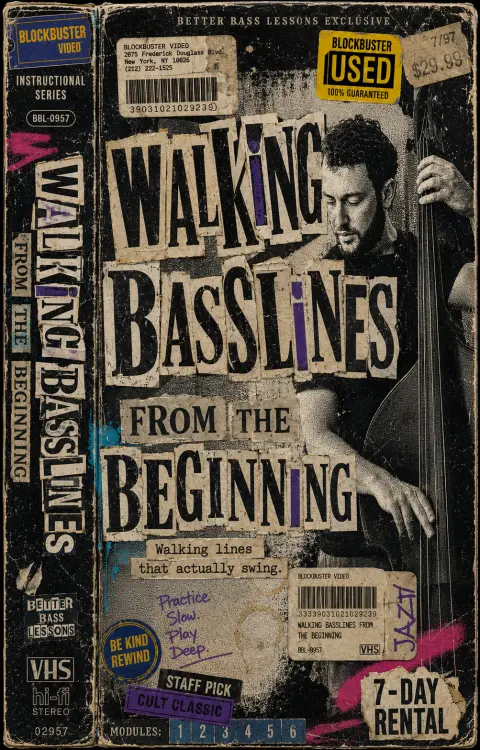
Walking Basslines on Upright Bass from the Beginning
Cole DavisFive lessons from “my walking lines don't sound like the records” to professional-grade walking.
- The chord first: the 1-3-5-7, where every great bass line starts.
- The master move: changing the order of the notes, bar by bar, on an F blues.
- The three questions every bass line has to pass, then the whole method on Autumn Leaves.
Not sure which course fits? Answer a few questions and we'll point you to one.