Billie's Bounce Walking Bass Line
Billie's Bounce is Charlie Parker's 12-bar blues in F, recorded on November 26, 1945, at the first session under his own name, with Curley Russell on bass. It runs on the standard jazz blues in F changes: a quick change to Bb7, a ii-V into the IV chord, a diminished passing chord in bar 6, and a I-VI-ii-V turnaround. Walk a bass line through these changes and you've learned the jazz blues in F, plus a bebop blues that gets called at jam sessions.
Turn the bass off and it's your gig: the piano and drums keep going and you walk the line. The band counts you in with one bar of hi-hat.
Recorded upright bass, grand piano and a jazz drum kit play the line. Tab is for 4-string bass in standard tuning.
The changes
Charts differ in two spots. Some keep bar 4 on F7 instead of Cm7 F7, and some stay on Bb7 in bar 6 instead of Bdim7 (a few put the Bdim7 on beats 3 and 4 of bar 2 instead). You'll also see bar 11's D7 written as D7b9.
How this line works
- The root lands on beat 1 of 12 of the 16 chord changes, so the harmony is clear. The rest start on the 3rd or 5th, which keeps the line from sounding like a list of roots.
- 15 of the 15 chord changes are approached by a half step or a whole step, so every new chord arrives smoothly instead of by a jump.
- Non-chord tones sit on the weak beats: 6 on beat 2 and 3 on beat 4. That's where passing and chromatic notes sound intentional instead of wrong.
- No note repeats back to back. A repeated note is the quickest way to make a walking line sound stiff.
What Billie's Bounce teaches you
- The quick change: bar 2 moves to Bb7, the IV chord, and bar 3 goes right back to F7, so the root moves F, Bb, F across the first three bars.
- A ii-V into the IV chord: Cm7 to F7 in bar 4 sets up Bb7 in bar 5. That's two chords in one bar, two beats each, and you'll see it again in bars 8, 11 and 12.
- A diminished passing chord: the root of Bdim7 in bar 6 sits a half step above Bb (bar 5) and a half step below C, the 5th of F7 in bar 7, so the bass can climb Bb, B, C.
- Roots that climb in fourths: bar 8's Am7 D7 is a ii-V into Gm7, and the roots from bar 8 to bar 11 run A, D, G, C, F, each a fourth above the last.
- A I-VI-ii-V turnaround: bars 11 and 12 (F7 D7 | Gm7 C7) send you back to the top of the form, two beats per chord.
How to practice it
- Hear the form first. Turn the bass off and play just the root of each chord along with the band until you never lose your place.
- Read the line slowly. Set the tempo around 80 and play the written line with the drums. Slow is the fast way here.
- Loop the hard spots. Turn on Loop, find the four bars that trip you up, and play them until they feel like the easy ones.
- Make it yours. Keep beat 1 of every bar, but change the approach note on beat 4. A half step above, a half step below, a whole step: each one changes the color of the arrival.
- Play it with the record. Put on one of the versions below and play along. That's where the time feel gets into your hands.
Want to build your own lines on these changes? Try the free Walking Line Builder and practice with the click on 2 and 4.
Recordings to hear
- Charlie Parker, The Charlie Parker Story (1945), with Curley Russell on bass.
- Stan Getz and J. J. Johnson, Stan Getz and J. J. Johnson at the Opera House (1957), with Ray Brown on bass.
- Dexter Gordon, Bouncin' with Dex (1975), with Niels-Henning Ørsted Pedersen on bass.
Billie's Bounce: questions
What key is Billie's Bounce in?
F. It's a 12-bar blues in F, and F is the key you'll see on lead sheets and hear at jam sessions.
What are the chord changes to Billie's Bounce?
It uses the jazz blues in F changes: F7 | Bb7 | F7 | Cm7 F7 | Bb7 | Bdim7 | F7 | Am7 D7 | Gm7 | C7 | F7 D7 | Gm7 C7. Some charts keep bar 4 on F7 or stay on Bb7 in bar 6, so check which version the band's using.
What tempo is Billie's Bounce played at?
Charts mark it medium-up swing, and Parker's original 1945 recording runs about 160 bpm. Get your line solid at a slower tempo first, then bring it up.
Your next step
This page gives you one line to study. These courses teach you to build your own, on the bass you play.
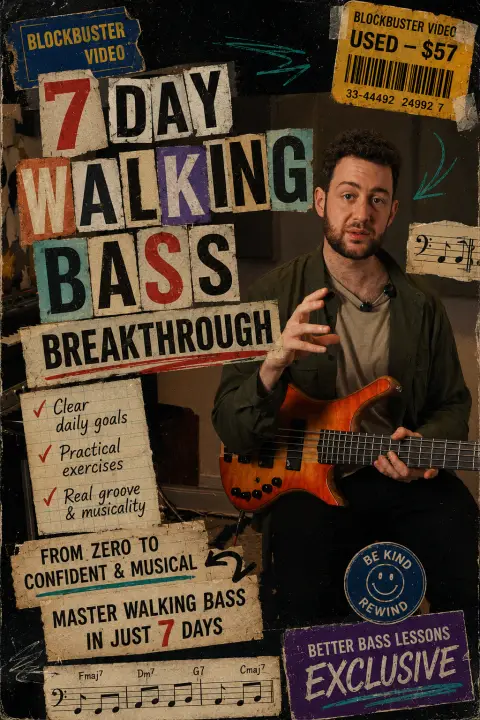
The 7-Day Walking Bass Breakthrough
Cole DavisWalk through any jazz tune with lines that move, swing, and never repeat themselves.
- Walk through any ii-V-I, major or minor.
- Solve the two-bar problem on static modal tunes.
- Never repeat yourself two bars in a row.
Not sure which course fits? Answer a few questions and we'll point you to one.