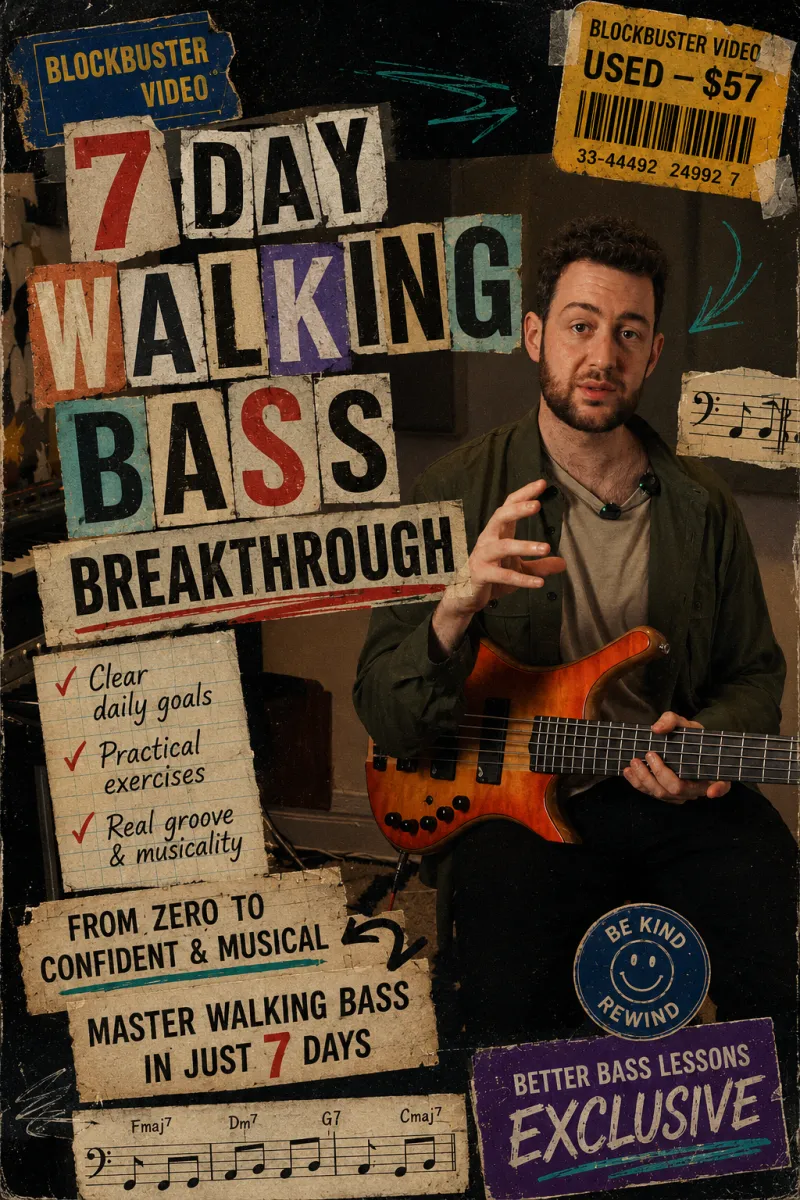
The 7-Day Walking Bass Breakthrough
A 7-day method for electric bassists who want to walk through any jazz tune (ii-V-Is, stepwise modern progressions, or static modal chords) with lines that move, swing, and never repeat themselves.
$37 · one-time · lifetime access
See how it's taught before you decide.
First 2 minutes of Day 3: The Scalar Connector. When anchor-approach lines sound jumpy, switch to linear motion: half-steps and whole-steps only. Cole demonstrates over the tri-tone move in Autumn Leaves (E♭ major 7 → A minor 7♭5).
This is for you if…
- You can play time and read a basic chord chart, but freeze when a jazz tune is called
- You've been told "real jazz bass is upright only" and you don't believe it
- You can walk a blues, but stepwise-motion tunes (Killer Joe, ESP, Inner Urge) trip you up
- You stand there going dum-dum-dum on D minor for 8 bars on So What and the band looks at you
- You learn scales and modes but your walking lines still sound like exercises, not music
- You play gigs where the leader hands you a Real Book chart and counts off
Maybe not if…
- You can't yet find the root, 3rd, 5th, and 7th of a chord on your bass. Start with chord-tone fundamentals first
- You want slap, funk, or pop bass technique
- You want a fakebook of pre-written bass lines to memorize
"You can't play jazz on electric bass." Yes you can. You just need the right system.
Walk into any jam session in any city and somebody will tell you that real jazz bass is upright only. The Real Book is closed. The downbeat hits. You're on a fretted instrument trying to play music that was written for an unfretted one, in a tradition built around players who don't sound anything like you.
So you do what every electric bassist does. You learn scales. You learn modes. You learn arpeggios up and down the neck. You transcribe a Paul Chambers line and try to copy it onto electric. None of it makes your walking lines sound like jazz. They still sound like exercises with attitude.
The reason isn't your instrument. The reason is that most jazz bass teaching is built around playing the right notes in the right places. But the most important thing in a walking bass line isn't clarity. It's movement. A great walking line goes somewhere. Every bar resolves into the next one. The note on beat 4 creates the tension that the note on beat 1 releases. That's the engine. That's what makes Ron Carter sound like Ron Carter on a flat-9 over a dominant chord. He's not picking the clearest note. He's picking the most movable one.
Nobody taught you that. They taught you scales. And scales don't tell you what to put on beat 4.
Right notes. Wrong notes. And the cadence that makes them move.
The most important thing in a walking bass line isn't clarity. It's movement.
Every walking bass line in jazz lives in one of three situations: a ii-V-I, a stepwise progression, or a static modal chord. Most standards are mostly ii-V-Is. Modern tunes use a lot of stepwise motion. Modal tunes (kind of blue, so what) sit on one chord for 8 bars. The 7-Day Walking Bass Breakthrough teaches you how to walk through all three, using the same underlying system.
The system is a system of right notes and wrong notes. There are six right notes (1, 3, 5, 7, 2, 6) and six wrong notes (everything else). Right notes go on beats 1 and 3. Wrong notes go on beats 2 and 4. And every bar resolves into the next one using one of three cadence moves (whole step, half step, or 5-1) from beat 4 to beat 1. That's the engine. Three moves. That's what makes Ray Brown sound like Ray Brown.
Over 7 days, you'll learn the three situations, the anchor-approach system (right notes plus passing tones), the scalar connector (for non-functional progressions), how to vary your lines so you never sound like you're running an exercise, and how to handle the two-bar problem on modal tunes. By day 7, you'll be walking through Green Dolphin Street, a standard that contains all three situations in one tune.
This is the same method I used to learn how to walk lines. It's the method I teach private students. And it's the method that finally made the great recordings make sense to me: once I knew what to listen for, I heard it everywhere. Paul Chambers, Ron Carter, Ray Brown, Sam Jones, Jimmy Garrison. They're all using these moves. You can too.
By the end of 7 days, you'll be able to…
- ✓Walk through any ii-V-I, major or minorThe progression that makes up most of the great American songbook.
- ✓Handle stepwise-motion tunes without freezingKiller Joe, ESP, Inner Urge: modern jazz built on whole-step and half-step movement.
- ✓Solve the two-bar problem on static modal tunesThe Paul Chambers move on So What: create movement when nothing changes.
- ✓Choose the most movable note, not the most obvious oneThe Ron Carter approach: pick notes that propel the line forward.
- ✓Use wrong notes (chromatic passing tones) musicallyThe trick that makes Sam Jones sound like Sam Jones over Autumn Leaves.
- ✓Walk through Autumn Leaves and Green Dolphin StreetTwo standards. Three situations. Now you've got the whole tune covered.
- ✓Resolve every bar with a whole step, half step, or 5-1 cadenceThe three-move engine that creates movement in every bar.
- ✓Never repeat yourself two bars in a rowThe discipline that separates a bass line from an exercise.
- ✓Create "imaginary ii-Vs" on static chordsHow Paul Chambers and Jimmy Garrison made modal music swing.
- ✓Hear the cadence in every Ray Brown line you've ever heardOnce you know the move, you can't unhear it.
- ✓Connect chords linearly when anchor-approach won't fitThe scalar connector, for non-functional progressions and tri-tone moves.
- ✓Walk into any jazz gig and feel readyNot for the impossible chart. For the standard. Which is most of it.
The 7-day curriculum.
11 video lessons · structured as a 7-day practice plan
- 00Introduction: "you can't play jazz on electric" and why that's wrong
- 1.1ii-V-Is: the foundation. Order of notes, cadence, the three-move engine
- 1.2Stepwise Motion: the modern-tune situation (Killer Joe, Inner Urge, ESP)
- 1.3Static Chords: the modal situation (So What, kind of blue)
- 2.1The Anchor-Approach System: right notes vs. wrong notes, where each goes
- 2.2Passing Tones: the 1-3-5-♭5 lick and how to use it on every ii-V-I
- 3.0The Scalar Connector: when to use it and why anchor-approach can sound jumpy
- 3.1What Makes It Linear: chromatic approach from above and below
- 4Separate Yourself: how to vary the line so it stops sounding like an exercise
- 5The Two-Bar Problem: imaginary ii-Vs, emphasizing the 5, and how Paul Chambers made modal music swing
- 6Putting It All Together: Green Dolphin Street, full chorus, every move applied
Total: 11 video lessons · PDFs for every lesson · backing tracks for the three situations
Everything you need to actually do the work.
- 11 HD video lessonsStructured as a 7-day practice plan: Introduction through the Green Dolphin Street finale
- 40-page Ray Brown bass line analysis (PDF)Cole's full analysis showing how Ray Brown uses whole step / half step / 5-1 cadences in every two-bar phrase he plays
- Course PDF referenceEvery lick, every example, every chart Cole demonstrates, written out in tab and notation
- Lead sheets: Autumn Leaves, Green Dolphin Street, So WhatThe three standards used in the course, with the situations annotated
- Backing tracks: three situationsii-V-I, stepwise motion, static modal. Multiple keys and tempos
- Lifetime accessNo subscription, no auto-renewal
- Free updates foreverEvery revision and addition, included

Cole Davis
First-call jazz bass player · Juilliard Artist Diploma
I went to Juilliard. I studied with Ron Carter. And I'm not a jazz purist. I believe, strongly, that you can play jazz on electric bass. In fact, I love playing jazz on electric. It's been my main instrument for thousands of gigs.
When I was learning walking lines, the most important thing Ron Carter taught me wasn't theory. It was 1-3-5-7. Just the chord tones, in different orders, with the right cadence between every bar. That's it. That was the lesson. And it was the most useful thing anyone has ever taught me about playing this music.
This course is everything I've learned since then, organized into a 7-day plan. The three situations every tune contains. The anchor-approach system. The scalar connector for when anchor-approach won't fit. The two-bar problem on modal tunes. And how to vary the line so it doesn't sound like an exercise.
If you can already play time and read a basic chord chart, this method will work for you. I've taught it to hundreds of private students. It's the same method I use myself. And it's the method that made every great walking bass recording I'd ever heard finally make sense.
- Juilliard Artist Diploma
- Studied with Ron Carter
- First-call jazz bass player
- Hundreds of private students
One price. Own it forever.
$37one-time · lifetime access
- ✓11 HD video lessons (7-day plan)Core
- ✓40-page Ray Brown bass line analysis PDFBonus
- ✓Course PDF reference (tab + notation)Included
- ✓Lead sheets: Autumn Leaves, Green Dolphin, So WhatIncluded
- ✓Backing tracks for all three situationsIncluded
- ✓Lifetime access & free updatesForever
If your walking lines don't move, we'll refund every dollar.
Try the whole 7-day plan. Watch every lesson. Print the Ray Brown PDF. Drill the backing tracks. If your walking lines don't sound more like jazz within 30 days, email support and we'll refund you in full. No follow-up sales pitch. No "are you sure?" survey.
I'm going to tell you something my teachers told me, in case you haven't heard it yet.
Jazz isn't about playing every scale and every mode and every transcription. Jazz is about three things: the form, the cadence, and the feel. If you've got those three, you've got jazz. You can play it on electric. You can play it on upright. You can play it on a kazoo if you really wanted to.
The reason most electric bassists struggle with this music isn't the instrument. It's that nobody taught them what to listen for. Once you know what to listen for, once you can hear the cadence in every Ray Brown line, every Paul Chambers line, every Ron Carter line, you can't unhear it. And then you can do it yourself.
That's what this 7-day plan is for. It's not a magic trick and it's not going to turn you into a different player. It's going to give you a system that you can use for the rest of your playing life. Every gig. Every tune. Every standard. Even on the impossible chart the leader hands you with five minutes to learn it.
If you've been told you can't play jazz on electric, and you don't believe it, this is the course I made for you.
Cole Davis
Questions people ask before they enroll.
Electric. Cole demonstrates everything on electric bass. Most of the harmonic ideas transfer to upright, but the fretboard examples are specifically for the electric instrument. The whole premise of the course is that you can play jazz on electric, if you do it right.
No. The course starts from 1-3-5-7 chord tones and builds up from there. If you can read a basic chord chart and find the root of a chord on your bass, you can start. Cole explains every concept from the ground up: what a ii-V-I is, what stepwise motion is, what a static (modal) chord is.
If you put in 20-30 minutes a day, you'll complete it in 7 days. If you have more time, you can move faster. If you have less, take 2 weeks. The 7-day structure is the sequence, not a deadline. You own it forever and can repeat any day as many times as you need.
The harmonic concepts (right notes / wrong notes, anchor-approach, scalar connectors, the two-bar problem) all transfer to upright. The fretboard demonstrations don't. Cole is showing things on an electric bass, not a double bass. If you want walking bass lines taught on upright, watch for Cole's upright walking course.
Soloing is what you play when the leader points at you. Walking is what you play the other 95% of the gig. This course is about the walking. The soloing course (Jazz Soloing on Electric Bass: from the Beginning) starts where this one leaves off: once you can walk a clear line, you can chisel it into a solo.
An electric bass and a way to hear yourself (amp or headphones). A metronome and a recording device are strongly recommended. Backing tracks for the practice progressions are included with the course.
YouTube gives you topics. This gives you a sequence. 11 lessons in the order that actually moves a bass player from "I freeze on jazz changes" to "I can walk through any standard," with PDFs, the 40-page Ray Brown analysis, and backing tracks attached.
Forever. One purchase, lifetime access, all future updates included. No subscription.
30-day money-back guarantee. Email support within 30 days of purchase for a full refund.
More questions? Email support
7 days. 11 lessons.
Walking lines that move.
$37
Get instant access30-day money-back guarantee · Lifetime access