Tune Up Walking Bass Line
Tune Up is traditionally credited to Miles Davis, but Wikipedia and Learn Jazz Standards both say Eddie Vinson wrote it. Miles first recorded it on May 19, 1953, with Percy Heath on bass. It's one of the best tunes for learning ii-V-Is, because it runs the same ii-V-I in three keys, D, C and B-flat, each a whole step down. Below you'll find the changes bar by bar and a walking line in D major, the key it's usually played in.
Turn the bass off and it's your gig: the piano and drums keep going and you walk the line. The band counts you in with one bar of hi-hat.
Recorded upright bass, grand piano and a jazz drum kit play the line. Tab is for 4-string bass in standard tuning.
The changes
Bars 12 to 16 change the most from chart to chart, and Learn Jazz Standards says Real Books and lead sheets disagree there. We use Ebmaj7 in bar 12, as in Jazzomat's chord annotation of a 1953 Miles Davis performance and Richie Zellon's analysis; the Learn Jazz Standards chart, taken from Miles's Cookin' recording, holds Bbmaj7 there, and Jazzadvice writes Gm7. The first ending is Em7 | F7 | Bbmaj7 | A7 in Learn Jazz Standards and Jazzadvice; Jazzomat has Em7 A7 in bar 16. The second ending lands on Dmaj7, and Jazzomat's annotation adds an Em7 A7 turnaround in bar 32.
How this line works
- The root lands on beat 1 of 16 of the 32 chord changes, so the harmony is clear. The rest start on the 3rd or 5th, which keeps the line from sounding like a list of roots.
- 31 of the 31 chord changes are approached by a half step or a whole step, so every new chord arrives smoothly instead of by a jump.
- Non-chord tones sit on the weak beats: 23 on beat 2 and 21 on beat 4. That's where passing and chromatic notes sound intentional instead of wrong.
- No note repeats back to back. A repeated note is the quickest way to make a walking line sound stiff.
What Tune Up teaches you
- ii-V-Is in three keys: Em7 A7 Dmaj7, then Dm7 G7 Cmaj7, then Cm7 F7 Bbmaj7, each key a whole step below the last.
- The major chord turns minor: Dmaj7 becomes Dm7 in bar 5, and Cmaj7 becomes Cm7 in bar 9. Only the third moves, down a half step (F# to F, E to Eb), so your line can shift that one note and keep going.
- Two bars on one chord: the first two ii-V-Is land on a major 7th chord that lasts two bars (Dmaj7 in bars 3 and 4, Cmaj7 in bars 7 and 8), so you need a line that keeps moving without a new root to aim at.
- The first ending turns you around: Em7 | F7 | Bbmaj7 | A7. F7 is the V of Bbmaj7, and A7 is the V of D, which takes you back to Em7 at the top.
- Coltrane's Countdown is built on it: Wikipedia calls Countdown a contrafact of Tune Up, reharmonized with Coltrane changes but keeping the same D, C and B-flat tonal centers.
How to practice it
- Hear the form first. Turn the bass off and play just the root of each chord along with the band until you never lose your place.
- Read the line slowly. Set the tempo around 80 and play the written line with the drums. Slow is the fast way here.
- Loop the hard spots. Turn on Loop, find the four bars that trip you up, and play them until they feel like the easy ones.
- Make it yours. Keep beat 1 of every bar, but change the approach note on beat 4. A half step above, a half step below, a whole step: each one changes the color of the arrival.
- Play it with the record. Put on one of the versions below and play along. That's where the time feel gets into your hands.
Want to build your own lines on these changes? Try the free Walking Line Builder and practice with the click on 2 and 4.
Recordings to hear
- Miles Davis, Blue Haze (1953), with Percy Heath on bass.
- Miles Davis Quintet, Cookin' with the Miles Davis Quintet (1956), with Paul Chambers on bass.
- Sonny Rollins, Newk's Time (1957), with Doug Watkins on bass.
Tune Up: questions
Who wrote Tune Up?
Eddie Vinson is believed to have written it. Miles Davis recorded it first, in 1953, and it's traditionally credited to him.
What key is Tune Up in?
D major. That's the key of Miles Davis's recordings and of the Learn Jazz Standards and Jazzadvice charts. The tune also passes through C major and B-flat major, one ii-V-I each.
How fast is Tune Up played?
It's an up-tempo swing; Jazzadvice's chart is marked Up Tempo Swing. The chords come fast, so learn the line slowly and get every ii-V-I landing clean before you push the tempo.
Your next step
This page gives you one line to study. These courses teach you to build your own, on the bass you play.

The 7-Day Walking Bass Breakthrough
Cole DavisWalk through any jazz tune with lines that move, swing, and never repeat themselves.
- Walk through any ii-V-I, major or minor.
- Solve the two-bar problem on static modal tunes.
- Never repeat yourself two bars in a row.
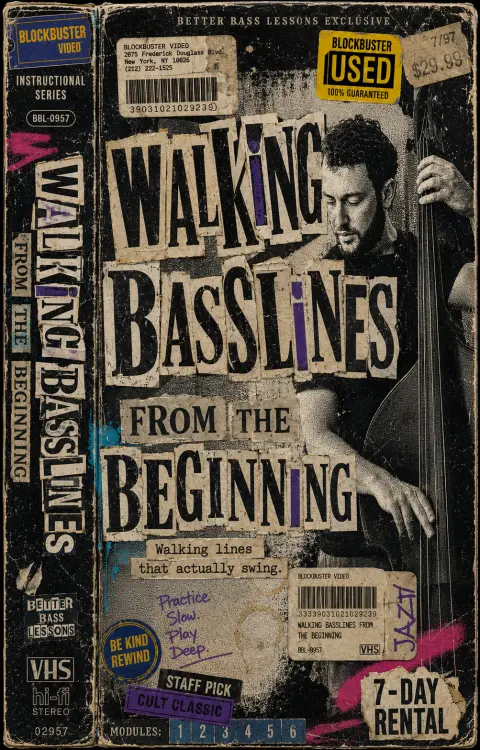
Walking Basslines on Upright Bass from the Beginning
Cole DavisFive lessons from “my walking lines don't sound like the records” to professional-grade walking.
- The chord first: the 1-3-5-7, where every great bass line starts.
- The master move: changing the order of the notes, bar by bar, on an F blues.
- The three questions every bass line has to pass, then the whole method on Autumn Leaves.
Not sure which course fits? Answer a few questions and we'll point you to one.