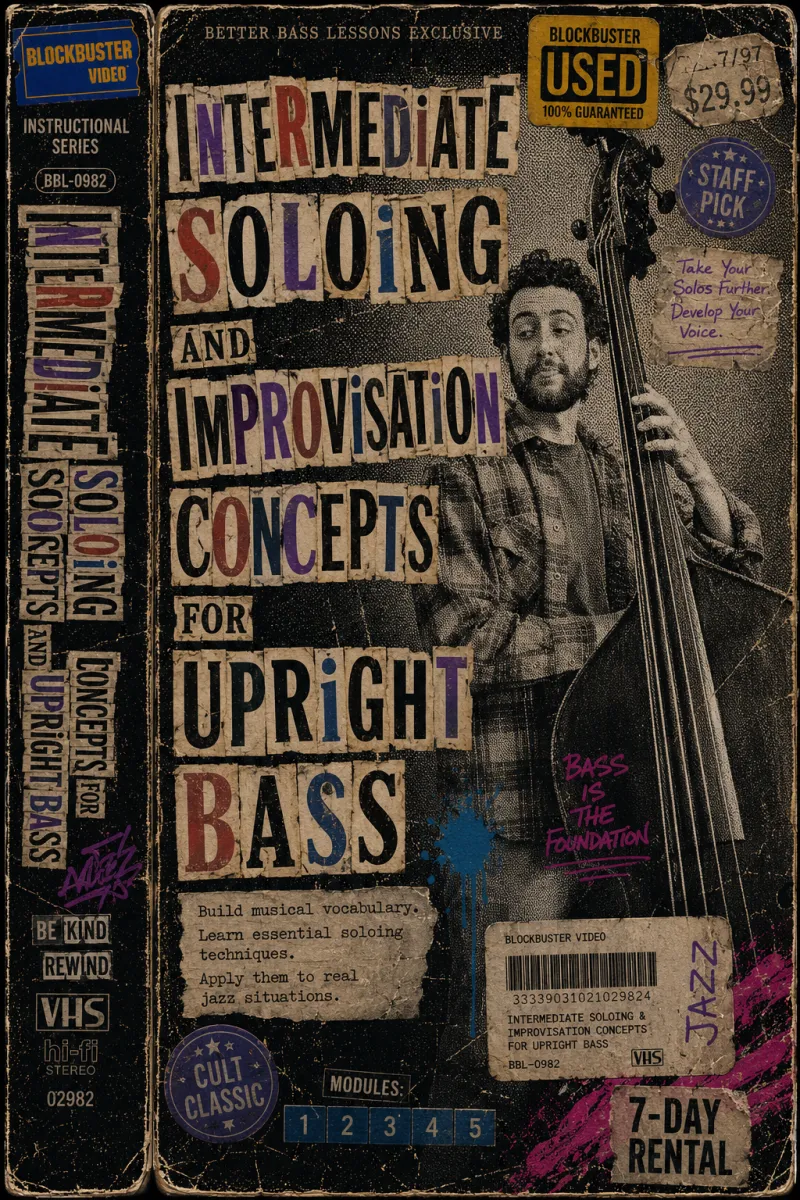
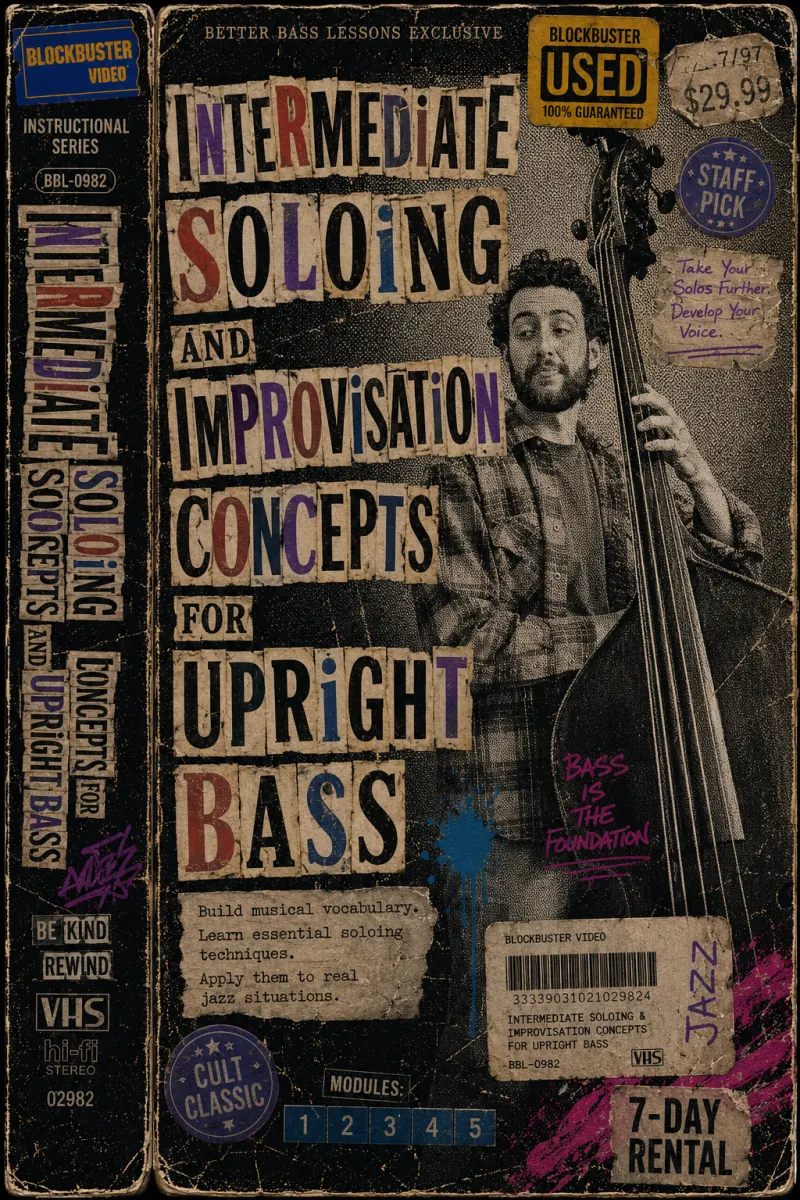
Intermediate Soloing & Improvisation Concepts for Upright Bass
You can already get through the changes. This is the system that turns those changes into a real solo, the exact thing Cole drills on every new tune. Thirds and sevenths, the exercise, the 9, and the half steps that make it sound like bebop. Built on an F blues, Autumn Leaves, and There Will Never Be Another You.
$97 · one-time · lifetime access
Learn to solo over these three, and you can solo over most of the jazz repertoire.
- F Blues
- Autumn Leaves
- There Will Never Be Another You
A blues, a major-and-minor ii-V-I standard, and a Songbook tune with two chords a bar. Between them they cover the harmony in almost everything you'll get called to play.
This is for you if…
- You can find the changes on a standard, but your solos still come out sounding like a faster walking line
- You've worked through scales and modes and they didn't fix your soloing
- You can play an F blues and you want to finally improvise over it like a horn player, not a bass player
- You've gigged for years and you've been "advanced beginner" at improvising the whole time
- You want one repeatable thing you do with every new tune, instead of guessing
- You freeze on the ii-V-I's and the m7♭5 chords in real standards
Maybe not if…
- You can't walk a line or get through a blues yet. Start with Jazz Soloing on Upright Bass: from the Beginning first
- You play electric and want electric-specific fingerings
- You want a book of finished solos to memorize, not a method you can use on any tune
Your solos sound like your bass lines. More scales won't change that.
You can get through the form now. The changes go by, you land the roots, you keep the time. Then the leader points at you for a solo, and the same notes come out, just twice as fast. Eighth notes instead of quarter notes, still hanging off the root, still sounding like the bass line everyone already heard.
So you go looking for more. You learn a mode for each chord. You buy the Real Book. You sit down to transcribe a Paul Chambers chorus, get two bars in, and quit because you can't figure out how to use any of it on the upright. Months later, the solos sound the same.
When a bass player hears an F7, they hear an F. When a horn player hears an F7, they hear the third and the seventh.
That's the gap. A bass line is about the root. It's your job, and the band falls apart if you stop playing it. A solo is about everything on top of the root. Nobody taught you to hear the chord that way, so your ear keeps reaching for the one note it already knows.
And scales don't fix it, because a scale hands you too much. Seven notes, no order, no sense of which ones matter, like trying to cook dinner and being handed a live chicken. You don't want the whole bird. You want the cut you're actually going to use.
The right notes, then the wrong notes.
Soloing is about 60% the right notes and 40% the wrong ones. Most bass players only ever play the right ones.
This is the exact sequence Cole runs on every new tune, even now, seven years into gigging in New York. It starts by getting the right notes into your ear and your hands in an order you can actually reach for: not a scale, but a system he just calls the exercise.
You take the 1-3-5-7 of a chord and turn it over: 1-3-5-7, then 1-7-5-3. Then you start it on the 3rd. Then on the 5th. Same four notes, scrambled, until your ear stops hearing "root" and starts hearing the chord the way a horn player does. Then you add one note, the 9, and the chord opens up. That's the right notes, and it's most of the work.
Then come the half steps. Not "approach tones," not "enclosures." Cole did two degrees of music school and still thinks the jargon is silly. They're half steps. You drop them in around the notes of the exercise, and the same arpeggio that sounded like a drill turns into a Charlie Parker line. That's the 40% you've been hearing in every solo you love and couldn't quite place.
The last piece is where your lines start and end. Begin a phrase on the 9 instead of the root and the same vocabulary sounds modern. That's guide tones, the door into the playing Cole goes deep on in Advanced Soloing for Jazz Bass. You drill all of it on three tunes, and every solo Cole plays in the course is transcribed in the PDF with time markers, so you can take it home and play it yourself.
By the end, you'll be able to…
- ✓Hear a chord by its 3rd and 7thNot just its root. The shift that starts everything.
- ✓Outline any chord with the exercise1-3-5-7 and its inversions, in any key.
- ✓Add the 9 for colorThe note Coltrane and Debussy lean on.
- ✓Drop half steps into a lineThe "wrong notes" that make it sound like bebop.
- ✓Solo through an F bluesAll five chords, eighth-note lines that swing.
- ✓Play through Autumn LeavesMajor and minor ii-V-I's, and the m7♭5.
- ✓Get through two chords in a barThe Giant Steps move, simplified.
- ✓Start a phrase on a note that isn't the rootGuide tones: the modern step.
- ✓Sing the harmony, not just finger itThe ear-training Cole still does on every tune.
- ✓Learn any new tune the way a pro doesThirds and sevenths first, every time.
- ✓Play a full transcribed chorusEvery solo in the course is written out for you.
- ✓Stop sounding like a bass player taking a soloAnd start sounding like a soloist.
The full curriculum.
5 parts · 3 tunes · every exercise and every solo transcribed in the PDF
- 1.1Thirds & Sevenths: the two notes that separate a solo from a bass lineCore
- 1.2The 1-3-5-7 of every chord, and why it isn't a scale
- 1.3The exercise, part 1: 1-3-5-7, then 1-7-5-3
- 1.4The exercise, parts 2 & 3: starting on the 3rd, then the 5th
- 1.5The exercise plus: adding the 9, the note that opens the chord
- 1.6Putting it over the form, with the F blues backing track
- 2.1Thirds & sevenths through all eight chords
- 2.2The exercise over a major ii-V-I
- 2.3The m7♭5 and the minor ii-V-I
- 2.4The exercise plus: the 9 on major, minor, and m7♭5 chords
- 2.5A full transcribed solo over the form
- 3.1Thirds & sevenths, fast, through every chord
- 3.2The exercise and exercise plus across the whole form
- 3.3Two chords per bar: picking arpeggios the way Coltrane does on Giant Steps
- 3.4A full transcribed solo, then the same solo up to tempo
- 4.1Half steps in a scale you already know
- 4.2Adding half steps to the exercise: building a lick
- 4.3The ultimate dominant lick, written out in all twelve keys
- 4.4Why an amateur plays the right notes and a pro plays both
- 4.5Full bebop solos over There Will Never Be Another You and Autumn Leaves
- 5.1What a guide tone really is, and what your teachers got wrong
- 5.2Non-linear guide-tone lines over Autumn Leaves
- 5.3Using guide tones to stop overshooting the changes
- 5.4Where this leads: a preview of Advanced Soloing for Jazz Bass
Total: 5 parts · 3 tunes · every solo transcribed · backing tracks for all three forms
Everything you need to actually do the work.
- 5-part HD video courseThe full method, taught and demonstrated on upright bass
- The Soloing on Upright Bass PDFEvery exercise and every solo Cole plays, transcribed with time markers so you can follow exactly what's on screen
- Backing tracks for all three formsF blues, Autumn Leaves, and There Will Never Be Another You, plus single-chord "free space" tracks for drilling the exercise
- The exercise worksheetsThe "fill in the wrong notes" pages: write your own half-step licks off the right notes you already have
- Lifetime accessNo subscription, no auto-renewal
- Free updates foreverEvery revision and addition, included

Cole Davis
First-call jazz bass player · Juilliard
I've spent the last seven years playing jazz in New York: restaurant gigs, sessions, a steady gig with a guitar player who knows more tunes than I do and keeps handing me new ones. Half the time I'm reading a chart I've never seen, the leader counts it off, and a few bars in he points at me for a solo.
Here's what I actually do with a new tune: I learn the thirds and sevenths and play them until I can hear the harmony. Then the 1-3-5-7 of every chord. Then the exercise. Every time, even now. It isn't glamorous, and it's the reason I can solo on a song I've never played.
I did my bachelor's at Manhattan School of Music and my master's at Juilliard, and in both places they called the half steps "approach tones" and "enclosures." I just call them half steps, because that's what they are. This course is the system underneath all of it, the part nobody slows down to teach. If you can get through the changes, I can get you soloing over them.
- Master's, The Juilliard School
- Bachelor's, Manhattan School of Music
- 7+ years gigging in NYC
- 10+ years teaching jazz bass
One price. Own it forever.
$97one-time
- ✓5-part HD video course$129
- ✓The Soloing on Upright Bass PDF: every solo transcribed$49
- ✓Backing tracks: all three forms + free-space tracks$39
- ✓The exercise worksheets$19
- ✓Lifetime access + free updates$49
Less than one private lesson, and you keep it forever.
7-day money-back guarantee.
Try the whole course for 7 days. Watch every part, run the exercise on the F blues, work the materials. If it doesn't move your playing forward, email support and we'll refund every dollar. No questions, no follow-up pitch, no "are you sure?" survey. We only want you in if it's working.
Things people ask before they buy.
Intermediate. You should already be able to get through a blues or a basic ii-V-I on upright. If you can't walk a line or find the changes yet, start with Jazz Soloing on Upright Bass: from the Beginning, then come back to this.
Helpful, but not required. Everything is demonstrated on upright, and the PDF gives you standard notation plus the exercise written in numbers (1-3-5-7) you can follow by ear. The time markers line up to the videos so you can match what you're hearing to the page.
No. Cole shows a few ideas up high, but he says plainly that you don't need thumb position to be a great soloist. Almost everything in the course lives in the lower positions, where you already spend most of your time.
No. Cole has it and mentions it, but the exercise and the half steps work the same whether you do or don't. The ear-training that actually matters is singing the lines, even out of tune, which the course walks you through on every tune.
At first it looks like one. That's the point. You start from something familiar and invert it until your ear stops hearing a root-position chord. By Part 4 you're dropping half steps into it and it sounds like Charlie Parker.
Don't let it stop you. Intonation is hard for everyone on this instrument. Even Edgar Meyer joked that someone someday will learn to play it in tune. Get the notes into your ear first; the intonation follows the more you play them.
Upright. Cole demonstrates the positions and fingerings on the acoustic instrument. The harmonic ideas transfer to electric (and Cole plays electric too), but the technique demonstrations are upright-specific.
Bebop for Bass breaks down twelve Paul Chambers licks note by note. This course builds the system those licks come out of (the exercise, the 9, and your own half-step lines) so you can write the licks yourself, on any tune. They pair well: this is the method, that's the vocabulary.
Forever. One purchase, lifetime access, all future updates included. No subscription.
7-day money-back guarantee. Email support within 7 days of purchase for a full refund. The guarantee section above has the policy.
Still have questions? Email email us
Almost every bass player I teach asks me the same thing: how do I solo? And almost every time, the answer isn't more. It's less. They've got scales they don't need and licks they can't use, and nobody ever showed them the one thing sitting underneath all of it.
That thing is the exercise. The right notes, in an order you can actually reach for, with the wrong notes dropped in on top. It's what I do with every new tune a leader hands me, and it's why I can solo on a song I've never played. I didn't invent it. It's the playing of Parker and Coltrane and Paul Chambers, taken apart slowly enough that you can put it back together yourself.
I transcribed every solo I play in this course and put it in the PDF, so you're not guessing at what I did. You can read it and play it. Spend a week on Part 1, just the thirds and sevenths over an F blues, and listen to how different your next solo feels.
If it doesn't move your playing, email support inside 7 days and I'll refund every dollar. But I don't think you'll want to.
Cole Davis
Intermediate Soloing
for Upright Bass.
$97, yours forever.
$97
Get instant access7-day money-back guarantee. Email support within 7 days for a full refund.