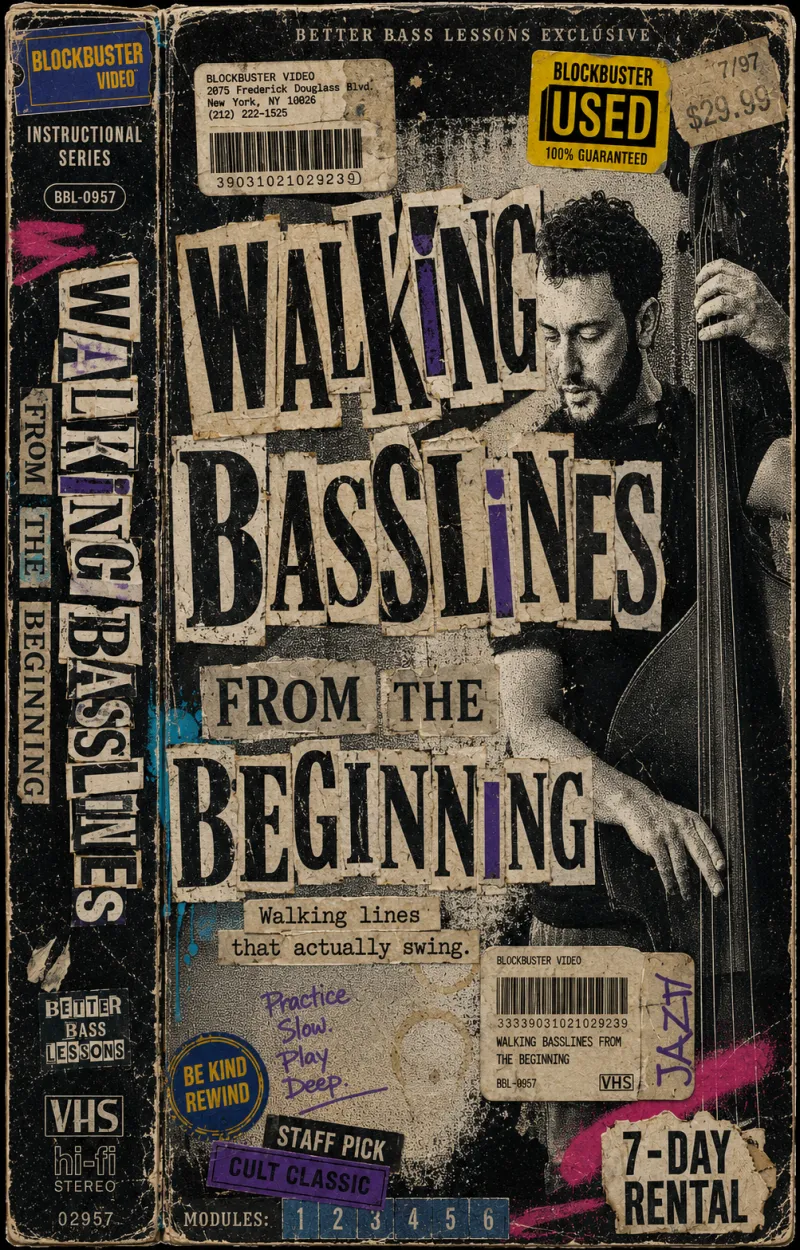
Walking Basslines on Upright Bass: from the Beginning
A 5-lesson method that takes you from "I can't figure out why my walking lines don't sound like the records" to professional-grade walking. The 1-3-5-7 method, the same process Ron Carter taught Cole at Juilliard.
$97 · one-time · lifetime access · 7-day money-back
This is for you if…
- You can play time on upright but your walking lines don't sound like the records and you can't figure out why
- You play through the same blues every gig and you're bored of your own bass lines
- You're not sure what notes are actually in the chord you're playing
- You can walk through a blues but it's repetitive and you know it
- You want the method behind how Ron Carter, Paul Chambers, and Ray Brown actually built their lines
- You've taken courses that gave you transcriptions and licks but never taught you how the lines were built in the first place
Maybe not if…
- You can't yet find the root of a chord on your bass: start with chord-tone fundamentals first
- You want slap, funk, or pop bass technique
- You want a transcription library of pre-written bass lines: this teaches you to build them yourself
Most bass players don't actually know the chord they're playing.
You'd think they would. They've been playing the tune for years. They walk through it every gig. They know it.
But ask them what an F7 is, what notes are actually in it, and the room goes quiet.
That's the reason most bass lines don't sound like the records. It's not a chops problem. It's not a vocabulary problem. It's that the foundation hasn't been laid. You can't build a great walking line on a chord you don't fully understand.
The greatest bass players in New York or LA can fully play every chord progression to every single tune they know. That's what makes them great bass players.
This course is the foundation. The 1-3-5-7. The same thing Ron Carter taught me at Juilliard, taught the same way I teach my private students. We start from zero and we build up: one chord at a time, one bar at a time, one tune at a time.
By the end, you can walk through a blues that sounds like a record. By Lesson 5, you can walk through Autumn Leaves. And more importantly, you understand why what you're playing works.
The 1-3-5-7 method.
Every great walking bass line is built on the 1-3-5-7 of each chord. Paul Chambers, Ron Carter, Ray Brown, Israel Crosby: they all use the 1-3-5-7. So do I, and so will you.
But here's the thing nobody tells you. The 1-3-5-7 isn't the bass line. What makes it the bass line is the order of notes. Same four notes (F, A, C, E♭ on an F7), but the order is what turns it from an exercise into music.
You change the order of notes. That's the thing that makes it a good bass line. Just by changing the order of notes you accomplish something completely different.
The course works in five lessons. Lesson 1 is the chord itself: knowing what notes you're playing. Lesson 2 is the F blues, learning to change the order of notes one bar at a time. Lesson 3 is the B♭ blues plus the three questions that turn a decent line into a professional one. Lesson 4 introduces wrong notes (placed correctly) and the available extensions, including the Ron Carter 1-9-5-9 lick he plays in every bass line he records. Lesson 5 takes the whole method to the songbook: Autumn Leaves, ii-V-Is, the walk-up.
If you can play your C major scale, you can play this course. The method is harmonic, not athletic. And it's the foundation everything else in jazz bass rests on.
The full curriculum.
5 lessons · PDFs for every bass line · MP3 backing tracks for F blues, B♭ blues, and Autumn Leaves
The first step is knowing the chord. The 1, the 3, the 5, the 7. The concept of chord changes comes from figured bass in 17th-century Baroque music. The bass note is the most powerful note in the music: it tells you what the chord actually is. Lesson 1 lays the foundation: the 1-3-5-7 of every dominant chord on the F blues, in the order they appear in the tune, played in half position on upright.
An F blues, bar by bar. Cole walks through how every bar gets a different order of notes (1-7-5-3 instead of 1-3-5-7, 1-3-7-5 instead of 1-5-7-3) and why those small reorderings completely change how the line sounds. By the end of Lesson 2, you have a professional-grade bass line over a full F blues, using only the 1-3-5-7. Every line is in the PDF.
Applying the method to a B♭ blues. New key, new fingerings, new resolutions. Then the three questions every bass line has to pass: Is it clear? Am I not repeating myself? Is each bar moving to the next bar? Cole walks you through how to apply these three checks in real time, on the bandstand. Once you can answer yes to all three, you have a professional bass line.
The ear hears beats 1 and 3 clearly, and barely registers beats 2 and 4 as harmonic content. Which means "wrong notes" placed on 2 and 4 don't sound wrong at all. They sound like movement. Lesson 4 covers exactly how to use wrong notes, the chromatic-approach licks that lead naturally to the next chord, the available consonant extensions (the 9 and the 13), and the Ron Carter 1-9-5-9 lick, the move he uses in nearly every recording he's made.
The whole method, applied to a standard. Autumn Leaves, the most-called tune in jazz. Cole walks bar by bar through the first 16 bars, applying every concept from Lessons 1–4. Plus: the ii-V-I walk-up (root, 9, 3, wrong-note-leading-to-the-root), the same construction as Stevie Wonder's I Wish. After this lesson, you can walk through any standard with confidence.
Total: 5 lessons · PDFs for every bass line · MP3 backing tracks for the three course tunes
Everything you need to actually do the work.
- 5 HD video lessonsThe Chord First · F Blues · B♭ Blues + Three Questions · Wrong Notes + Ron Carter Lick · From the Blues to the Songbook
- Every bass line written out (PDF)Every line Cole plays in the course, in standard notation. Print, fold, gig-bag.
- Backing tracks: F blues, B♭ blues, Autumn Leaves (MP3)Piano + drums at three tempos per tune. Drill the lines against a real band-style track, slow to gig pace.
- The Three-Question Checklist (PDF)The check Cole runs on every line he plays, printable for the music stand.
- BONUS · The 1-3-5-7 Cheat Sheet for 10 Standards (PDF)Every chord in Autumn Leaves, All The Things You Are, Stella, Body and Soul, There Will Never Be Another You, Confirmation, Solar, A Train, Days of Wine and Roses, Miss Jones, with the 1-3-5-7 spelled out for each.
- BONUS · The Walk-Up Library in 12 Keys (PDF)The four-note walk-up move from Lesson 5, written out in every key on the circle of fifths, plus the long Stevie Wonder I Wish walk-up.
- BONUS · The Half-Position Map for Upright (PDF)Every note in half position, first position, and second-and-a-half position, laid out by string and Simandl fingering. The map that lets you play a whole gig from the bottom of the bass.
- Lifetime accessNo subscription, no auto-renewal
- Free updates foreverEvery revision and addition, included

Cole Davis
First-call jazz bass player · Juilliard Artist Diploma
I went to Juilliard. I studied with Ron Carter. And the most important thing he ever taught me was the 1-3-5-7.
That's it. Just the chord tones. No tricks. No fancy patterns. No scales. The 1, the 3, the 5, the 7, in different orders, in different bars, with the right cadence between them. And once you have that, the music opens up. You can walk through a blues. You can walk through a standard. You can walk into a jam session and play with anyone.
I've been teaching this method to private students for over a decade. It works for beginners, it works for working pros who never learned it the right way, and it works for me: I still use it on gigs every week. This course is everything I'd teach you in twenty private lessons, condensed into five.
- Juilliard Artist Diploma
- Studied with Ron Carter
- First-call jazz bass player
- Hundreds of private students
One price. Own it forever.
$97one-time · lifetime access
- ✓5 HD video lessonsCore
- ✓Every bass line written out (PDF)Included
- ✓Backing tracks: F blues, B♭ blues, Autumn Leaves (MP3)Included
- ✓The Three-Question Checklist (PDF)Included
- ✓The 1-3-5-7 Cheat Sheet: 10 Standards (PDF)Bonus · $27
- ✓The Walk-Up Library in 12 Keys (PDF)Bonus · $27
- ✓The Half-Position Map for Upright (PDF)Bonus · $17
- ✓Lifetime access & free updatesForever
7-day money-back guarantee.
Try the whole method. Watch every lesson. Drill the bass lines against the backing tracks. If it doesn't move your walking lines forward within 7 days, email support and we'll refund every dollar. No follow-up sales pitch. No "are you sure?" survey.
Things people ask before they enroll.
Cole demonstrates on upright throughout. The course is built around upright fingerings (half position, second-and-a-half position, open strings). But the 1-3-5-7 method is harmonic, not instrument-specific, so electric bassists can apply every concept to their fretboard. The bass lines in the PDFs transfer to both.
No. The course starts from 1-3-5-7 chord tones and builds up. Cole explains every concept from the ground up. If you can find the root of a chord on your bass and read a basic chord chart, you're ready.
Each lesson is built to be drilled in 20–30 minutes a day. The full method is roughly 4–6 weeks of focused practice. Most students notice the change in their walking lines by Lesson 3.
Different mechanism, different instrument. The 7-Day Walking Bass Breakthrough is electric-specific and built on the right-notes / wrong-notes system + cadence movement (whole step / half step / 5-1). This course is upright-focused and built on the 1-3-5-7 method + changing the order of notes. Both are walking bass methods. They teach different routes to the same destination. Many players own both.
An upright (or electric) bass and a way to hear yourself. A metronome and recording device are strongly recommended. MP3 backing tracks for the three course tunes (F blues, B♭ blues, Autumn Leaves) are included: piano and drums at three tempos each.
Beginner-to-intermediate jazz bassist. You should already be able to play time and read a basic chord chart. If you've been winging it through walking lines and can't figure out why they don't sound like the records, this is the course for you.
YouTube gives you topics. This gives you a sequence. Five lessons in the order that actually moves an upright bassist from "I don't know the chord I'm playing" to "I can walk a professional-grade line over any blues or standard." With PDFs for every bass line, MP3 backing tracks for the three course tunes, plus three printable bonuses: the 1-3-5-7 cheat sheet for 10 standards, the walk-up library in 12 keys, and the half-position map for upright.
Forever. One purchase, lifetime access, all future updates included. No subscription.
7-day money-back guarantee. Email support within 7 days of purchase for a full refund.
Five lessons. Walking lines that
sound like the records.
$97
Get instant access7-day money-back guarantee · Lifetime access