Free from Cole Davis · Better Bass Lessons
Walking Bass Lines for Jazz Standards
Changes, notation, tab and a play-along for the tunes that actually get called at jam sessions. Every line is one chorus you can read, loop and slow down. Then turn the bass off and walk it yourself with the piano and drums.
Pick a tune
BBL-S01Autumn LeavesG minor · AABC, 32 barsMajor and minor ii-Vs in one key signature: Cm7-F7-Bbmaj7 is a ii-V-I in B-flat major, and Am7b5-D7-Gm7 is a ii-V-i in G minor, its relative minor. Apart from the chromatic run near the end, the tune stays in those two keys.Open the line →BBL-S02All the Things You AreA-flat major · AABA, 36 bars (8+8+8+12)Five key centers in 36 bars: Ab, C, Eb, G and E. The first A lands in C, the second in G and the bridge in E, so you've got to know where each ii-V is headed, not just what the next chord is.Open the line →BBL-S03Billie's BounceF blues · 12-bar blues, 12 barsThe quick change: bar 2 moves to Bb7, the IV chord, and bar 3 goes right back to F7, so the root moves F, Bb, F across the first three bars.Open the line →BBL-S04Blue MonkB-flat blues · 12-bar blues, 12 barsThe quick change: bar 2 goes to Eb7, the IV chord, and bar 3 comes right back to Bb7.Open the line →BBL-S05Blues for AliceF blues · 12-bar blues (Bird blues), 12 barsBird blues: Parker keeps the landmarks of a blues, Bb7 in bar 5 and a ii-V home in bars 9 and 10, and fills the space between them with ii-Vs.Open the line →BBL-S06Bye Bye BlackbirdF major · AABA, 32 barsMaking one key move: the A sections keep coming back to Fmaj7, with Gm7 C7 (the ii-V of F) in between. The harmony won't push your line anywhere, so you've got to change direction and register yourself.Open the line →BBL-S07Days of Wine and RosesF major · ABAC, 32 barsIt leaves the key in bar 2: Fmaj7 moves to Eb7, a whole step down. Eb7 comes back for two bars at the end of each A section, so get comfortable approaching Eb from D or E.Open the line →BBL-S08Have You Met Miss JonesF major · AABA, 32 barsRoots in fourths: after Fmaj7, most of the A section moves up a fourth at a time, D7 to Gm7 to C7, then Am7 to Dm7 to Gm7 to C7. Every bar hands your line a new target.Open the line →BBL-S09Mr. P.C.C minor · 12-bar minor blues, 12 barsThe minor blues: the same 12-bar shape as a regular blues, but the I chord is Cm7 and the IV is Fm7, both minor.Open the line →BBL-S10Now's the TimeF blues · 12-bar blues, 12 barsThe basic jazz blues in F: F7 for most of the first four bars, a quick change to Bb7 in bar 2, Bb7 again in bar 5, and back to F7 in bar 7.Open the line →BBL-S11OleoB-flat major · AABA, 32 bars (rhythm changes)Rhythm changes: Oleo uses the chord progression of George Gershwin's I Got Rhythm, in B-flat. Learn to walk it and you've learned a form, not just one tune.Open the line →BBL-S12So WhatD Dorian (D minor) · AABA, 32 bars (16 bars D Dorian, 8 bars E-flat Dorian, 8 bars D Dorian)Walking without ii-Vs: Dm7 lasts 16 bars. Aim for a chord tone (D, F, A or C) on beats 1 and 3, then use the rest of D Dorian and chromatic approach notes on beats 2 and 4 to set up the next target.Open the line →BBL-S13Tune UpD major · 16 bars played twice with first and second endings, 32 barsii-V-Is in three keys: Em7 A7 Dmaj7, then Dm7 G7 Cmaj7, then Cm7 F7 Bbmaj7, each key a whole step below the last.Open the line →BBL-S14All of MeC major · ABAC, 32 barsSecondary dominants in a row: E7 is the V of Am7 and A7 is the V of Dm7, so from E7 on, the roots go E, A, D, each a fifth below the last. The 3rds of those chords, G# and C#, aren't in the key of C, and they're the notes that tell the band the chord has changed.Open the line →BBL-S15Just FriendsG major · ABAC, 32 barsIt starts on the IV chord: bar 1 is Cmaj7, not G. The home chord, Gmaj7, doesn't arrive until bar 5, which catches a lot of players off guard.Open the line →BBL-S16Softly, as in a Morning SunriseC minor · AABA, 32 barsOne move, over and over: the A sections alternate Cm7 with a one-bar minor ii-V, Dm7b5 G7b9. You'll play that two-bar cycle 11 times in one chorus, so the real test is keeping your line from repeating itself.Open the line →BBL-S17SolarC minor · 12 barsFour key centers in 12 bars: C minor, then a ii-V-I in F (Gm7 C7 to Fmaj7), then E-flat (Fm7 Bb7 to Ebmaj7), then D-flat (Ebm7 Ab7 to Dbmaj7), then a minor ii-V back to C minor. Each new major chord is a whole step below the last one.Open the line →BBL-S18Stella by StarlightB-flat major · ABCA', 32 barsIt takes eight bars to get home: the tune opens with Em7b5 A7b9, a minor ii-V pointing at D minor, then goes to Cm7 F7 instead. The home chord, Bbmaj7, doesn't arrive until bar 9.Open the line →BBL-S19There Will Never Be Another YouE-flat major · ABAC, 32 barsA minor ii-V to the vi chord: after two bars of Ebmaj7, Dm7b5 G7b9 takes you to Cm7. The third of G7, B natural, is the only chord tone in those four bars outside the key signature, and it pulls up a half step to C.Open the line →BBL-S20Fly Me to the MoonC major · ABAC, 32 barsThe diatonic cycle: bars 1 to 7 go Am7, Dm7, G7, Cmaj7, Fmaj7, Bm7b5, E7, and each root is a fourth above the last (F to B is the one augmented fourth). That's all seven notes of the C major scale as roots, in order, so every bar hands your line a new target.Open the line →BBL-S21Satin DollC major · AABA, 32 barsii-Vs that move up a step: bars 1 to 4 play Dm7 G7 twice, then Em7 A7 twice, the same pattern a whole step higher. Neither pair resolves to its I chord, so the line has to keep moving.Open the line →BBL-S22SummertimeA minor · 16 bars (four 4-bar phrases)The minor ii-V: Bm7b5 to E7 takes you back to Am7 five times in 16 bars. In bars 2, 10, 14 and 16 it goes by at two beats per chord, and in bars 7 and 8 it gets a full bar each, so you practice both speeds in one chorus.Open the line →BBL-S23Take the "A" TrainC major · AABA, 32 barsLong stretches on one chord: each A section opens with two bars of C6 and two bars of D7#11, and the bridge sits on Fmaj7 for four bars. That's eight or sixteen beats on one chord, so your line needs a direction, not a loop around the root.Open the line →
How these lines are built
- Chord tones on the strong beats. Beat 1 of every chord, and beat 3 when a chord lasts a whole bar, lands on the root, 3rd, 5th or 7th, so the harmony is always clear.
- "Wrong" notes on 2 and 4. Passing and chromatic notes live on the weak beats, where they pull the line forward instead of fighting the chord.
- Chords are approached by a half step or a whole step. That's what makes the next chord sound like it arrives instead of appearing.
- Never the same note twice in a row. It's the fastest way to make a walking line sound stiff.
Practice tools that go with them
- Walking Line Builder: type any changes and get a line to study.
- Click Trainer: a metronome that clicks on 2 and 4, the way jazz drummers feel it.
- Guide Tones: the 3rds and 7ths that make ii-V-Is sound right.
Your next step
These pages give you lines to study. These courses teach you to build your own, on the bass you play.
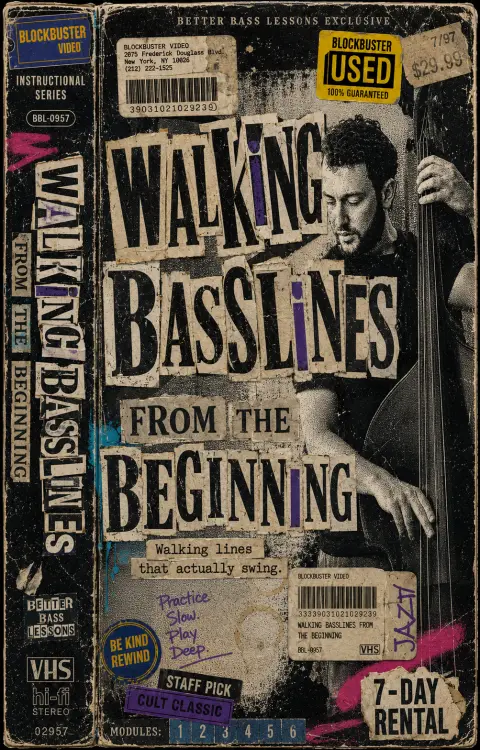
Walking Basslines on Upright Bass from the Beginning
Cole DavisFive lessons from “my walking lines don't sound like the records” to professional-grade walking.
- The chord first: the 1-3-5-7, where every great bass line starts.
- The master move: changing the order of the notes, bar by bar, on an F blues.
- The three questions every bass line has to pass, then the whole method on Autumn Leaves.
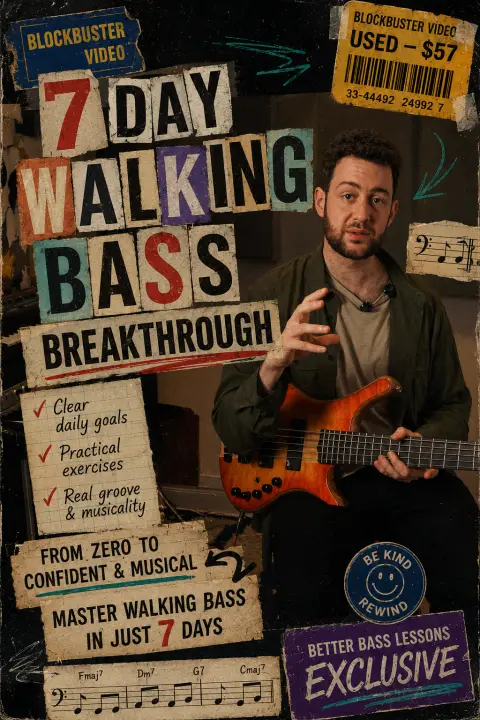
The 7-Day Walking Bass Breakthrough
Cole DavisWalk through any jazz tune with lines that move, swing, and never repeat themselves.
- Walk through any ii-V-I, major or minor.
- Solve the two-bar problem on static modal tunes.
- Never repeat yourself two bars in a row.
Not sure which course fits? Answer a few questions and we'll point you to one.