Stella by Starlight Walking Bass Line
Stella by Starlight started as Victor Young's theme for the 1944 film The Uninvited, and Ned Washington added the lyric in 1946. It's a 32-bar tune in B-flat, and it's one of the most popular jazz standards of all. For a bassist, it's a lesson in ii-Vs that don't resolve where you expect: the home chord doesn't show up until bar 9. Below you'll find the changes bar by bar and a walking line in B-flat.
Turn the bass off and it's your gig: the piano and drums keep going and you walk the line. The band counts you in with one bar of hi-hat.
Recorded upright bass, grand piano and a jazz drum kit play the line. Tab is for 4-string bass in standard tuning.
The changes
We use the changes on the Learn Jazz Standards and Jazzadvice charts, which agree bar for bar. jazzguitar.be calls these the modern changes and ties them to Miles Davis's version on My Funny Valentine. Victor Young's original has a B-flat diminished chord in the first two bars where these charts have Em7b5 A7b9. Bar 17 is written G7#5 on Jazzadvice and G+ on Learn Jazz Standards. The b9s on the dominant chords are how both charts spell them; plenty of players just call them A7, D7, G7 and F7.
How this line works
- The root lands on beat 1 of 28 of the 35 chord changes, so the harmony is clear. The rest start on the 3rd or 5th, which keeps the line from sounding like a list of roots.
- 34 of the 34 chord changes are approached by a half step or a whole step, so every new chord arrives smoothly instead of by a jump.
- Non-chord tones sit on the weak beats: 28 on beat 2 and 19 on beat 4. That's where passing and chromatic notes sound intentional instead of wrong.
- No note repeats back to back. A repeated note is the quickest way to make a walking line sound stiff.
What Stella by Starlight teaches you
- It takes eight bars to get home: the tune opens with Em7b5 A7b9, a minor ii-V pointing at D minor, then goes to Cm7 F7 instead. The home chord, Bbmaj7, doesn't arrive until bar 9.
- Backdoor moves to the major chords: Ab7 in bar 8 goes up a whole step to Bbmaj7, and Bbm7 Eb7 in bar 12 goes to Fmaj7 in place of the usual Gm7 C7. Both borrow from the minor key and resolve to major.
- A dominant held for two bars: G7#5 in bars 17 and 18 resolves to Cm7. Its notes are G, B, D-sharp and F, so walk through B natural and D-sharp rather than the B-flat and D of the key.
- Ab7#11 for two bars (bars 21 and 22), then Bbmaj7: another bVII7 to I. The sharp 11 on top is D, which is the third of the Bbmaj7 it's heading to.
- A chain of fourths at the end: the roots from bar 25 go E, A, D, G, C, F, Bb, each a fourth above the last, as three half-diminished ii-Vs (Em7b5 A7b9, Dm7b5 G7b9, Cm7b5 F7b9) step down to Bbmaj7.
How to practice it
- Hear the form first. Turn the bass off and play just the root of each chord along with the band until you never lose your place.
- Read the line slowly. Set the tempo around 80 and play the written line with the drums. Slow is the fast way here.
- Loop the hard spots. Turn on Loop, find the four bars that trip you up, and play them until they feel like the easy ones.
- Make it yours. Keep beat 1 of every bar, but change the approach note on beat 4. A half step above, a half step below, a whole step: each one changes the color of the arrival.
- Play it with the record. Put on one of the versions below and play along. That's where the time feel gets into your hands.
Want to build your own lines on these changes? Try the free Walking Line Builder and practice with the click on 2 and 4.
Recordings to hear
- Miles Davis, Jazz Track (1959), with Paul Chambers on bass.
- Miles Davis, My Funny Valentine (1965), with Ron Carter on bass.
- Keith Jarrett, Standards Live (1986), with Gary Peacock on bass.
Stella by Starlight: questions
What key is Stella by Starlight in?
B-flat major, the key on Learn Jazz Standards, Jazzadvice, jazzguitar.be and standardrepertoire.com. Don't wait for Bbmaj7 at the top, though: the tune starts on Em7b5 A7b9 and doesn't reach Bbmaj7 until bar 9.
Why does Stella by Starlight start on Em7b5?
Victor Young's original starts on a B-flat diminished chord. Jazz players swapped it for Em7b5 A7b9, a minor ii-V, which jazzguitar.be calls standard practice in the bebop era. Bbdim7 and A7b9 share four notes, so the sound is close, and the ii-V gives the bass a clear root to walk from.
What's the form of Stella by Starlight?
It's 32 bars. JazzStandards.com calls it A1-B-C-A2 and jazzguitar.be calls it ABCA': four 8-bar sections, with the last one starting like the first before it runs down a chain of ii-Vs to B-flat.
Your next step
This page gives you one line to study. These courses teach you to build your own, on the bass you play.

The 7-Day Walking Bass Breakthrough
Cole DavisWalk through any jazz tune with lines that move, swing, and never repeat themselves.
- Walk through any ii-V-I, major or minor.
- Solve the two-bar problem on static modal tunes.
- Never repeat yourself two bars in a row.
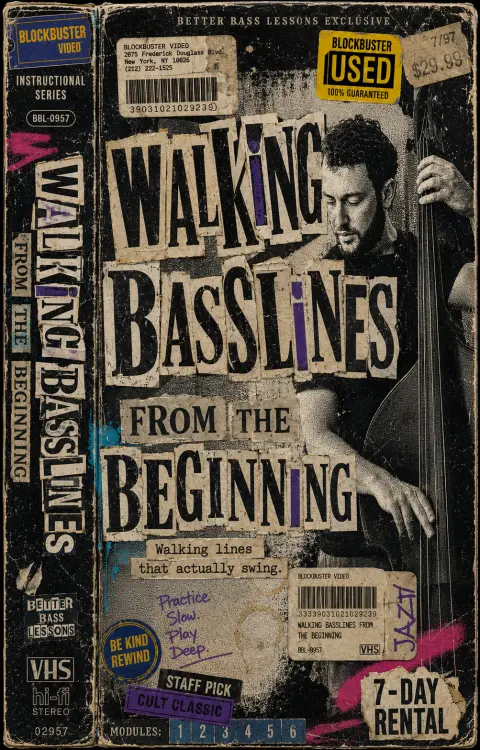
Walking Basslines on Upright Bass from the Beginning
Cole DavisFive lessons from “my walking lines don't sound like the records” to professional-grade walking.
- The chord first: the 1-3-5-7, where every great bass line starts.
- The master move: changing the order of the notes, bar by bar, on an F blues.
- The three questions every bass line has to pass, then the whole method on Autumn Leaves.
Not sure which course fits? Answer a few questions and we'll point you to one.