The Upright Walk-to-Solo Path · Three Courses
An open letter to every upright bassist who can walk a blues all night, then freezes the second the leader points at them for a solo
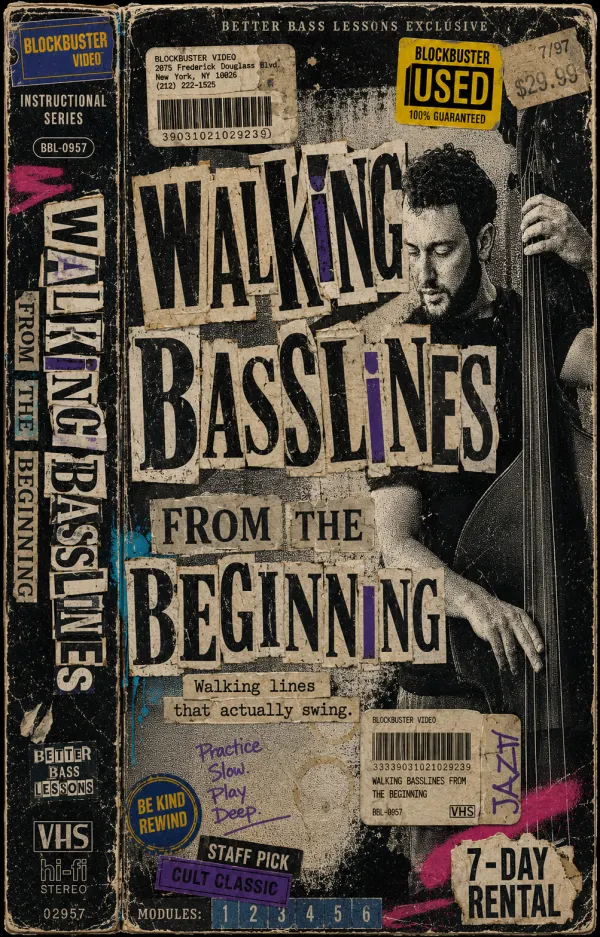
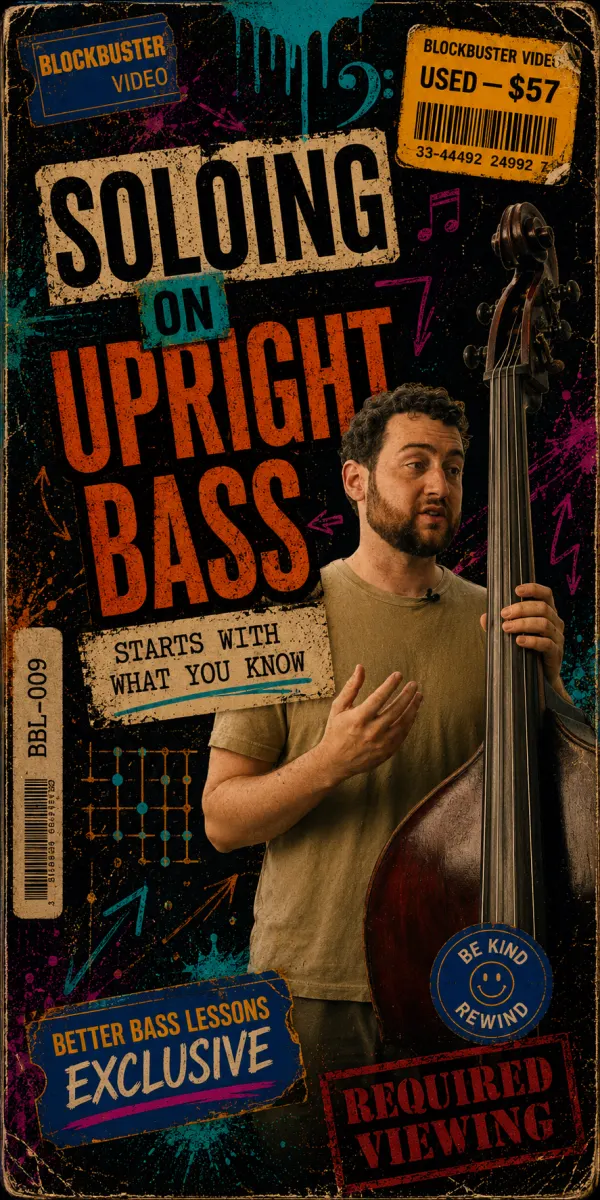
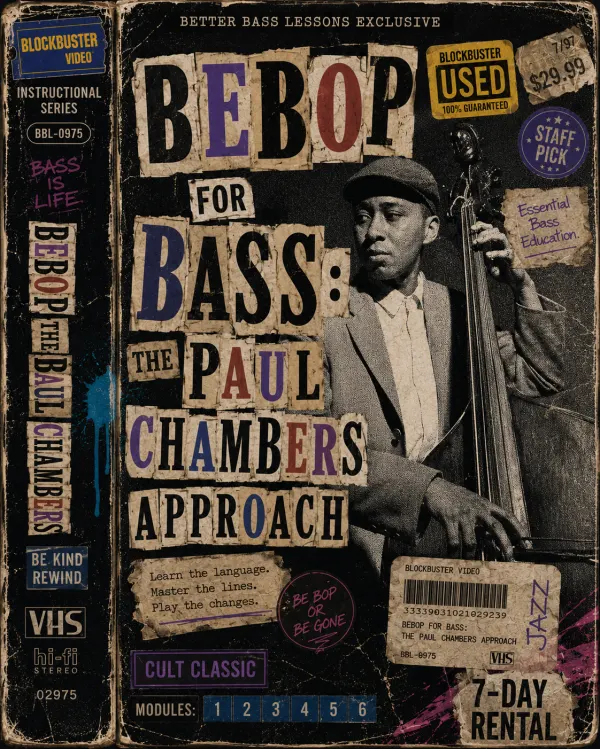
Walking · Soloing · Paul Chambers · By Cole Davis
Three courses, taken in order: a walking line that sounds like the records, a solo carved out of that same line, and the bebop language Paul Chambers worked out on the upright. One payment. $177 for all three.
One payment · All three courses
Get all three for $177One payment · Lifetime access to all three courses, every PDF and every backing track · 7-day money-back guarantee
Your walking line works. That's the problem.
The drummer leans on it. The band leans on it. If you lay out for two bars, the whole stand panics.
Upright players spend their whole lives on quarter notes. Every gig, every rehearsal, every practice session. Then the leader points at you, and suddenly you're supposed to leave space, play eighth notes and start phrases on beats that aren't beat one. Nobody taught you how to do that. They handed you a Real Book and said “play.”
So you do what every one of us does. You play a fast walking line for sixteen bars and pray the chorus ends.
Call it the sixteen-bar prayer.
I know it well. Here's the night it happened to me:
“The leader called a tune I'd never played, counted it off, and four bars in, pointed at me for a solo. I froze. Played a fast walking line for sixteen bars and prayed it was over.”
I went home that night and stopped trying to learn more scales. What I did instead became the five moves in the soloing course.
And here's the part most players get backwards. They think the fix is somewhere else: more scales, more modes, a Charlie Parker transcription they quit two bars in. It isn't somewhere else.
The solo is already inside the line you walk.
Which means if the line underneath is shaky, so is everything you build on it. Most bass players don't actually know the chord they're playing. Ask them what's in an F7 and the room goes quiet. You can't carve a solo out of a line you don't fully understand.
It was never a talent problem. Nobody laid the foundation first.
All three, in order, on one account.
Walking Basslines on Upright Bass: From the Beginning
Five lessons that take you from “I can't figure out why my walking lines don't sound like the records” to walking through a blues and Autumn Leaves. It's the 1-3-5-7 method, the same process Ron Carter taught me at Juilliard.
- ✓The one change that turns a 1-3-5-7 exercise into a professional line. (Lesson 2. It doesn't add a single new note.)
- ✓The three questions every great bass line passes, and how I run them in real time on the bandstand. (Lesson 3.)
- ✓Where to put a “wrong note” so it sounds like movement instead of a mistake. (Lesson 4.)
- ✓The Ron Carter lick, “the move he uses in nearly every recording he's made.” (Lesson 4.)
- ✓The ii-V-I walk-up, built the same way as Stevie Wonder's I Wish. (Lesson 5.)
Jazz Soloing on Upright Bass: From the Beginning
Five lessons that take you from “I can walk a line but I freeze when it's my turn to solo” to soloing through blues, rhythm changes and ii-V-Is. No scales to memorize. No modes. Pure pizz, the same hands you walk with.
- ✓The first move of the whole system. (Lesson 1. It starts from the line you already play.)
- ✓The two notes horn players hear in every chord, and how to hear them the same way. (Lesson 2.)
- ✓The rhythm shift that stops a solo sounding like a fast walking line. (Lesson 3.)
- ✓How to start a phrase on any beat without losing the form.
- ✓Eighth notes that swing on upright: “Not too straight. Not too triplet. Right in the pocket.” (Lesson 5.)
- ✓The upright fingering rules that keep your sound the same across position shifts.
Bebop for Bass: The Paul Chambers Approach
Charlie Parker is nearly impossible on the bass. He played alto. Paul Chambers took Bird's language and worked out how to say it on the upright, so this course runs through him: twelve of his licks, pulled off the records and broken down note by note.
- ✓The ratio of right notes to wrong notes that bebop runs on. (Lesson 1. This is where it clicks.)
- ✓The single note at the end of the bar that makes the whole Confessin' phrase. (Lesson 2.)
- ✓The B♭ that's a wrong note and a right note at the same time. (Lesson 2.)
- ✓How to mutate a Paul Chambers lick until it stops sounding like him and starts sounding like you. (Lesson 3.)
- ✓The lift on “the and of three” that's a trademark of Bird. (Lesson 4.)
- ✓Dexterity, from Chambers' Music, Coltrane's first date as a sideman in 1956 and my favorite bass solo ever recorded. (Lesson 4.)
Each course hands off to the next.
And the pages say so themselves.
The soloing course starts from a walking line. If you can't walk one yet, its own page sends you to the walking course first. The bebop course is intermediate and asks you to know your major and minor triads.
Here's how I think about it:
“The bass line is the marble. The solo is the sculpture.”
The walking course gives you the marble. The soloing course is the chisel. And Bebop for Bass is where the four notes you walk on turn into the four you solo on. They aren't the same four.
Roy Hargrove was a fixture at Smalls when I was coming up, and he told every young player the same thing: learn Bird. On the bass, Paul Chambers is how you do it. But he's the third step, not the first. Take him first and he's just licks you read off a page.
This is all three, in order, on one account.
Built for the upright player who freezes at the solo.
Upright players who can play time and read a basic chord chart, whose walking lines don't sound like the records and who freeze when the leader points at them for a solo.
One payment. $177 for all three.
You keep $84. One payment, lifetime access to all three courses, every PDF and every backing track. No subscription.
For scale: the walking course alone is, as I put it on its page, “everything I'd teach you in twenty private lessons, condensed into five.”
You keep $84
One payment · Lifetime access to all three courses, every PDF and every backing track · 7-day money-back guarantee
7-day money-back guarantee. Email support within 7 days of purchase for a full refund.
The solo was in your walking line the whole time.
Questions before you buy.
It was never your fault.
From here, it's a choice.
You didn't freeze because you're not a soloist. You froze because nobody showed you where the solo was hiding. It was in your walking line the whole time.
$261 separately · $177 for all three
Walking · Soloing · Bebop · Lifetime access
Here's everything you get.
One payment · Lifetime access to all three courses, every PDF and every backing track · 7-day money-back guarantee
Start the path: $177P.S. Here's a test you can run right now. Put on an F blues, walk one chorus and record it. Play it back and ask the three questions from Lesson 3 of the walking course: Is it clear? Am I not repeating myself? Is each bar moving to the next bar? If any answer's no, that's where the path starts.
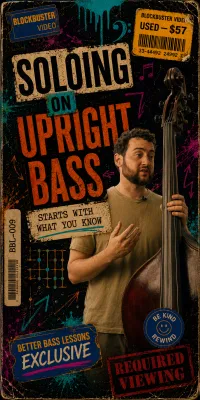
Upright Walk-to-Solo Path (3-Course Bundle)
$177.00
Quantity