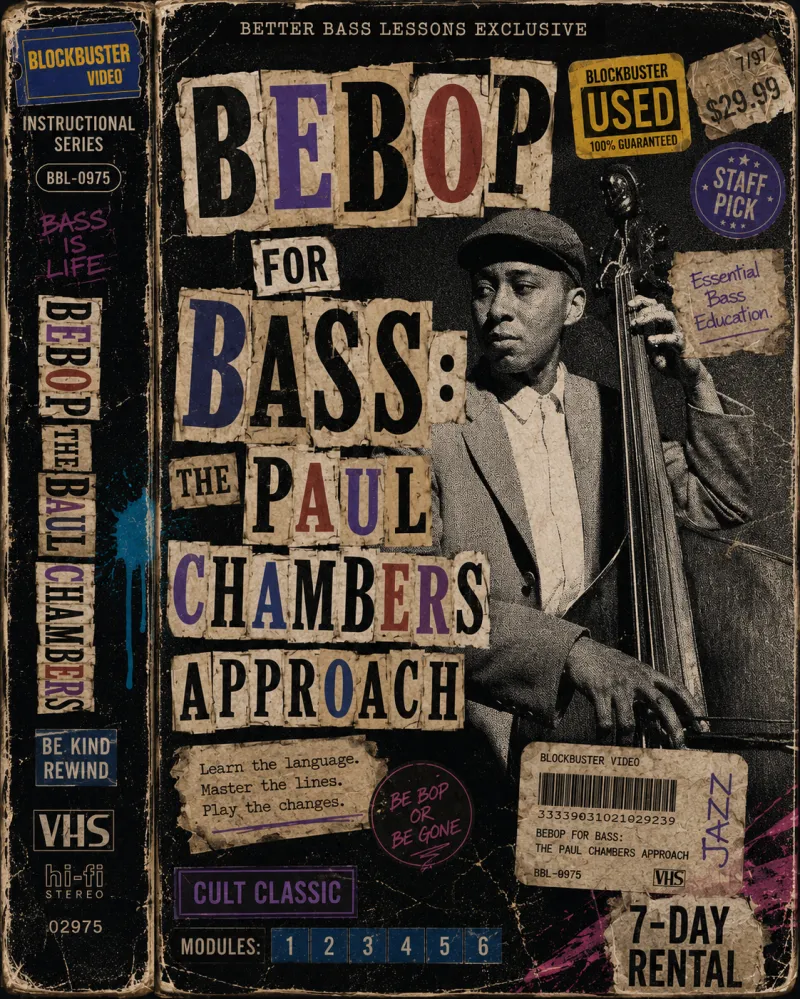
Bebop for Bass: The Paul Chambers Approach
Learn to solo on the upright bass so it actually sounds like jazz, by borrowing the language of Paul Chambers, the one player who translated Charlie Parker onto the instrument. Twelve of his licks, broken down note by note.
$67 · one-time · lifetime access · the free 12 Essential PC Licks PDF · 7-day money-back
This is for you if…
- You can play, but your solos come out sounding like the blues scale or an exercise instead of jazz
- It's your turn to solo over a standard and you freeze, or feel like you're faking it
- You've tried to learn bebop straight from Charlie Parker and it just doesn't lie on the bass
- You know your major and minor triads and you're ready to actually use bebop language
- You want lines that work on a blues at any jam session, in any key, even the ones you avoid
- You've collected licks, but they come out stiff, like you're reading them off a page
Maybe not if…
- You're still finding the notes on the bass. Start with fundamentals first
- You don't yet know your major and minor triads
- You want a shortcut that skips the woodshed. This is language you internalize, not a trick
Your solos don't sound like jazz, and it isn't a talent problem.
Are you tired of taking bass solos that don't really sound like jazz? Of playing over the same standards without ever feeling confident you can solo on them?
For a long time, that was me. I felt inadequate every time it was my turn. I'd reach for something and play the wrong stuff. Or I'd outline the changes so plainly it sounded like an exercise. Or I'd grab at chromaticism and dissonance with no real idea how they worked. The notes that make the jazz language so special, I couldn't find them on the bass.
If you only play the "correct" notes, it starts to sound like the blues scale, or something you'd hear in folk music. Which is great, but it isn't jazz. The thing that makes a phrase sound like jazz is the note you'd swear is wrong.
Wrong notes are what make the right notes sound good. Without them you've got a kind of boring, dry consonance.
Then I started studying one bass player, and it changed how I heard the whole instrument: the great Paul Chambers.
Charlie Parker is impossible on the bass. Paul Chambers already translated him.
Every improviser is told the same thing: you have to learn the language of Charlie Parker. Roy Hargrove, who we lost far too soon, was a fixture at Smalls when I was coming up, and he told every young player exactly that. Learn Bird. Trying to take a jazz solo without understanding him is like trying to write a novel with no vocabulary.
But we bass players have a harder job, because Bird's language doesn't really sit on the bass. He played alto saxophone. What does work on the bass is the language of Paul Chambers, and his language is a direct line from Charlie Parker. He took Bird's vocabulary and worked out how to say it on the upright.
As intimidating as bebop can be, we have a perfect translator in Paul Chambers.
So this whole course runs through PC. Twelve of his licks, pulled straight off the records and broken down note by note: the right notes, the wrong notes, the resolution, the phrasing. Underneath the licks are the ideas that make them work: the roughly 80/20 ratio of right notes to wrong notes; the fact that melodic means memorable, not pretty: every great phrase has a beginning, a direction, and an end; and the shift from the 1-3-5-7 you walk on to the 3-5-7-9 you solo on.
And it doesn't stop at copying him. You'll learn to mutate the licks (change a few notes, develop them) until they stop sounding like Paul Chambers and start sounding like you.
The four lessons.
4 video lessons · plus the 12 Essential Paul Chambers Licks PDF, written out in all 12 keys
Charlie Parker is nearly impossible on the bass: he played alto. Paul Chambers took Bird's language and worked out how to say it on the upright, so we learn bebop secondhand through the one player who already made it work. Then Wrong Notes 101: wrong notes are what make the right notes sound good. Play only the consonant notes and it drifts toward the blues scale or folk music. The dissonance is what makes it jazz. Bebop runs on roughly an 80/20 ratio of right notes to wrong notes, and this is the lesson where that clicks.
Melodic is the most misunderstood word in music. It doesn't mean pretty. It means memorable. Every great phrase has a beginning, a direction, and an end, the three questions you ask of any line you play. Then the first lick, from Confessin', note by note: the single note at the end of the bar that makes the whole phrase, the ii-V resolution (C minor 7 to F7) through a flat-9, and the B♭ that's a wrong note and a right note at the same time.
PC played in his keys because he was a bass player, but with a little alteration his lines work in all twelve, even B major, which has no open strings and which most of us avoid. You'll take a lick through the keys, then learn the second lick (You and the Night and the Music, with Bill Evans: the "imaginary five," extreme tension that resolves right back to the root). And you'll mutate it: change a few notes and develop it until it stops sounding like Paul Chambers and starts sounding like you.
The advanced licks: Tad's Delight (Sonny Clark Trio, with Philly Joe Jones on drums), Whims of Chambers, and Dexterity, from Chambers' Music, Coltrane's first date as a sideman in 1956 and my favorite bass solo ever recorded. Then bebop phrasing: accenting certain notes to create forward motion, that lift on the "and of three" that's a trademark of Bird, the difference between notes that just sit there and notes that swing. We close on how to keep getting further inside the language for good.
Total: 4 video lessons · plus the 12 Essential Paul Chambers Licks PDF, in all 12 keys
Everything you need to actually get this language under your fingers.
- The full Bebop for Bass video course4 lessons breaking down Paul Chambers' language and his essential licks, note by note (the right notes, the wrong notes, the resolutions, the phrasing), worked through in multiple keys.
- The free PDF · 12 Essential Paul Chambers LicksEvery lick written out, with fingerings, transposed into all twelve keys. Print it, put it on the stand, and woodshed.
- Lifetime accessNo subscription, no auto-renewal.
- Free updates foreverEvery revision and addition, included.

Cole Davis
First-call jazz bass player · Juilliard Artist Diploma
I went to Juilliard, where I studied figured bass, the way Baroque players read changes. That's part of why I hear bebop the way I do: a set of rules you improvise inside, the same way Bach did over a sheet of figured bass.
Paul Chambers is, to me, the foundation of learning to solo on the upright bass. He scratched the surface of the whole instrument before Scott LaFaro, before NHØP, before Christian McBride, and he did it by translating Charlie Parker's language onto the bass. I've spent years getting that language under my fingers, and I write about it in books like 25 Easy Bebop Licks.
This course is the thing I wish I'd had when I felt stuck on my own solos. I'm thrilled to put it out at a price where any bass player can grab it, so we can all get further inside this language and finally take solos on the upright that sound like jazz.
- Juilliard Artist Diploma
- First-call NYC jazz bassist
- Author of 25 Easy Bebop Licks
- Studied figured bass at Juilliard
One price. Own it forever.
$67one-time · lifetime access
- ✓The full Bebop for Bass video course (12 licks)Core
- ✓12 Essential Paul Chambers Licks: PDF, all 12 keysIncluded
- ✓Lifetime access & free updatesForever
7-day money-back guarantee.
Watch every lesson, download the PDF, take the licks to your bass. If they don't get you closer to a solo that sounds like jazz within 7 days, email support and we'll refund every dollar. No follow-up sales pitch, no "are you sure?" survey.
Things people ask before they grab it.
It's built on the upright. That's where Paul Chambers lived and where Cole demonstrates every lick and fingering. The concepts (wrong notes, melodic shape, the 3-5-7-9 mindset, bebop phrasing) carry straight over to electric, but if you play electric, know the examples and fingerings are upright-first.
If you know your major and minor triads, you're ready. The first lick starts on the first four notes of the minor scale, the most basic thing imaginable. What makes it bebop is what comes next, and that's exactly what Cole walks you through.
To start, yes, and then you mutate them. Cole shows you how to change a few notes and develop a lick until it's your own line. Think of taking a great speech and changing a few words in each sentence: it still sounds sharp, because it came from a great source. That's how you build your own voice instead of sight-reading licks on the bandstand.
All twelve keys are in the free PDF, fingerings included, even B major, which has no open strings and which most bass players avoid. PC's lines work in every key with a little alteration, and the PDF does that work for you.
No. Every lick is written out in the PDF if you want it, but Cole breaks down each one by ear and by function on video: the right notes, the wrong notes, the resolution, the phrasing. You don't need to be a strong reader to follow along.
Forever. One purchase, lifetime access, all future updates included. No subscription.
7-day money-back guarantee. Email support within 7 days of purchase for a full refund.
Twelve licks. Solos that
finally sound like jazz.
$67
Get instant access7-day money-back · Free 12 Essential PC Licks PDF included