The Electric Solo and Pocket Path · Three Courses
Take the solo. Play it anywhere on the neck. Then lock back in so tight the drummer turns around and nods.

Cole Davis · Anthony Muthurajah · Paul “Papa Bear” Johnson
Three courses from three New York bassists, in the order you'll need them: me on your first real solo, Anthony Muthurajah on the whole fretboard, and Paul “Papa Bear” Johnson on where every note sits. $127 for all three.
One payment · All three courses
Get all three for $127One payment · Lifetime access to all three courses, every PDF and every backing track · Money-back guarantee on every course
Your notes are right. That's the problem.
You can walk a blues. You can hold down the changes. You know your arpeggios. And there are still three moments on every gig where it falls apart, and none of them are about wrong notes.
The first is the solo. The leader points at you, and you play a few notes, run out of ideas, fall back into a walking line, run out of ideas again and pray the chorus ends. So you go home and learn more scales. It isn't a scales problem. That's why scales aren't fixing it.
The second is the neck. When you do get a line going, you reach for the same shapes you already know, in the same position you happened to start in. The line you hear in your head never reaches your hands. That's a fingerboard problem, not a theory problem. Most players only ever move across the strings at one fret, or up and down one string. Both keep you in the box.
The third is the pocket. You sit in at a jam. You play the right notes. Everybody nods politely. But nobody moves. You listen back and can't find anything wrong, because technically, nothing is wrong. It just doesn't feel like anything.
Three moments. Three gaps. None of them close by practicing more notes.
Nobody taught you how to leave space. Nobody showed you the neck as one map instead of five boxes. And the pocket is something you've never practiced, because nobody ever taught you it existed.
That's not your fault. It's what got left out.
Three courses from three New York bassists.
Jazz Soloing on Electric Bass: From the Beginning
Five lessons that take you from “I can walk a line but I freeze when it's my turn to solo” to soloing through blues, rhythm changes and ii-V-Is. No scales to memorize. No modes. No bebop licks you can't actually use.
- ✓The first move of the whole system. (Lesson 1. It starts from the bass line you'd have played anyway.)
- ✓The two notes that outline any chord, and how to hear them the way horn players do. (Lesson 2.)
- ✓The rhythm shift that turns a bass line into a solo. (Lesson 3.)
- ✓How to use chromatic approach notes on purpose instead of at random.
- ✓Eighth notes that swing: “Not too straight. Not too triplet. Right in the pocket.” (Lesson 5.)
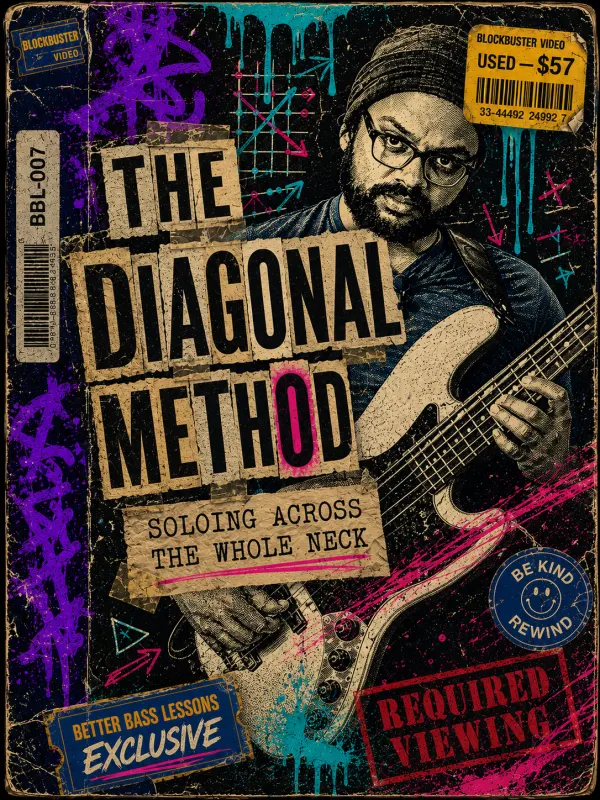
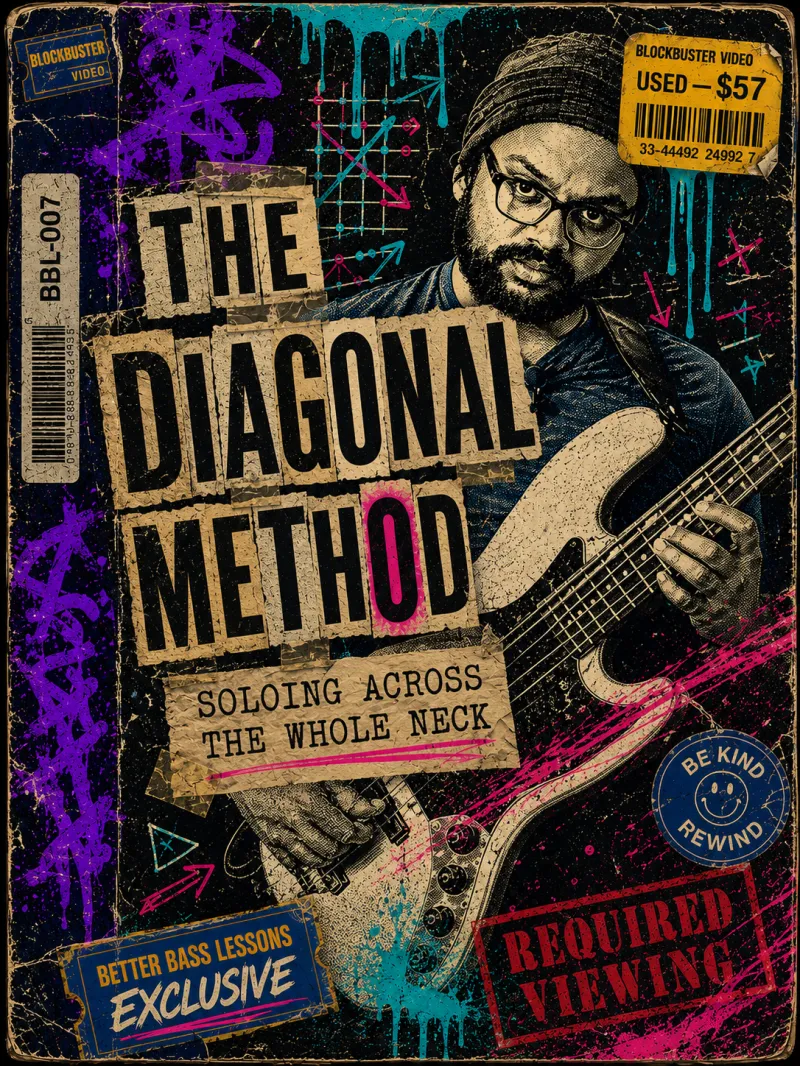
The Diagonal Method
Anthony has played with The Brand New Heavies and The Supremes and performed at Jazz at Lincoln Center. By his own account, he started out as “a very stubborn gospel musician and heavy metal musician that couldn't hear or know the difference between major seven and minor seven.”
The Diagonal Method is what he wishes someone had handed him on day one: 25 lessons, about two and a half hours, in six modules that rebuild your fingerboard from the rudiments up.
- ✓What “diagonal” actually means, and why the players who improvise freely move that way. (Module 1.)
- ✓The index and pinky rule for the fretting hand.
- ✓The five essential scales on a single string, in all twelve keys.
- ✓How a C major and an A♭ major 7 “share more than you think.” (Module 4.)
- ✓Anthony's three-note melodic cells: the four shapes, and the link that lets you pile them across the changes. (Module 5.)
- ✓Why you should stop trying to be the rhythm guy when you solo. (Module 6.)
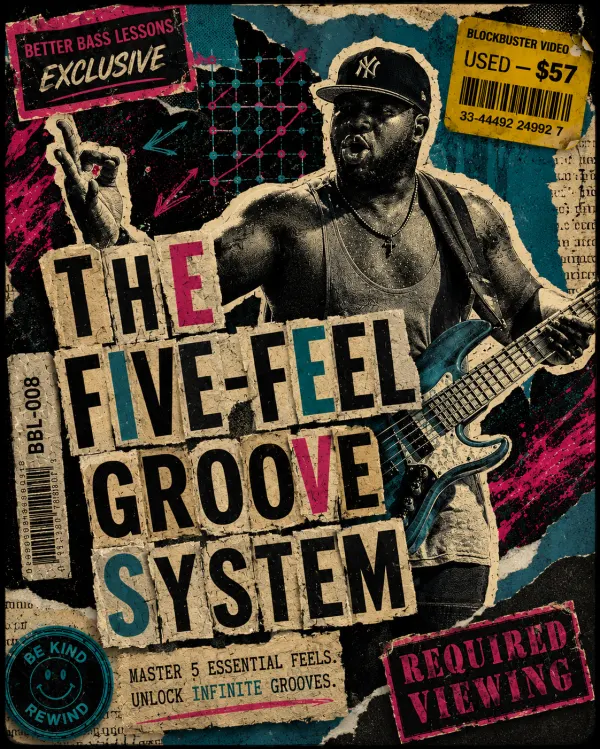
The Five-Feel Groove System
Papa Bear tours with Taylor Swift, Doja Cat, Lizzo and Leon Bridges, and plays Broadway in Aladdin and Hadestown. I watched him play one note over a drum loop and make it sound like five different bass players. Same note, same tempo, same track. I asked him to teach exactly that. Sixteen lessons, taught entirely by him.
- ✓The one-note drill that exposes your time feel. (It's the daily practice that fixes it, too.)
- ✓The five feels you can create with the exact same notes, and how to move between them on command.
- ✓Note duration, “the secret to groove nobody talks about.” (Lesson 8.)
- ✓The four-bar rule that keeps your fills from landing flat. (Lesson 7.)
- ✓Ghost notes with control, instead of by accident. (Lesson 11.)
- ✓A live session where he builds a bass line in real time over a pop song he's never heard. No chart. (Lesson 14.)
Each one fixes the gap the one before it leaves open.
My course comes first because it starts from something you already do. It's the beginner step, and the one that stops the freeze.
The Diagonal Method is intermediate, and it's what comes next: once you've got a solo, you need somewhere on the neck to put it. It starts with the rudiments most courses skip, because, in Anthony's words from the course, “without the technical foundation, the concepts are futile.”
Then Papa Bear, because a solo is sixteen bars and the pocket is the whole night. His course isn't about notes at all. As he says near the start:
“I'm not going to give you a bunch of licks you can play. You can find a lick for free on YouTube. What I want to give you is a concept you can hold for the rest of your life.”
The solo gets you noticed. The neck gets the idea out of your hands. The pocket is what gets you called back.
If you're an upright player who's started doubling on electric, this is the path for you too. The harmony in both soloing courses carries over to upright, and the Five-Feel system works on either instrument.
Built for the electric player who freezes at the solo.
Electric bassists who can walk a line and hold time but freeze when it's their turn to take a chorus, reach for the same shapes in the same position, and want their playing to feel like something to the band. Also the upright player who has started doubling on electric.
One payment. $127 for all three.
You keep $54. One payment, lifetime access to all three courses, every PDF and every backing track. No subscription.
Three New York players. One on the solo, one on the fretboard, one on feel. One payment.
You keep $54
One payment · Lifetime access to all three courses, every PDF and every backing track · Money-back guarantee on every course
Every course keeps the money-back guarantee on its own page: 7 days for Jazz Soloing on Electric Bass, 30 days for The Diagonal Method and 60 days for The Five-Feel Groove System.
The pocket is what gets you called back.
Questions before you buy.
It was never your fault.
From here, it's a choice.
You were never short on notes. You were short on three things nobody put in front of you: a way into the solo, a map of the whole neck, and the feel that makes a room move.
$181 separately · $127 for all three
The solo · The neck · The pocket · Lifetime access
Here's everything you get.
One payment · Lifetime access to all three courses, every PDF and every backing track · Money-back guarantee on every course
Start the path: $127P.S. Here's a test you can run right now. Play a line you know well, in the position you learned it. Now play the same line starting on a different string, higher up the neck, without stopping to think. If it falls apart, you've just found the box The Diagonal Method is built to get you out of. Module 1 of The Diagonal Method starts there.
Electric Solo and Pocket Path (3-Course Bundle)
$127.00
Quantity