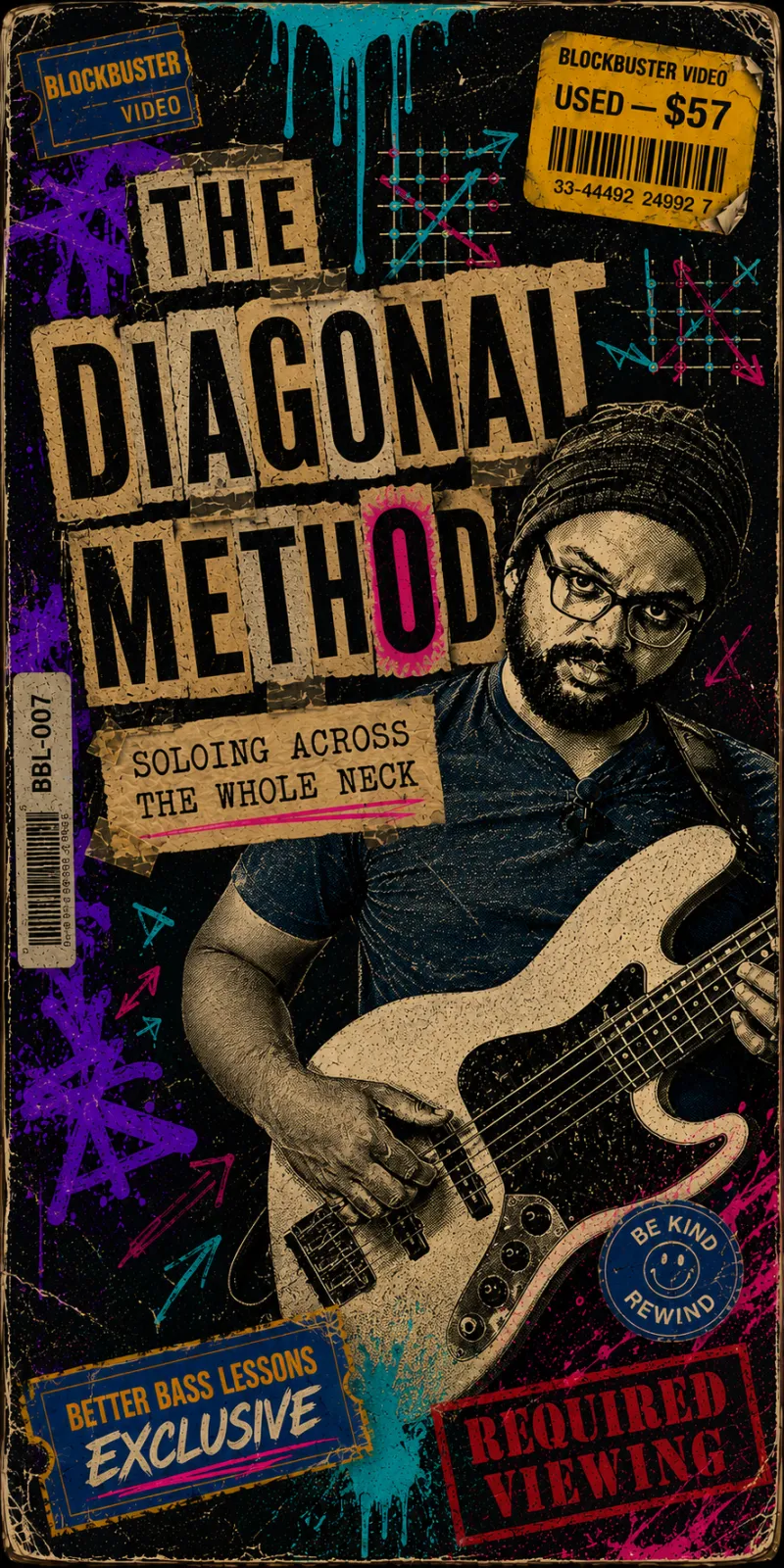
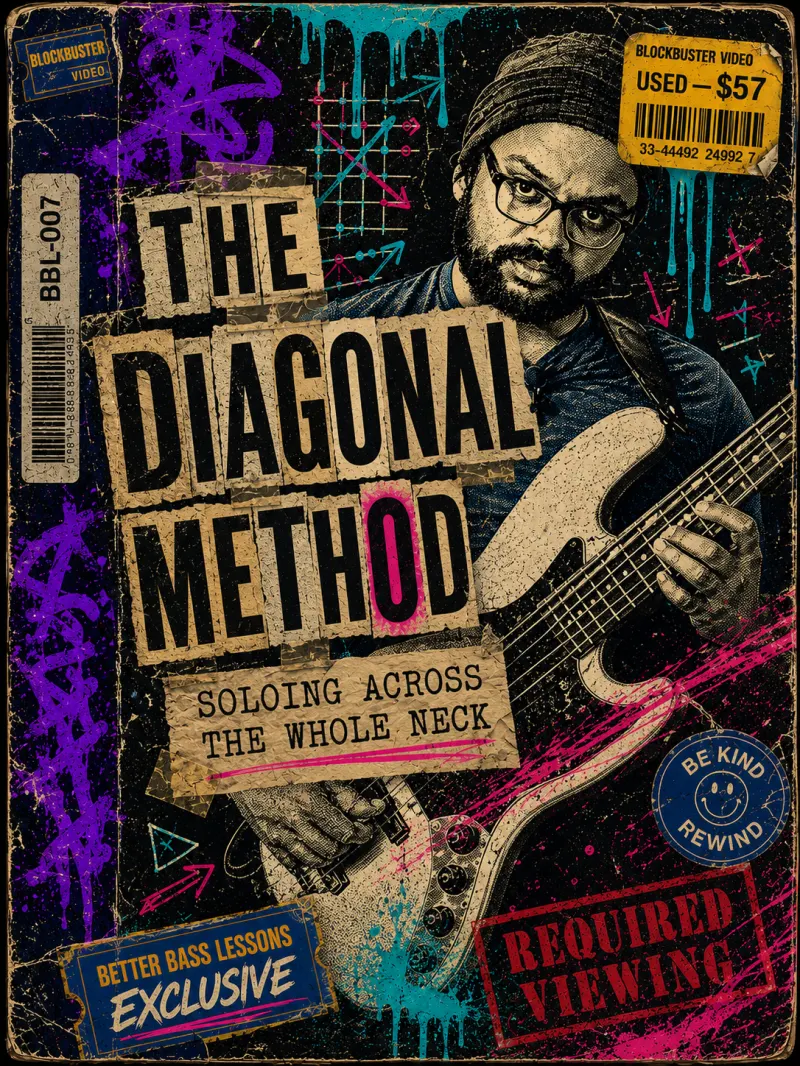
Solo across the strings and the fretboard.
The Diagonal Method is a ~2.5-hour video course for intermediate electric bassists who can play time but freeze the moment it is their turn to take a chorus. Anthony Muthurajah teaches the diagonal approach he used to go from gospel and metal sideman to the Brand New Heavies, the Supremes, and Jazz at Lincoln Center.
$57 · one-time · lifetime access
See how it is taught before you decide.
First 2 minutes of a 17-minute lesson: guide tones over an F blues. The 3 and the 7 are how you outline any chord.
This is for you if…
- You play electric bass and can hold time, but freeze when it is your turn to take a chorus
- You know your scales in one position and want to play them anywhere on the neck
- You can hear a line in your head but it never comes out of your fingers
- You play in a wedding band, a function band, or a fusion project and want to actually solo when the moment comes
- You have been on YouTube for years and feel like you are running in place
- You want a method, sequenced from the rudiments up, not another content library
Probably not if…
- You are a total beginner and have not played time yet. Start with foundations
- You only play upright (the course demonstrates on electric, though the harmony transfers)
- You want shred-bass technique and metal economy picking
Why your solos sound the same every time you take one.
You can play time. You can lock in a groove. You have spent years learning patterns: pentatonics, modes, arpeggios, all of it. But when the moment comes to actually take a chorus, you reach for the same six shapes you already know, in the same position you happened to start in, and the line you hear in your head never reaches your hands.
That is not a theory problem. It is a fingerboard problem. Most bassists move in one of two directions: across the strings at a single fret, or up and down one string. Both are limiting. Both make the neck feel half-mapped. Both keep you trapped in the box.
The bassists who improvise freely are doing something different. They are moving diagonally: across the strings and across the fretboard at the same time. Any line they can hear, they can play in whatever position they happen to be in. The neck is one continuous map instead of five disconnected boxes.
That is the gap. And it does not close from more theory. It closes from rebuilding the rudiments, slowly, on purpose, in a specific order.
The Diagonal Method: a sequenced video course that rebuilds your fingerboard from the rudiments up.
The course is six modules of focused video instruction, roughly two and a half hours total. It moves from the technical rudiments most courses skip, through the six essential seventh-chord arpeggios, into guide tones over an F blues, then scale tones and modal connections, then the three-note melodic cells Anthony uses to build phrases, and finally rhythm and creative control.
These five scales form the harmonic foundation for ninety-nine percent of music. The other one percent you can explore on your own time.
The sequencing is the point. Without the rudiments, the harmony has nowhere to live. Without the harmony, the rhythm has nothing to organize. Anthony's words from the course itself: "without the technical foundation, the concepts are futile." So the course starts with single-string skills in twelve keys, finger-by-finger fretting rules, and the picking-hand decisions most players never consciously make.
From there each module adds one layer on top of the previous one. By the end you have a fingerboard you can navigate diagonally, a chord-tone library you can hear in real time, and a phrasing vocabulary built from three-note cells that link from one chord to the next.
By the end of the course you will be able to…
- ✓Navigate the fretboard diagonallyAcross strings and across frets, not just one or the other
- ✓Play the five essential scales on a single stringMajor, melodic minor, harmonic minor, and the two symmetrical diminished, in all twelve keys
- ✓Outline any chord with two notesThe 3 and the 7: guide tones that work over any progression
- ✓Recognize the six essential seventh-chord arpeggiosMajor 7, minor 7, dominant 7, half-diminished, diminished 7, minor-major 7
- ✓Link non-diatonic chord changes melodicallyHow a C major and an A-flat major 7 share more than they look like they do
- ✓Build phrases from three-note cellsStart, middle, resolution: the structure underneath every great solo
- ✓Use rhythm without losing the lineQuarter notes through 16th-note triplets, anchored to the harmony
- ✓Hear what you are about to playThe shift from pattern recall to intentional improvisation
- ✓Solo without taking responsibility for the grooveThink like a horn player when it is your turn
- ✓Find your habits and break themThe recording-and-reviewing practice that exposes what you actually do
- ✓Practice for prolonged stretches without losing focusThe chorus-after-chorus stamina Anthony built on backing tracks
- ✓Improvise in any style where it mattersJazz, R&B, funk, fusion, gospel, wedding-band moments
The full curriculum.
25 lessons · 2h 25m · 6 modules
- 01.01Across strings vs. across the fretboard: what diagonal actually meansPreview5:30
- 01.02Fretting-hand mechanics: the index and pinky rule6:00
- 01.03Picking-hand mechanics: alternate vs. economy4:45
- 01.04The five essential scales on a single string, in all twelve keys7:00
- 01.05Two-octave scales and position shifts without breaking the line5:30
- 02.01Triads: every finger combination, every inversion6:00
- 02.02Major 7, minor 7, dominant 7: the three workhorsesPreview7:00
- 02.03Half-diminished, diminished 7, minor-major 7: the other three6:00
- 02.04Two-octave variations: playing the second octave a different way every time5:30
- 03.01What guide tones are and why they outline harmony better than scales doPreview6:30
- 03.02Guide tones over the F blues: half notes, then opened up8:00
- 03.03Adding the root: when one extra note changes everything5:00
- 03.04Adding the 5th: the full pyramid built up from chord tones5:00
- 04.01Scale tones across all six seventh-chord types6:00
- 04.02Lydian over major 7, Dorian over minor 7, and the rest of the pairings6:30
- 04.03Linking non-diatonic chords: C major and A-flat major 7 share more than you think6:00
- 04.04Running scales with intent, not patterns5:30
- 05.01The four cell shapes: 1-2-3, 1-2-b3, 1-b2-b3, 1-b2-3Preview5:30
- 05.02Every note belongs to at least two cells: finding the link6:00
- 05.03Phrasing with direction: start, midpoint, resolution5:30
- 05.04Building longer phrases by piling cells across the changes6:00
- 06.01The C major subdivision drill: quarters through 16th-note triplets at 75 bpm6:00
- 06.02Same two notes, different rhythms: the placement game5:30
- 06.03Why you should stop trying to be the rhythm guy when you solo5:00
- 06.04Finding your habits, breaking them, and keeping a practice journal6:30
Total: 25 lessons · 2h 25m of video · 6 modules
Everything you need to actually do the work.
- 25 HD video lessons2 hours, 25 minutes of focused instruction
- Three-Note Cell Library (PDF)7 pages: all 4 cell shapes, every interval, all twelve keys on the A string, plus a worked example linking cells across a chord change
- Single-String Scale Charts (PDF)7 pages: the five essential scales (major, melodic minor, harmonic minor, both symmetric diminished) drilled in all twelve keys
- Seventh-Chord Fingering Reference (PDF)8 pages: all six essential 7th chord types (maj7, m7, dom7, ø7, °7, m(maj7)) with Anthony's fingering rules and the diagonal logic behind each
- Two-Octave Arpeggio Diagrams (PDF)8 pages: the same six chord types across two octaves, diagonal fingerings, all twelve keys
- Lifetime accessNo subscription, no auto-renewal
- Free updates foreverEvery revision and addition, included
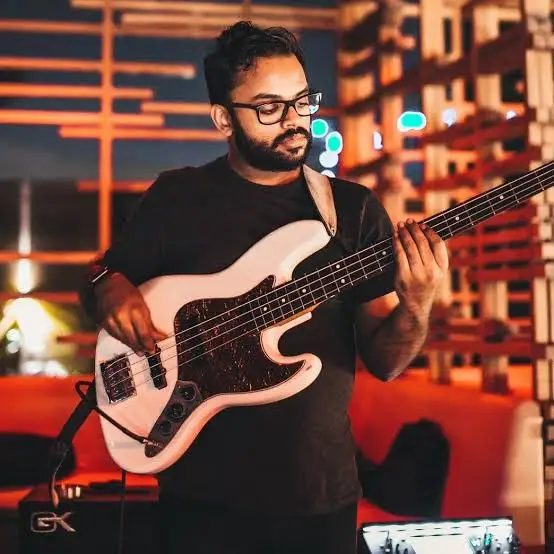
Anthony Muthurajah
Electric bassist. The Brand New Heavies, The Supremes, Jazz at Lincoln Center.
Anthony is a working electric bassist who has performed with The Brand New Heavies, The Supremes, and at Jazz at Lincoln Center. He plays regularly at Matthew Garrison's ShapeShifter Lab in Brooklyn alongside guitarists like Rez Abbasi, and is a fixture in the New York improvised-music scene.
His teaching reputation runs ahead of him. No Treble called him "one of the best teachers… definitely at the top in terms of the quality of your information." A podcast that interviewed him about his method named the episode "Complex Information In A Simple Format." That phrase has stuck because it is accurate: the course assumes you are an intelligent adult who can sit with one concept and turn it over until it makes sense, and it does the work of arranging the concepts in the order that has actually worked for his private students.
He did not arrive at this method through a conservatory pipeline. As he says in the course itself: he was "a very stubborn gospel musician and heavy metal musician that couldn't hear or know the difference between major seven and minor seven." Eighteen years of methodical practice later, this is what he wishes someone had handed him on day one.
- Performed with The Brand New Heavies
- Performed with The Supremes
- Performed at Jazz at Lincoln Center
- Resident performer, ShapeShifter Lab, Brooklyn
- Featured by No Treble for teaching quality
- 18+ years of practice and pedagogy
"I was a very stubborn gospel musician and heavy metal musician that couldn't hear or know the difference between major seven and minor seven. And here I am today recording this for you all. These concepts have been my bread and butter, not just as a player, but as a writer and producer. Spend time with this. I guarantee you you will see and hear and feel results."Anthony Muthurajah
One price. Own it forever.
$57one-time
- ✓25 HD video lessons (2h 25m)$197
- ✓Three-Note Cell Library PDF (7 pages)$29
- ✓Single-String Scale Charts PDF (7 pages)$29
- ✓Seventh-Chord Fingering Reference PDF (8 pages)$29
- ✓Two-Octave Arpeggio Diagrams PDF (8 pages)$29
- ✓Lifetime access + free updates$49
30-day money-back guarantee.
Try the whole course for 30 days. Watch every lesson, work the rudiments, run the guide-tone drills against a backing track, build a few three-note phrases. If it does not move your playing forward, email support and we will refund every dollar. No follow-up sales pitch. No "are you sure?" survey.
Things people ask before they buy.
Most bassists move either across the strings at one fret (vertical) or up and down one string (horizontal). The diagonal method trains you to move across the strings AND across the fretboard at the same time, so any line you can hear, you can play in the closest position, not the position you happened to start in.
Electric. Every demonstration is on electric bass, with focus on fretting-hand mechanics, position shifts, and picking-hand technique that apply specifically to the electric instrument. The harmonic content (guide tones, three-note cells, modal pairings) transfers to upright, but the technique chapters do not.
Intermediate. If you can hold time, read a basic chord chart, and play your major and minor scales in at least one position, you are ready. Total beginners should build a foundation first.
The video runtime is roughly 2 hours and 25 minutes. Working through the rudiments, arpeggios, and three-note cell drills at 20 minutes a day, most students internalize the method in 6 to 10 weeks. There is no clock: you own it forever.
Not required. Anthony demonstrates every concept on the fretboard and the materials include both tab and standard notation.
An electric bass and a way to hear yourself (amp or headphones). A metronome and a recording device are strongly recommended. Anthony makes recording yourself a core practice habit in the course's final module.
No. Anthony's own work spans R&B, funk, fusion, and gospel as much as jazz. The mechanics apply anywhere improvisation matters: wedding bands, function bands, fusion projects, gospel groups.
YouTube gives you topics. This gives you a sequence. Twenty-five lessons in the order Anthony's private students actually learn, with the materials and the drills attached. The difference is finishing versus spinning.
Forever. One purchase, lifetime access, all future updates included. No subscription, no auto-renewal.
Email support within 30 days of purchase for a full refund. The guarantee section above has the policy.
No. It's a one-time payment of $57, with lifetime access.
Still have questions? Email [email protected]
I have been recording and writing and producing music for almost two decades, and the longer I do it the more I am convinced that the gap between players is not talent. It is the order they learned things in, and how much time they spent with each one before adding the next.
This course is the order that worked for me. Rudiments first, because without them the harmony has nowhere to live. Then arpeggios, then guide tones over a blues, then scales, then the three-note cells I teach all my students, then rhythm. Each one sits on the one before it.
If you are stuck where I was stuck, knowing the line in your head but never quite getting it out of your hands, sit with this material the way I sat with it. Take your time. Record yourself. Practice the things you cannot do yet, not the things you already can.
I guarantee you you will see and hear and feel results. And if you do not, email support and we will give your money back, no follow-up sales pitch.
Until next time, peace.
Anthony Muthurajah
The Diagonal Method. $57. Yours forever.
$57
Get instant access30-day money-back guarantee. Email us within 30 days for a full refund.