An Advanced Thumb Position Method For Upright Bass
Play like a horn player in thumb position, once your thumb stops acting like an anchor.
Freedom of Movement · By Cole Davis
One payment · Lifetime access
Get Freedom of MovementPDF book · 44 pages · 15 etudes · 30-day money-back guarantee
You can already get into thumb position. The trouble starts once you're up there. Your thumb sits on the harmonic, you stay on the top two strings, and the melodies you hear won't fit under your hand. That's not a talent problem. Most great solos in jazz aren't playable in standard thumb position. This book is about the rest of it.
Why thumb position turns into the same three or four licks.
I'll start with an admission. Before I wrote this book, I played the same three or four licks in thumb position. I wasn't the only one, either.
“Most of us, including myself before writing this book, fall privy to playing the same 3 or 4 licks in thumb position.”
Here's how it usually goes. You climb past the octave. Your thumb lands on the harmonic and stays there like an anchor. You keep to the top two strings. You play whatever fits under your hand in that one spot. Then a melody you hear goes somewhere that spot can't reach, and you head back down.
It isn't your ears, and it isn't your hands. It's the way thumb position gets taught. I put it this way on page 2: “Many standard methods teach thumb position as one singular position, as opposed to a series of positions that allow for freedom of expression and movement.”
One position. One place for the thumb, on the harmonic. The standard 0-2-3 fingering. The G and D strings. That's the whole map, and it's a small one.
Here's the part nobody mentions when they hand you that map:
“Most great solos in jazz are not playable in standard thumb position.”
So if the music you hear won't fit up there, that was never your fault. The position you were given can't hold it.
And it isn't a vocabulary problem, so another pile of licks won't fix it. In the Freedom of Direction etude I wrote: “This isn't really an issue of vocabulary, it's an issue of finger independence: we simply do not have the same independence in our fingers that we have in the lower register.”
Down low, you already cross strings and stretch without thinking about it. Up top, that freedom disappears. Part of the reason is the way the thumb gets used.
In the standard position it's an anchor. It sits on the harmonic, and every other finger works around it. In my method it doesn't stay put.
“There are many more notes that can be reached with the thumb than one may think.”
So how does it move without you shifting all over the fingerboard? I got the answer from basketball. I use the thumb like a pivot foot: it lets the other fingers move, and then it follows them up the fingerboard.
Which finger stays planted, when the thumb follows, and how far it can travel before you'd have to shift: that's what the etudes are for. On the page it's a number over each note (0 for the thumb, then 1, 2 and 3). The walkthroughs take the key phrases one at a time and tell you why the fingering is there.
That's Freedom of Movement.
The first etude drops the standard fingering in bar 4.
Open to page 3. The Etude on “Miss Jones” starts on the standard fingering, 0-2-3. In the 4th bar my thumb plays the C#, and from there the fingerings go somewhere else.
“The standard fingering is 0-2-3, but I quickly leave that fingering to demonstrate how much more you can play with different fingerings.”
That's page 5. By page 38, in the Ultimate Scale Exercise, I've moved around almost all of thumb position without a single shift.
“With this exercise, we've covered almost every position in thumb position with zero shifting, only pivoting our way around the fingerboard!”
In between, there's a Keith Jarrett quote (page 8), an etude based on Eddie Gomez's solo on “Dolphin Dance” from Bill Evans's recording (page 13), and a line lifted straight from Coltrane's solo on the original “Moment's Notice” (page 22). Every one of them is written out with fingerings.
Get the thumb moving and the book shows you how to:
- ✓Use the thumb in every position of thumb position, not just on the harmonics
- ✓Swap thumb-1-2 and thumb-1-3 whenever the line calls for it
- ✓Cross strings to reach wider intervals, the way you do in the lower positions
- ✓Play 4ths up there, on a bass that's tuned in them
- ✓Play like a horn player, or play violin-like passages, in the upper register
One honest thing: this book is advanced.
I say so myself on page 8. If you're new to thumb position, there's an easier place to start, and it's further down this page.
Two real pages. Judge them before you buy.
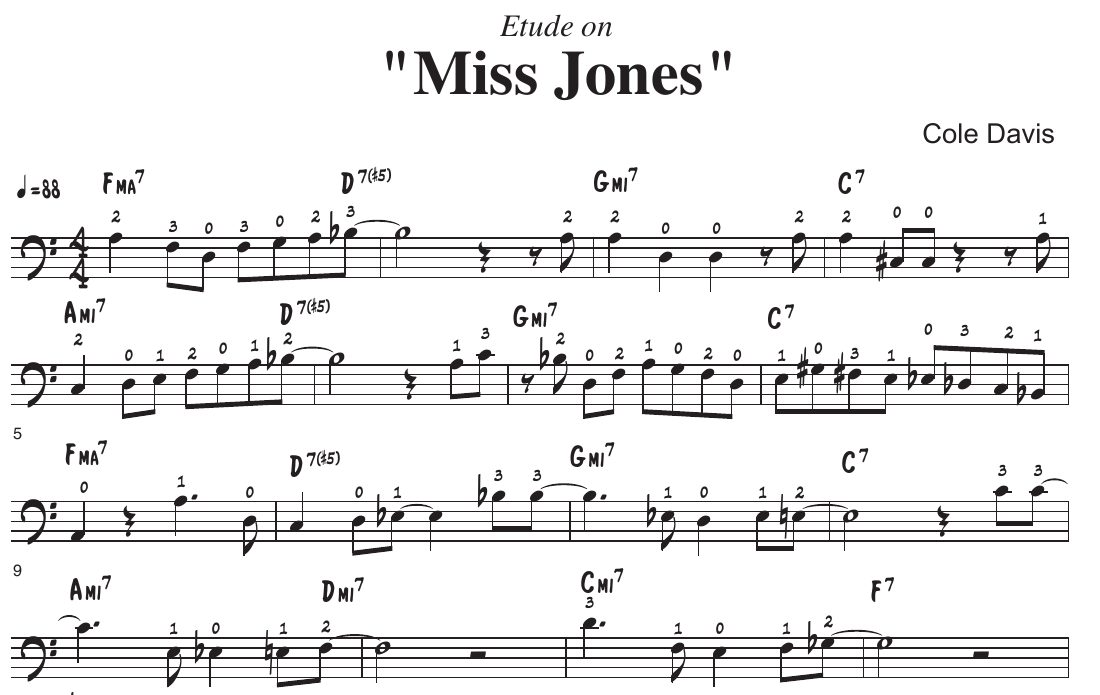
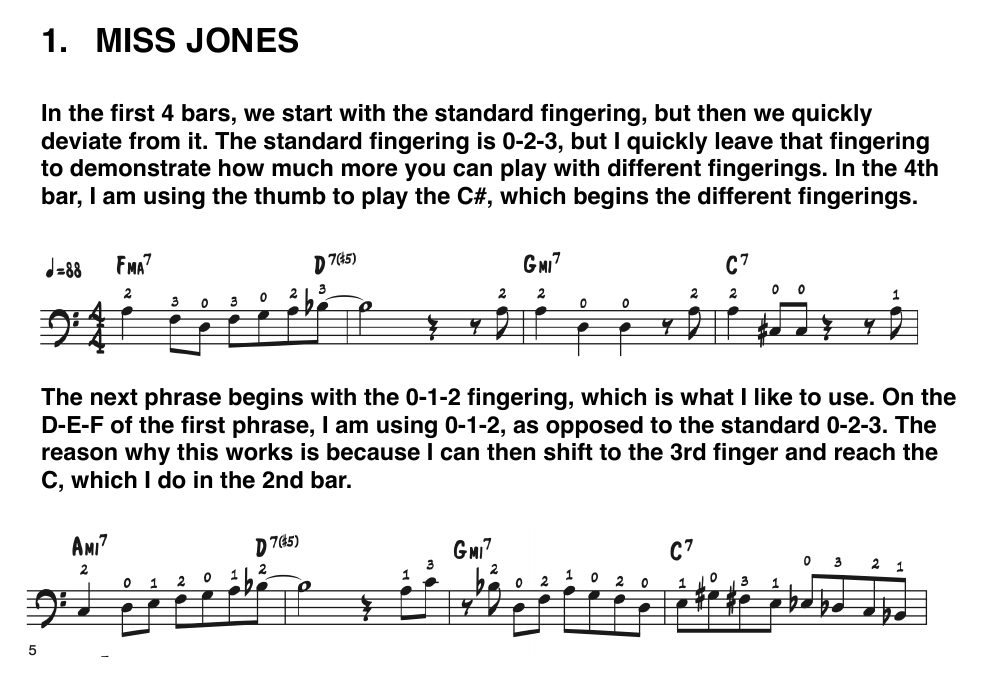
Every etude in the book follows that pattern: the full etude with fingerings, then my walkthrough of its key phrases.
Fifteen etudes. A written walkthrough for every one.
Each etude is printed in full with fingerings. Then I walk you through its key phrases, and every phrase is reprinted with its bar numbers so you can find it in the etude.
Eight etudes on jazz standards
- 1“Miss Jones”Opens on the standard fingering and leaves it in the 4th bar. (Then a phrase I designed for the independence of all the fingers.)
- 2“All The Things”A 4th between the thumb and the 3rd finger, and a chord I change on purpose. (It's a direct quote from a Keith Jarrett live recording.)
- 3“Stella”A phrase that shows what the standard position can still do. (Then a 3-2 fingering for a major 2nd that I say you can make even with small hands.)
- 4“Dolphin Dance”Based on Eddie Gomez's solo from Bill Evans's recording, on the album “I Will Say Goodbye.” (In bar 10 I move up the fingerboard without shifting.)
- 5“Inner Urge”Some completely different fingerings, and the line that introduces 4ths in thumb position. (Plus one shape I pivot around the whole position.)
- 6“Stablemates”Pivoting and all four strings at the same time, in the second chorus. (“If you can play this, you're well on your way to mastering thumb position!”)
- 7“Moment's Notice”One of the hardest chord progressions in jazz, and the furthest I move the thumb in the whole book. (There's a Coltrane quote in there, too.)
- 8Time to Burn: “Cherokee Challenge”It has the simplest fingerings, because it's meant to be played as fast as possible. (Page 25 says why it's built the way it is.)
Seven technique etudes
- #1Changing of the 2nd and 3rd FingerThe same notes with two different fingers, which goes against the Old Simandl method. (Then the inverse: one finger for different notes.)
- #2“The Pivot Finger”The basketball idea that first shaped my technique in thumb position. (I also name the best pivot finger, and why it's the best.)
- #3“Freedom of Direction”6ths and 7ths across the strings, just like you'd play them down low. (Including a minor 6th between the 2nd finger and the thumb.)
- #4G# 3rd Finger D StringOne note that connects the standard position to the rest of thumb position. (And a phrase where the thumb works like a capo.)
- #5The Ultimate Scale ExerciseUp to the high F and back to where you started, without a single shift. (Page 38 explains why this one scale matters so much.)
- #6“Complete Flexibility”An unusual fingering that brings the thumb around to the G harmonic. (Then a jump off the D harmonic, and yes, I say you can make it.)
- #7“Sideways”All the different ways of tackling 4ths in thumb position. (The name tells you what your hand has to do.)
A few things waiting on those pages:
- ✓The note on the D string I grab with the 3rd finger for a substitution over the D7 in Miss Jones. (Page 5, bar 33, where I take the first phrase's idea across all four strings.)
- ✓The half step between the thumb and 3rd finger that you can play no matter how small your hands are. (It's pretty much the shape you make when you hold your phone. Page 5.)
- ✓How to play a 4th between the thumb and the 3rd finger. (I call it “totally doable regardless of how small your hands are.” Page 8.)
- ✓Where the thumb goes to keep a bebop line moving in All the Things. (It isn't where the standard method parks it, and the line resolves right into the next chord. Page 8 names the note.)
- ✓Why I play a major 2nd with just two fingers. (It isn't about the 2nd. It's about what the other fingers get to do. Page 13.)
- ✓The move that tucks the 2nd finger under the thumb and puts you back in the “standard” position. (For when you want to be there. Page 13.)
- ✓Two ways to finger a 4th in thumb position. (The bass is tuned in 4ths, so as I put it, “it is not the easiest.” Page 16 shows both.)
- ✓The stretch in Stablemates from the Db on the A string to the G harmonic, 3rd finger to thumb. (Page 19 has it, along with what I say is even more important to learn than the finger combinations on each string.)
- ✓Why a “0-0” fingering isn't a typo. (It might seem weird. Page 19 shows why it's natural.)
- ✓The furthest I move the thumb in the whole book. (It's at the start of a half-chorus in Moment's Notice. Page 22 names the note.)
- ✓The bar in Moment's Notice that comes straight from Coltrane's solo on the original recording. (Page 22 tells you which one.)
- ✓Part of the reason we struggle to play fast in thumb position. (Page 25 names it, and the Cherokee Challenge is built around it.)
- ✓How to play the same notes with two different fingers, “contrary to what is taught in the Old Simandl method.” (Page 28.)
- ✓The best pivot finger, and the two things it frees up at once. (Page 30.)
- ✓How far the thumb can move while your 1st finger holds its place. (Farther than you'd think. Page 30 gives the distance.)
- ✓The stretch that feels “harder” in thumb position but isn't. (We use stretches like it all the time down low. Page 33 shows you the fingering.)
- ✓How to use the thumb as a capo. (Page 36 names the exact line of notes it sits on.)
- ✓The one scale that, once you can play it in thumb position without a shift, effectively gets you around the whole position by pivoting alone. (The etude on page 37 takes it up to the high F.)
- ✓A phrase that uses every finger as an anchor, so you're not leaning on the thumb. (Page 41 says what that does for your fingers.)
- ✓Why 4ths get even harder in thumb position. (There's something your left hand can't do up there. Page 44 names it.)
The book opens in your Better Bass Lessons member area. Read it right there in your browser, or download the PDF and keep it wherever you practice from.
Built for the bassist who gets up there and runs out of places to go.
✓This is for you if…
- You play upright, and you can already get into thumb position
- Your thumb sits on the harmonic like an anchor
- You mostly stay on the top two strings up there
- You keep playing the same three or four licks in thumb position
- The melodies and solos you hear won't fit under your hand up there
- 4ths and wide intervals feel out of reach above the octave
- You'd rather work from the page, with every fingering written out and the key phrases explained
×This isn't for…
- Anyone new to thumb position. Start with the video course below.
- Electric-only players. This is a method for the upright bass.
- Anyone who wants video, audio, tab or backing tracks. This is a PDF of notation and my written explanations.
- Anyone who doesn't read bass clef yet. Everything is in notation.
- Anyone who wants to stay in the standard fingering. The first etude leaves it by bar 4.
- Anyone who wants it easy. I'll say it myself: this book is advanced.
If the second list sounds like you, skip this one. If the first does, keep reading.
Start with Understanding Thumb Position. I point readers to it twice in this book, because it's the easier place to begin. It started as a book, and on this site it's now my video course on the basics. Get comfortable up there first. This book will be here when you're ready for it.
One payment. $47. Lifetime access.
Freedom of Movement is $47, one time. No subscription. That's all 15 etudes and every walkthrough, 44 pages, and it stays in your Better Bass Lessons member area for good.
Why $47? Because it's a book, not a video course, so it costs less than my video course does. Work it out per etude and it's just over $3 each, walkthrough included.
And the walkthroughs are a big part of what's new in this edition. I wrote the original when I was 23. Later I realized it left many questions unanswered, so in this edition I made more of a point to explain each exercise.
One payment · Lifetime access · 30-day money-back guarantee
You can move freely up there, even if…
- ✓Even if your hands are small. About the half step between the thumb and 3rd finger, I wrote: “No matter how small your hands are, you can do this!” I say it more than once in this book.
- ✓Even if you've only ever played the top two strings up there. That's the usual way. Etude after etude uses all four strings.
- ✓Even if you learned thumb position the Simandl way. The hand's capable of much more up there than the Simandl book suggests. Etude #1 does something contrary to what the Old Simandl method teaches.
- ✓Even if you keep playing the same three or four licks. So did I, before I wrote this book.
- ✓Even if 4ths feel impossible above the octave. They're one of the hardest things to play on a bass tuned in 4ths. That's why a whole etude, Sideways, covers them.
- ✓Even if you're not a fast player. To me, complete flexibility in thumb position isn't about playing fast.
- ✓Even if stretches feel “harder” up there. We make stretches like them all the time down low.
“It's really not harder, it's just sideways!”
Freedom of Movement, page 33
Get your thumb off the anchor.
Four things I'd rather you hear from me now.
“Note: I am playing the Abma7 as an Ab7, just for fun. This is actually a direct quote from a Keith Jarrett live recording of this tune. (Yes, this book is advanced.)”
“This whole etude is challenging, but a great way to develop dexterity!”
“I realized that there were many questions unanswered in this book, so I made more of a point to explain each exercise in this edition”
“I cover this exercise more in depth in my book ‘Understanding Thumb Position’ which is a far easier book explaining the basics of thumb position.”
Why I play it this way.

I'm Cole Davis. I studied with Ron Carter, and I earned my Artist Diploma at Juilliard.
I wrote the first Freedom of Movement when I was 23. In this updated edition I spell out the mission on page 2: “My mission with this book is to evolve the standard technique of thumb position.”
The pivot idea came from basketball. I watch a lot of basketball, and the pivot foot is actually what first influenced my technique in thumb position.
In the book I thank Francois Rabbath for developing a method that inspired this one, and Eddie Gomez and John Patitucci for showing me the breadth of possibilities the upper register has to offer.
Here's what I believe about the top of the bass. The same way the hand can cover a lot of notes in the lower positions, it's capable of much more in thumb position than the Simandl book suggests. My goal is for you to use the upper register to express what you're hearing and feeling.
Questions before you buy.
Your thumb's been an anchor long enough.
Let it move.
Fifteen etudes, and a written walkthrough for every one. Which finger stays planted and when the thumb follows is all in the book.
$47 one time
44-page PDF · 15 etudes · Lifetime access
Here's everything you get.
One payment · Lifetime access · 30-day money-back guarantee
Get The Book: $47P.S. Here's a test you can run before you decide. Put your thumb on the G harmonic and improvise over a tune you know. Then count how many different ideas you played up there. If it's the same three or four licks, you're where I was before I wrote this book. The Freedom of Direction etude aims to fix exactly that.

Freedom of Movement
$17.00
Quantity