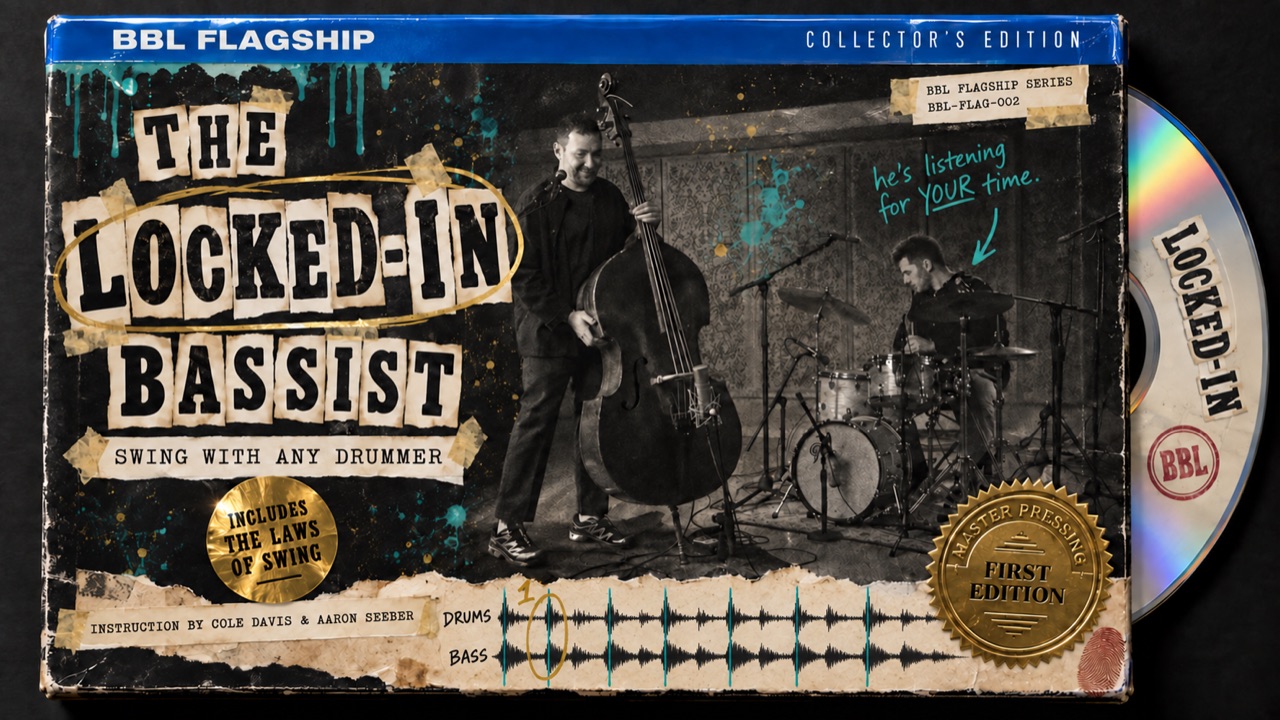
There are two kinds of time. You've been practicing the borrowed kind.
It sounds great with a metronome. It sounds great with a play-along. Then a real drummer counts off, throws one fill across the bar line, and the one is gone for eight bars. This is how you stop following him, from the bass chair and the drum chair.
$77 · one-time · instant access · 14-day guarantee
Here's what you've been told.
"Follow the drummer."
"Just play to a click."
"Lock in with the kick drum."
"Figure out how far behind the beat you're supposed to sit." And maybe you've tried all of it.
You talk to the drummer, and nothing changes. You go with him when he pushes, and the tune ends twice as fast as it started. You hold steady, and somebody asks why you're dragging.
The closer you follow the drummer, the faster your time falls apart.
When I was coming up, I was the bass player who lost the one. A drummer would throw a fill, I'd look up, and it'd take me four, eight, sometimes sixteen bars to find the time again.
So I did what almost every bass player does.
I blamed the drummer.
It took me years to figure out he wasn't the problem. I was following him.
Think about how you practice. A metronome. A backing track. A play-along. What do they all have in common?
They never move.
So you learn to follow them. And following works perfectly, right up until the thing you're following is a person who pushes, drags and throws fills across the bar line.
Your time sounds great in the practice room and falls apart the second a real drummer counts off. It was never yours. It was borrowed.
That's not a talent problem. Every hour you ever practiced came with something steady to lean on. Nobody told you the steady thing was supposed to be you.
"To me, the time comes from the bass player."
The drummer isn't keeping the time. He's listening for yours.
I made this course with Aaron Seeber. He's recorded with Peter Washington and played with Buster Williams and David "Happy" Williams.
But that's not the important part. This is:
When Aaron gets called for a gig with a bass player he doesn't like playing with, he'll very often turn it down. In his words, because "the time itself wasn't good."
Every drummer you've ever sat in with gets to make that same call. Most of them will never tell you they made it.
So what's he listening for?
When you follow him, nobody's keeping the time. You're both waiting on each other, and the tune drifts.
And when you hold it? A good drummer does something most bass players never expect.
He follows you.
Ask Aaron what he does when the bass player drags and he'll tell you: "Honestly, I just follow."
So we broke it on purpose.
There's one thing no metronome, no backing track and no walking course can teach you, including mine: what to do when the time's coming from a person who moves. So Aaron and I did something you don't see in bass courses.
- He threw fill after fill across a blues, far more than he'd ever play on a gig.I stayed put, and the time didn't move.
- I dragged on purpose to see what he'd do.He came with me, and it still felt good.
- Then he fought me instead.You'll hear exactly how bad that gets.
- Then he wandered all over the time.I took charge and pulled it back.
You watch every one of those moments go wrong and then get fixed, from the bass chair and the drum chair. It's filmed in the studio, so you see and hear every detail.
Aaron buries a blues in fills. Watch what happens to the time.
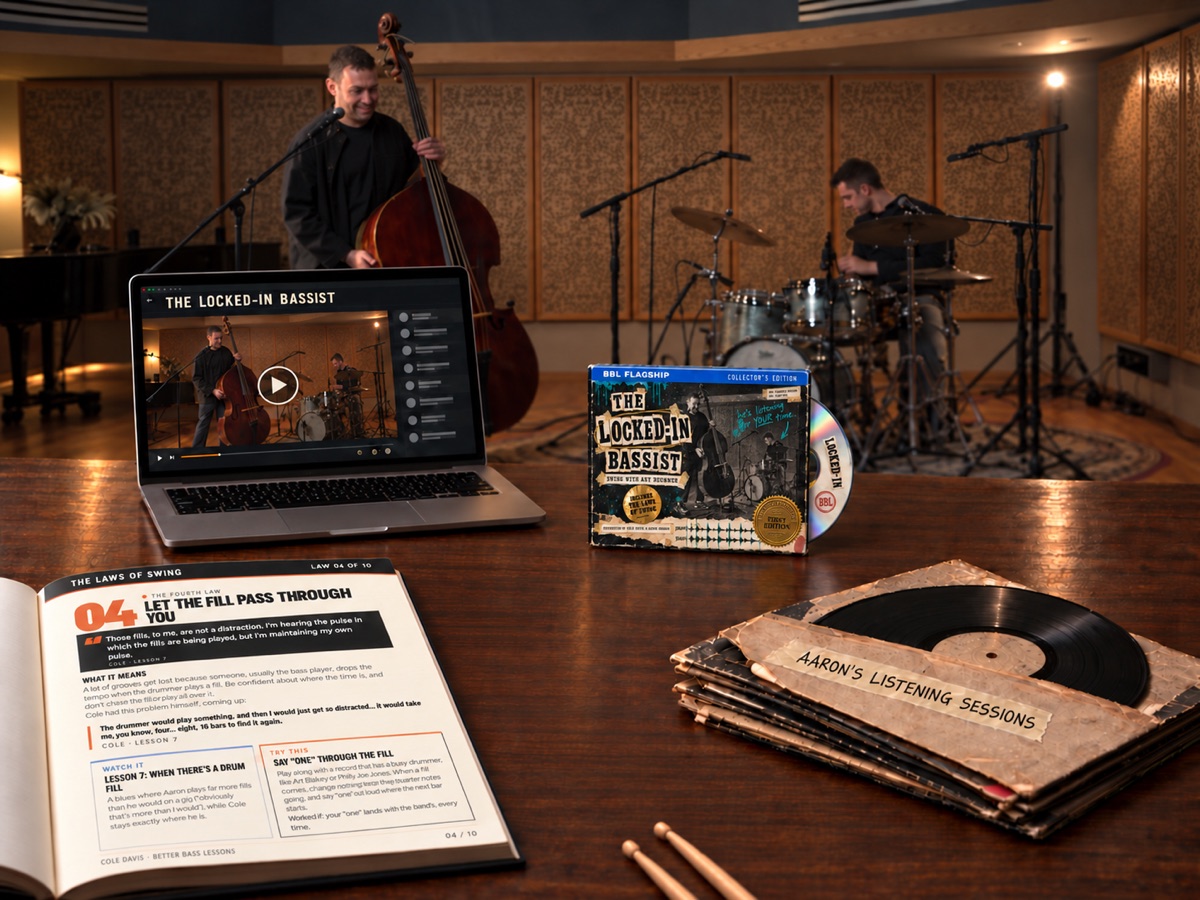
Lesson 7, complete. 4:02. You're two choruses into a blues at a jam. The drummer drops a press roll into bar 12 and lands a hair late. Most bass players look up, chase the fill, and spend the next eight bars hunting for the one. After this lesson you'll do the opposite, and the band will land on your one.
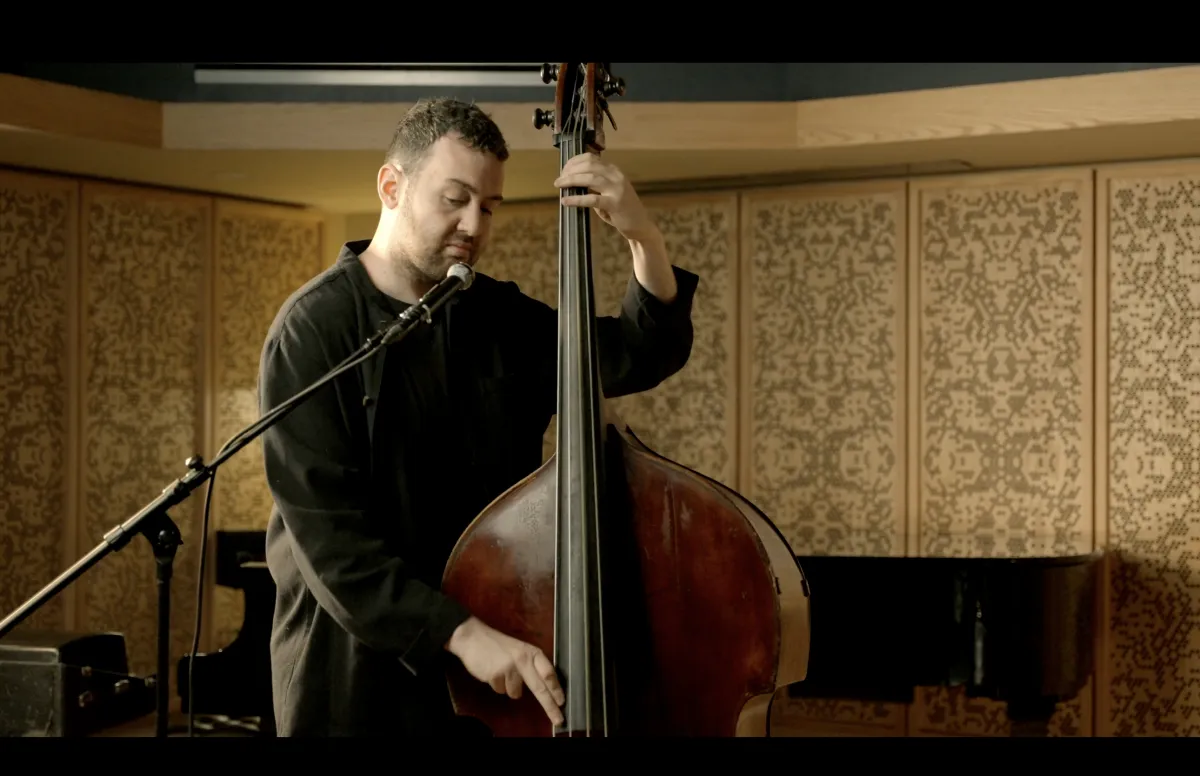
Cole Davis & Aaron Seeber
Bass chair · drum chair · same room
I've won the Ron Carter Bass Competition, I've been named an NEA Future Jazz Master, and I play bass for Lambchop. I'm not telling you that to impress you. I'm telling you because for years, none of it stopped a drum fill from costing me the one.
What finally fixed it wasn't another drill. It was taking responsibility for the time instead of handing it to the drummer.
You can't learn that from a bass player alone, though. You need to hear what the drummer's actually doing to you, in his own words, while it's happening. That's why Aaron's in every lesson. He tells you what he hears while I play, and sometimes we disagree on camera.
- Cole: Ron Carter Bass Competition winner
- Cole: NEA Future Jazz Master
- Cole: Bassist, Lambchop
- Cole: Studied with Ron Carter
- Aaron: Recorded with Peter Washington
- Aaron: Played with Buster Williams
- Aaron: Played with David "Happy" Williams
- Filmed in the studio, both chairs
Even if you don't have a drummer.
Even if you've got nobody to play with. Part Four is the records. You'll practice this with records you already own: who to lock in with, and why following the soloist throws you off. The records become your rhythm section.
Even if you play electric. I play upright in the clips, but time doesn't care what you're holding. Nothing in the course is upright-only.
Even if your time's already solid with a metronome. Keep practicing with it. The metronome builds your time. This is about why that time disappears the second a real drummer pushes, drags or plays a fill, and what to do in the next bar.
Even if you already own Bulletproof Time or Pocket Drills. Those are the practice-room side, drills you do alone. This is what happens when the drummer's a person instead of a click. It's the part a drill can't give you, because a drill never pushes back.
Even if most of your gigs are quiet ones. Weddings, singers, cocktail hours where the drummer plays brushes all night and never picks up sticks. That's where time gets tested hardest, and there's a whole part of the course on it.
A small taste of what you'll discover.
- ✓The 2-minute test that tells you whether your time is really yours, or borrowed.No metronome, no drummer, no track. My rule: if it doesn't feel good to you, it won't feel good to anyone else.
- ✓What to do in the very next bar when the drummer throws a fill across the bar line.This one mistake used to cost me sixteen bars at a time.
- ✓Why "how far behind the beat should I be?" is the wrong question.Ray Brown and Paul Chambers sat in different places and both swung like crazy. Here's what they had in common instead.
- ✓What to do the moment the drummer starts to drag.Holding steady isn't enough. Here's what actually pulls the band back to you.
- ✓The non-musical move that fixes time problems "90 to 95 percent of the time."It starts before you play a single note. Bandleaders say their favorite rhythm sections do it.
- ✓The simple trick a great drummer taught Aaron for the nights nothing's locking in.It sounds silly. Aaron says it's worked for him a lot of the time.
- ✓How to stay in the pocket once you find it, by thinking the way Billy Hart does.Hint: it has nothing to do with the bar you're in.
- ✓Why a plain two-feel under brushes "doesn't sound like anything."And the three rhythms that make it swing. Perfect for the singer gigs where the drummer never picks up sticks.
- ✓The Art Blakey trick for swinging a tune in 3/4.He played the ride cymbal in four. Here's why it works, and what your line does underneath it.
- ✓The Charlie Parker record that throws off almost every student who plays along with it.If you've ever felt lost playing along with Bird, it isn't your time. You're following the wrong person.
- ✓The controversial rule a lot of jazz drummers were taught about a dragging bass player.Hal Galper taught it to Aaron. If your time ever drifts, you need to know it.
- ✓Why Sam Jones sounded like Sam Jones no matter which drummer was behind him.And how to get that same quality into your own time.
Here's everything inside, part by part.
Four parts · filmed in the studio · Cole on bass, Aaron on drums
- 01What It Means to "Lock In"
- 02How to Find the Pocket
- 03The Different Sides of the Beat
- 04Drummer's Perspective: Playing With the Greats
- 05How Drummers Adjust to Bass Players
- 06How Bass Players Adapt to Drummers
- 07What to Do When There's a Drum FillFree4:02
- 08What to Do When It's Not Locking In
- 09How Bass Players and Drummers Solve Problems Differently
- 10What to Do When You Find the Pocket
- 11Two-Feel: How Bass Players Swing in Two
- 12Two-Feel: What Drummers Want From Bass Players
- 13Interaction Between Bass and Drums in a Two-Feel
- 14Locking In Without Sticks or Cymbals
- 15Playing in 3/4 (Part 1)
- 16Playing in 3/4 (Part 2)
- RECThe Records: How Bass Players Respond to Different Drummers
- RECThe Records: How Bass Players Should Play Along to Records
- RECThe Records: Leroy Vinnegar
Plus The Laws of Swing PDF · ten laws, a page each, one thing to try this week
The first time Aaron recorded with Peter Washington, he said it felt "like I was sitting in a luxury car and the car was just driving itself."
Everything you need to take it to a gig.
- The Locked-In Bassist: Swing With Any DrummerEvery lesson in all four parts, filmed in the studio from the bass chair and the drum chair
- The Records play-alongsHow to practice taking charge of the time at home, with no drummer in the room
- The Laws of Swing PDFAll ten laws on a page each, with one thing to try this week. Print the one that bugs you most and put it on your music stand.
- 14 days to try it on a gigIf your time doesn't feel better under your hands, you get every penny back
This is not for you if…
- You can't walk a chorus of blues yet. I never explain how to build a walking line, and it won't teach you a single new note. It assumes you've got a line to hold the time with. Start with Walking Basslines From The Beginning and come back when your lines hold up.
- You're looking for licks. There aren't any. This is about where the time comes from, not what notes you play over it.
- You'd rather not know. Once you hear it, you can't unhear it. You'll notice it at every jam: the bass player chasing the drummer, the tune drifting, the drummer glancing over. You'll never be that bass player again, but you'll never stop hearing it either.
Still here? Good. Upright or electric, this was made for you.
It took me years of lost bars. You can have it this afternoon.
$77one-time · instant access
- ✓The Locked-In Bassist, all four partsCore
- ✓The Records play-alongsIncluded
- ✓The Laws of Swing PDFIncluded
- ✓Aaron in every lesson, from the drum chairIncluded
- ✓14 days to try it on a gigGuarantee
Take it to a gig. If it doesn't work, I'll buy it back.
Before you watch Lesson 1, record yourself walking one chorus alone. No metronome, no track. Record another after Lesson 10. Then take it to your next jam or gig.
Either you feel the difference on the bandstand, or you don't pay a penny. If it doesn't feel better, email me within 14 days of buying and I'll refund every penny.
Two kinds of bass players.
The one who follows
Sounds great with a metronome. Looks up at the first fill. Spends the next eight bars hunting for the one, and blames the drummer on the drive home.
The one he calls back
The fill comes across the bar line and he doesn't flinch. The drummer lands on his one. Halfway through the set the drummer hasn't looked over once. He doesn't have to.
It isn't talent. It isn't how many records you've transcribed. It's who the time comes from.
Questions before you buy.
Both. I play upright in the clips, but it's about time, feel and the rhythm section, not fingerings. Nothing in the course is upright-only.
Yes. The Records play-alongs show you how to practice this with the records you already own: who to lock in with, and why following the soloist throws you off. The records become your rhythm section.
Keep practicing with it. The metronome builds your own time. This course is about why that time disappears the second a real drummer pushes, drags or plays a fill, and what to do in the next bar.
No. Those are drills you do alone. The Locked-In Bassist is what happens with a real drummer: the fills, the drags, the nights it won't lock in, from both chairs.
If you can't walk a chorus of blues yet, not on its own. It won't teach you a single new note, and it assumes you've got a line to hold the time with. Learn to walk first with Walking Basslines From The Beginning, then come back and learn to lock in.
You've got 14 days. Try it on your next gig. If it doesn't feel better, email [email protected] within 14 days of buying and I'll refund every penny.
Reply to any email I send. I read them.
More questions? Email support
At every level, right up to the professional New York City level, you'll run into a drummer and a bass player who aren't locking in. It's going to happen to you. The only question is whether you know what to do when it does.
Everything up to now wasn't your fault. You practiced with things that never move, so you learned to follow, and nobody ever told you the time was supposed to come from you.
Now you know. From here, it's a choice.
Hold the time,
Cole
P.S. Here's a test you can do tonight, and it costs nothing. Walk one chorus of a blues by yourself. No metronome, no play-along, no drummer. When you're done, ask yourself one question: did that feel good? If it doesn't feel good to you, it won't feel good to anyone else. Most bass players find out how much of their time was borrowed from the click. This is how you make it yours.
P.P.S. Lesson 7, the one on drum fills, is free on this page. It's four minutes long. If you've ever looked up at a fill and looked back down to find the one gone, watch it before you decide anything.
Every drummer decides whether to call you back.
$77
Get instant access14-day guarantee · Instant access · Upright or electric