A PDF Packet For Upright Bass
Play 13ths, #11s and altered dominant arpeggios on upright without a single shift.
Scales and Arpeggios · By Cole Davis
One payment · Lifetime access
Get Scales and ArpeggiosPDF packet · 14 pages · 30-day money-back guarantee
A lot of upright players leave the 13ths, the #11s and the altered notes alone. Part of what stops them isn't the theory. It's all the shifting it takes to get there. These are the scales and arpeggios I warm up with every day, fingered so there's no shifting at all.
It's not the chord. It's the shifting.
I'll start with the honest part. There's no new theory in this packet. A major 13 #11 is the same chord it's always been, and a C major scale is still a C major scale. What you get is a 14-page packet: a one-page introduction from me, then 12 pages of notation with the fingering written over the notes. No video. No audio. No tab.
So why would you want it?
Because of the fingerings.
If you play upright, there's a good chance the 13ths, the #11s and the altered dominants are the notes you leave alone. You know what they are. You could spell the chord for me. But on upright, getting to them usually means a shift, and then another one.
I wrote about it in the introduction to the packet:
“Part of the reason a lot of us upright bass players tend to shy away from extended harmony is because of all the shifting that is often involved.”
A lot of us. That's the enemy this packet goes after. Not the chord. The shifting.
And that isn't on you. If the fingerings you learned were built around shifting, the extensions were always going to feel like hard work. That's a fingering problem, and you can't fix a fingering problem by practicing the same fingering harder.
So I re-fingered all of it. The major scales, the minor scales, the arpeggios and the extensions. Most of them lean on something that's been on your bass the whole time.
The open strings.
“With these scales and arpeggios, there is no shifting; just practical use of the open strings so you can move around the bass more freely.”
Which open string, on which note, in which key? That's what the 14 pages are for, and I'm not going to write it out here. It's in the packet, with the fingering over the notes and the string or position written under them.
It's the follow-up to The New Simandl. Same idea, in the form of scales and arpeggios, and like The New Simandl, it'll get you moving all over the bass. (If you haven't worked through The New Simandl, start there.)
Get these under your hand and you can:
- ✓Play the #11, the 13 and the altered notes as arpeggios instead of leaving them alone
- ✓Run all 12 major and all 12 minor scales from the low register up the neck, most of them into thumb position, without a shift
- ✓Take each dominant extension on its own, one page at a time
- ✓Move around the bass more freely
One honest thing: there's no explanation next to each exercise.
There's a one-page introduction from me, then the notation. The fingerings do the talking.
See the pages before you buy.
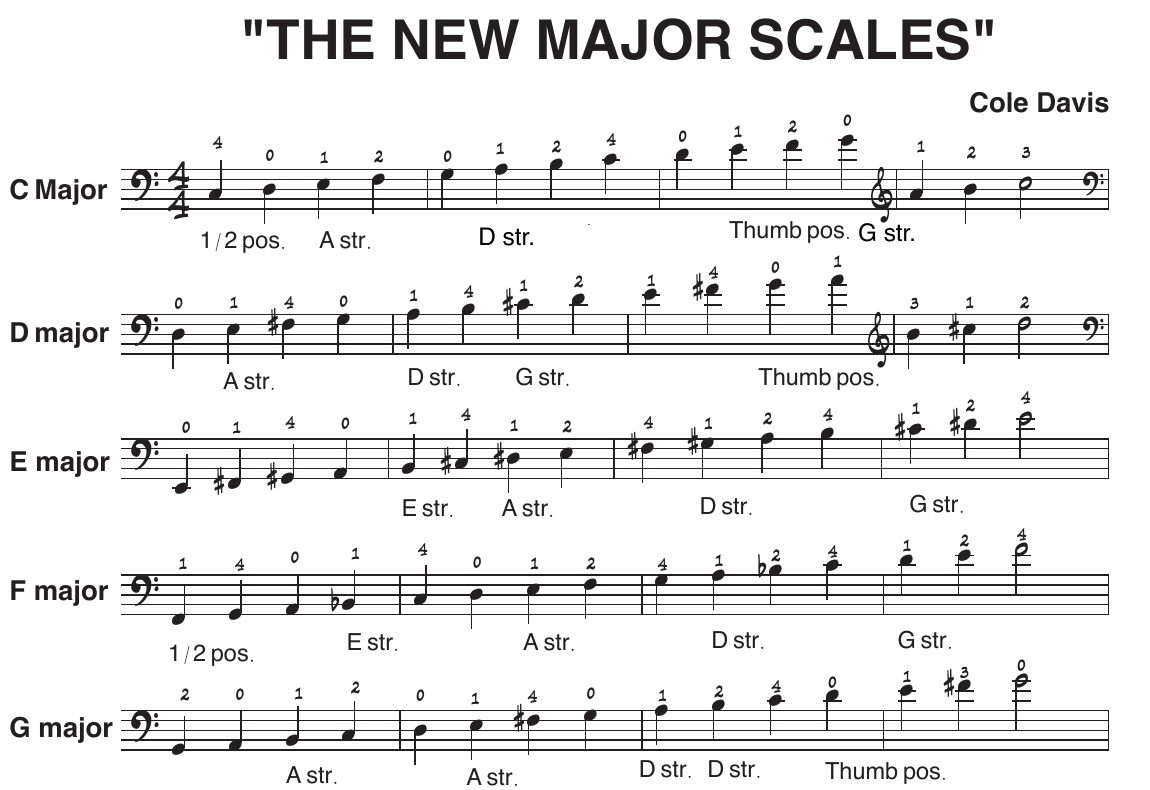
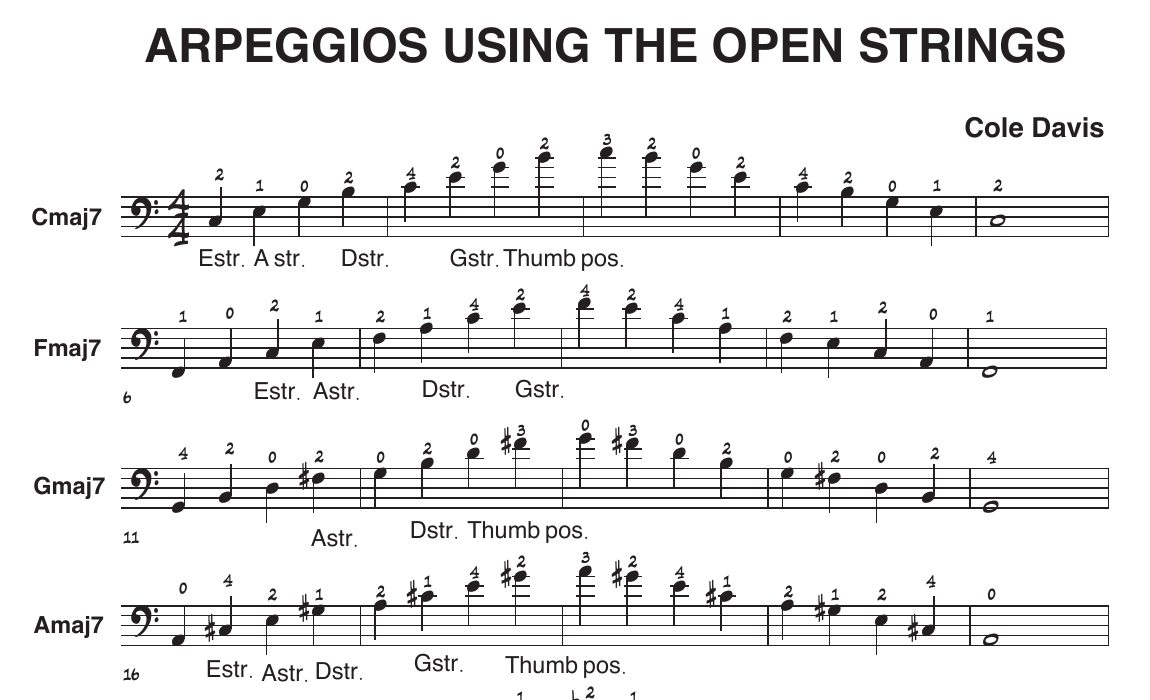
Those are real pages, not mockups. The whole packet looks like that: notation, fingerings and string markings.
What's on all 14 pages.
- Page 2My introductionOne page on why the packet's built the way it is.
- Pages 3-4The New Major ScalesAll 12 keys: C, D, E, F, G, A, B, Bb, Db, Eb, Gb and Ab.
- Pages 5-6The New Minor ScalesAll 12 keys: C, D, E, F, G, A, B, Bb, C#, Eb, F# and Ab.
- Pages 7-8Arpeggios Using the Open StringsCmaj7, Fmaj7, Gmaj7, Amaj7 and Bbmaj7. Cmin7, Dmin7, Emin7, Gmin7, Amin7 and Bmin7. Up and back down.
- Page 9Major 13 #119 keys: F, Gb, G, Ab, A, Bb, B, C and Db.
- Page 10Minor 1310 keys: F, F#, G, Ab, A, Bb, B, C, C# and D.
- Page 11Dominant 7 #1110 keys, F up to D.
- Page 12Dominant 7 b910 keys, F up to D.
- Page 13Dominant 7 #510 keys, F up to D.
- Page 14Dominant 7 #910 keys, F up to D.
Page numbers are the PDF's page numbers, counting the cover as page 1.
A few things you'll find in there:
- ✓The scales and arpeggios I warm up with every day, and the foundation for my improvisational ideas. (Nothing on these pages is there for show. It's what I play.)
- ✓A C major scale on page 3 that starts in half position and finishes in thumb position, up in treble clef, without shifting the way I describe it in the introduction. (The zeros over the notes are your first clue.)
- ✓The E major scale on page 3, which starts on your open E string and uses all four strings on the way up. (The strings are marked under the staff. Watch where the open A falls.)
- ✓Why I don't think in modes, even though several of my students do. (I've got no problem with modes. I just prefer to deal with something else, and page 2 tells you what.)
- ✓Dmin7 on page 7, the one open-string arpeggio that climbs high enough to switch into treble clef. (It's only for a few notes. Then it's back in bass clef on the way down.)
- ✓The Major 13 #11 page: nine keys, F up to Db, every arpeggio up and back down. (If the #11 is the note you've been leaving alone, page 9 is the one to open first.)
- ✓Why the dominant arpeggios get four pages and the major and minor ones get one page each. (The answer's on page 2. Thelonious Monk is part of it.)
- ✓The #11, b9, #5 and #9 dominant arpeggios, each extension on its own page, pages 11 to 14. (Page 2 says why I'd rather take them one at a time than learn the scale that holds them all.)
Built for the upright player who leaves the #11 alone.
✓This is for you if…
- You play upright and skip the 13ths, #11s and altered notes because of the shifting it takes to reach them
- You'd rather see the extensions as arpeggios than work them out from modes
- You want the scales and arpeggios I actually warm up with every day
- You've worked through The New Simandl and want the scales and arpeggios that follow it
- You want all 12 major and all 12 minor scales fingered from the low register up the neck
- You read bass clef and want the fingering written over the notes
×This isn't for…
- Electric-only players. It's fingered for upright.
- Anyone who wants video or audio. It's a 14-page PDF.
- Anyone who doesn't read notation. There's no tab.
- Anyone after a theory course. There's a one-page introduction, and the rest is notation.
- Anyone who needs every extended arpeggio in all 12 keys. Those sets cover 9 or 10 keys each.
If the second list sounds like you, skip this one. If the first does, keep reading.
One payment. $19.95. Lifetime access.
Scales and Arpeggios is $19.95, one time. No subscription. That's all 14 pages, and it stays in your Better Bass Lessons member area for good. Read it in the browser or download the PDF.
Why $19.95? Because it's a PDF. There's nothing to watch. It's the scales and arpeggios I warm up with, written down and fingered, and it's priced like what it is.
One payment · Lifetime access · 30-day money-back guarantee
You can get to the extensions, even if…
- ✓Even if you've always played the root and the third and moved on. The extensions are written out as arpeggios, one set per page.
- ✓Even if you don't think in modes. Neither do I, and page 2 says what I use instead.
- ✓Even if treble clef isn't your thing. It's only the top notes of some of the scales, plus a few notes of one arpeggio. Everything else is in bass clef.
- ✓Even if the altered dominants look like a wall of accidentals. Each extension gets its own page: #11, b9, #5 and #9.
- ✓Even if you think of the open strings as notes to avoid. In this packet, they're how you get around.
“The purpose of this packet is not only to simplify the harmonic information, but to show how these scales and arpeggios can be played without shifting.”
Page 2
Four things from my introduction, word for word.
“In this PDF are the scales and arpeggios that I use to warm up every day, as well as the foundation for my improvisational ideas.”
“You'll notice that I don't really think in terms of modes (although several of my students do).”
“In the Dominant Arpeggios, I deal with each extension separately. Each page of Dominant Arpeggios is dedicated to a different extension (#11, b9, #5, #9 respectively).”
“My line is always open for comments, questions, or feedback.”
Why I finger it this way.

I'm Cole Davis. I studied with Ron Carter, and I earned my Artist Diploma at Juilliard.
What's in this packet is what I actually play: the scales and arpeggios I use to warm up every day, and the foundation for my improvisational ideas.
I wrote it down with two goals. To simplify the harmonic information, and to show how all of it can be played without shifting. That's why the extensions are written out as arpeggios, and why the fingerings lean on the open strings.
It picks up where The New Simandl leaves off. Same idea, now in scales and arpeggios.
Questions before you buy.
Get the extensions under your hand.
Without the shifting.
The scales and arpeggios I warm up with every day, fingered around the open strings. The how is on the page, over every note.
$19.95 one time
PDF packet · 14 pages · Lifetime access
Here's everything you get.
One payment · Lifetime access · 30-day money-back guarantee
Get The Packet: $19.95P.S. Here's a test you can run before you decide. Pick up your bass and play an F major 13 #11 arpeggio from your low F, up and back down, without shifting once. It's the first arpeggio on page 9. If you can't do it yet, or you can but it takes a shift or two, that's exactly what this packet is for.

Scales and Arpeggios
$19.95
Quantity