Full speed
The line played in time
Every bass player you love learned the same way, and it wasn't from a book of scales. They put a record on, found the line that stopped them cold, and stole it. Note for note. Until it wasn't Jaco's line or Jamerson's anymore. It was theirs.
That's the whole secret. There isn't a second one.
So here's the deal. Every Tuesday, we hand you a legendary bassline, lifted straight off the record and broken all the way down. You steal it, you make it yours, and one line at a time you start to sound like the players you've been chasing your whole life.
You've done the work. The modes, the chord scales, the arpeggios, cold. You probably know more theory than the horn player who stands up, plays half as many notes as you, and gets the whole room to lean in. So what does he have that you don't?
And nobody in the history of music ever moved a room by reciting the alphabet. You didn't learn to talk by studying grammar. You learned it by hearing real sentences, over and over, till they came out of you without a thought. Music's no different. The lines are the sentences, and you've been studying letters this whole time, wondering why you can't hold a conversation.
Because doing it alone is brutal. You sit there rewinding the same two bars forty times, missing half the notes, guessing at the rhythm, no clue if you've even got it right. It's slow. It's lonely. And most players quit long before the line's actually in their hands.
Not because they're lazy. Because grinding a line off a record by yourself is a job almost nobody sticks with.
So we took that part off your plate.
How the club works
No 40-hour course to start and abandon. No curriculum to schedule. One great walking line lands in your feed every Tuesday, already transcribed, already broken down, ready to play. You show up, you get it under your fingers, you move on. We call it Transcription Tuesday.
Step 01
Every Jaco line we've already dropped this month is yours to play tonight. You start caught up, not from zero.
Step 02
A new note-for-note line drops. Full breakdown, slowed-down breakdown, backing track, chart. Roughly fifteen minutes and it's yours.
Step 03
One master a month. Jaco now. A new name on the first. The shelf never stops growing, and it stays yours while you're in.
Every Tuesday line comes fully done.
Nothing to figure out. Nothing to transcribe. Just play.
Full speed
The line played in time
Slowed down
Broken down bar by bar
Backing track
Bass stripped, you play it
PDF chart
Printable, note for note
Stack a line a week, and a year from now you don't have a folder of dead PDFs. You've got the vocabulary of a dozen giants, living in your hands, coming out of you on the bandstand without you thinking about it.
What's actually inside
Christian McBride said Jaco is the Charlie Parker of the electric bass: play the instrument long enough and you have to deal with him. Everyone steals his solos. Everyone steals his fills. Almost nobody steals his walking. This month, you start here.
From a rare live bootleg
A tune that moves in fourths
Not the head. The bassline.
Herbie Hancock, with a personal story
As melodic as an Israel Crosby line
And you're not alone in there
Here's the part that actually keeps a bass in your hands. You're not grinding this by yourself in a bedroom. The Club is a room full of players working the same line you are, the same week. You post what you got. You hear what they got. Cole's in there. And somebody's always a step ahead of you, which is exactly the thing that gets you to pick the bass up on a Tuesday night when the couch is winning.
A one-time bundle
The Jazz Transcription Club
The Tuesday ritual is the point. It's the difference between owning transcriptions and actually playing them.
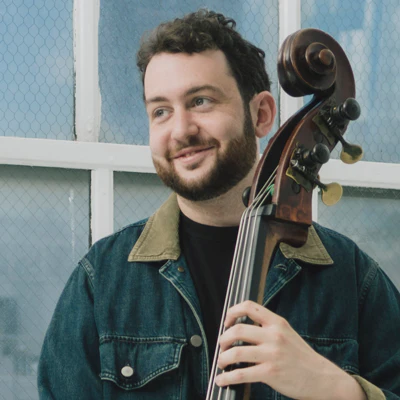
Who's pulling these lines
Cole is a working bassist on the New York scene, electric and upright. He came through Juilliard's jazz department, studied with the great Ron Carter for two years, and put in his hours in the clubs where this music actually gets made. He was a finalist at the Ron Carter Jazz Bass Competition, has shared the stage with Macy Gray, and wrote The New Simandl, a hybrid upright method.
So when Cole says a line is note for note, it is. That accuracy is the promise this whole Club rests on.
Don't take my word for it
Real students. Different ages, different decades on the instrument.
★★★★★
I played the same thing over every chord change, because that's all I knew. Now I understand what professional jazz bassists are doing, and I have the tools to do it.Dan S. · rock, R&B & funk player
★★★★★
Cole demystifies complicated topics into easy concepts and shows a clear, actionable path. The walking-line development alone has me playing with more control, and far more effective in a jazz group.Jim · 58, 40 years playing
★★★★★
Cole has a real knack for pragmatic, actionable methods. I'm finding the notes I'm hearing, consistently, in different positions on the neck.Alec · 59, ~30 years playing
This is for you if
It's not if
A year in the Club: twelve legends. Around fifty lines in your hands.
The shelf never stops growing, and it stays yours
Two ways in
Less than a dollar a day. A fraction of one private lesson, and it shows up whether you booked it or not.
The membership
Founding-member price, locked for life. The price goes up after launch, but not for you.
Cancel anytime, two clicks. No contract.
Rather pay once a year? Get 12 months for $270, two of them free.
Join, get your first Tuesdays, work the lines. If the Club isn't for you, email [email protected] inside 30 days and we'll refund you. No forms, no hoops, no hard feelings.
No contract, ever. Cancel from your account any time, and everything you've downloaded stays yours. We never want you paying for something you're not using.
Before you join
Nope. You get tab and notation both, plus video of Cole playing it slow enough to follow. If you can find the notes on your bass, you're set.
Both, and the lines come from both worlds. It's about vocabulary, and a great line works on either one once it's in your hands.
You'll want to be past the total-beginner stage. If you can play through a tune and hold a groove, you're ready. The breakdowns slow everything down and meet you where you are.
One line a week. Twenty focused minutes a day and it's yours long before the next drops. You're not drowning in content, you're getting one thing at a time and actually learning it.
Anytime, in two clicks. No contract, no phone call. While you're in, your whole shelf stays open to you.
Look, you can keep doing what you've been doing. Keep drilling scales, keep hoping the music shows up on its own. Plenty of smart, dedicated players spend ten years that way and never once sound like the records they fell in love with. That's not a threat. It's just what happens when you practice the alphabet and expect a conversation.
None of that was your fault. Nobody ever handed you the lines. Now somebody is.
The first one's waiting. Come get it.
Cole