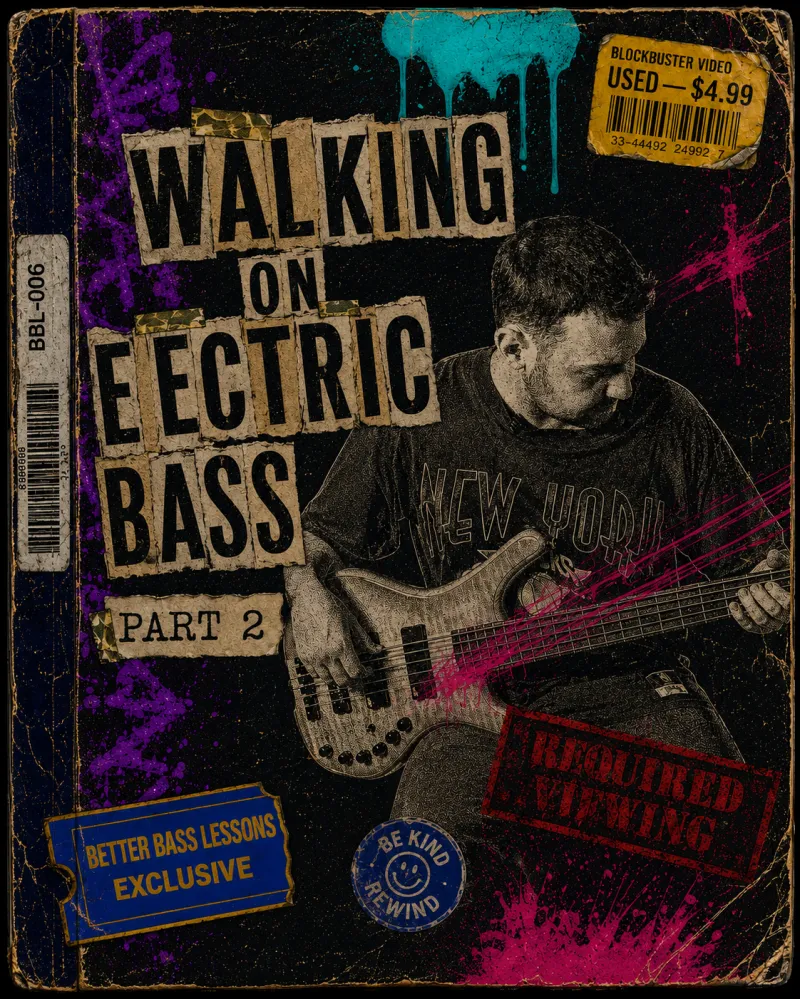
Walking lines that move, instead of the same four notes on a loop.
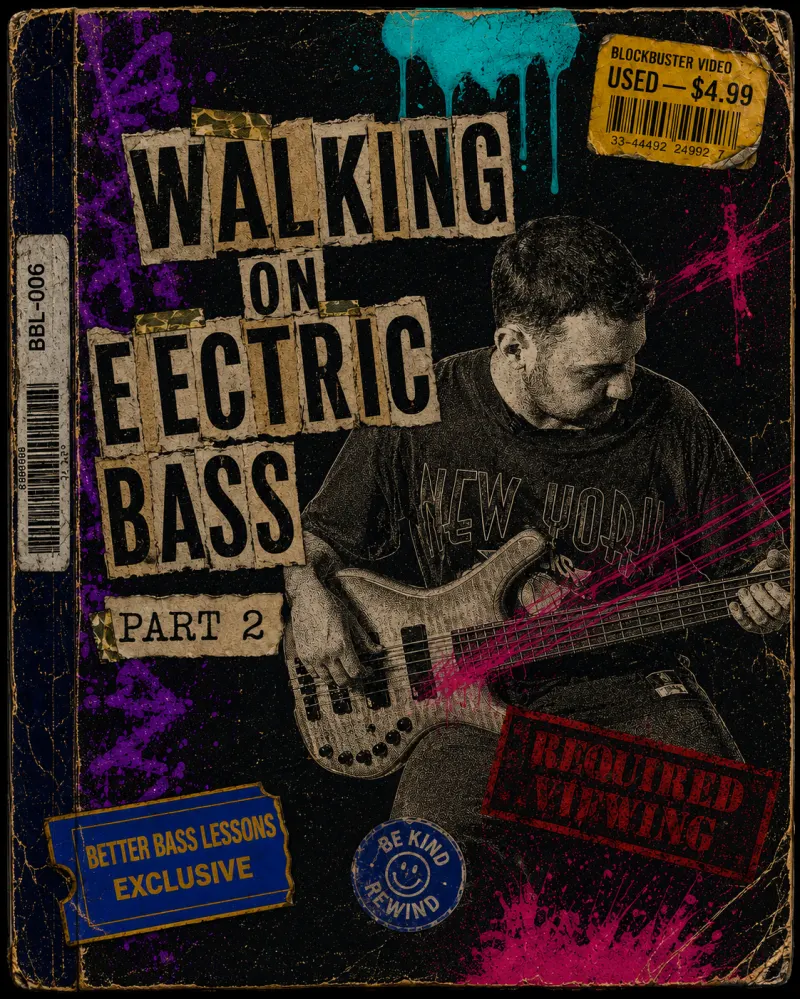
Part 2 of Walking on Electric Bass is the full vocabulary working players actually use: the six right notes, the licks Ron Carter passed down, and the one principle that makes a line swing instead of repeat, worked all the way through an F blues and Autumn Leaves.
$47 · one-time · lifetime access
Perfect for you if…
- You finished Part 1 and your 1-3-5-7 lines are starting to sound like a backing track
- You can play the chord tones but your bass lines all sound the same after a chorus
- You want the actual NYC vocabulary: the licks Ron Carter passed down, not Berklee scale practice
- You can already walk through a blues at slow tempo and want to make it sound musical
- You're an adult player with 20 minutes a day and you want to skip the 200-page modes detour
- You're getting called for jazz gigs and you want to sound like you belong on the bandstand
Maybe not if…
- You haven't done Part 1 yet. Start there, then come back
- You want a fakebook of pre-written lines to memorize
- You're looking for slap technique, modes, or solo bass arrangements
You learned the 1-3-5-7. Now your lines all sound the same.
This is the wall that catches every adult player who actually puts the work in. You learned the chord tones. You can hit 1-3-5-7 over an F blues without thinking. You can scramble the order, repeat notes, leave notes out. The line is consonant. The notes are right.
And it sounds like a backing track. Even when you're grooving. The drummer is happy. The pianist is happy. But you can hear it: the line is doing its job and not much else. After a chorus, you start playing the same things again. By the second chorus you're bored of yourself.
Here's what's actually happening: you're working with four notes. Four notes, four beats per bar, a dozen bars in a chorus. The math runs out fast. And the whole point of a bass line is to outline the changes subtly, to create movement underneath the soloist, not to become the soloist by playing the same figure on a loop.
It isn't a knowledge problem. Your notes are right. It's that nobody handed you the rest of the system: the two notes you're still missing, the licks that create real movement, and the one habit that keeps a line from repeating itself. That's the whole difference between a backing track and a bass line, and it's been hiding in plain sight on every record you love.
It comes down to six right notes, and what you do with them.
You've got 12 notes on the bass. Six of them are right notes, and that's enough to play a beautiful, interesting walking line for the rest of your life. Part 1 covered four. Part 2 hands you the last two (the 9 and the 13) and then spends most of its time on the part nobody teaches: the five ways to organize those notes, the licks that create movement, and the variety that makes a band swing. Same vocabulary Israel Crosby used under the Ahmad Jamal Trio. Same thing Bach did in his bass lines. Same thing Ron Carter showed me at Juilliard.
Six right notes is enough to play a beautiful, interesting bass line for the rest of your life. The whole question is what order you put them in.
This course teaches you how the 9 and the 13 behave on every chord type. Where they sit. When they create movement. Why the 13 sounds dark on a minor chord, rubbing right up against the seventh, and warm on a dominant. Then I give you the licks: the actual phrases working bassists use, the ones that come back to where you started, the ones that open up the line.
Then we put it all together on an F blues. Then we talk about the thing that matters more than the right notes: variety. Because once you have six notes, the most important question stops being "what should I play" and starts being "did I already play that."
By the end, you'll be able to…
- ✓Use the 9 over any chordMajor, minor, dominant: it's the same note, it always works
- ✓Hear the 13 against the chord and choose it on purposeIncluding when to use it for warmth and when to use it for darkness
- ✓Play the 1-2-5-2 lick that lands you back where you startedThe Ron Carter move that creates movement without being chromatic
- ✓Add space and width to a line with the 1-6 jumpThe Bach interval that opens the bass line up
- ✓Walk an F blues with all six right notesTwelve bars of consonant, varied, swinging line
- ✓Stop repeating yourself bar to barThe variety drill that fixes the "everything sounds the same" problem
- ✓Start a bar on the 3, the 5, or any other right noteNot just the root. Every right note is a valid downbeat
- ✓Hear what the early bass players were doingJimmy Blanton, Oscar Pettiford, Israel Crosby: the consonant tradition
- ✓Write a bass line on paper before you play itThe exercise that builds the variety you can't get to on the spot
- ✓Apply all six notes to Autumn LeavesThe first eight bars recycle through the whole tune. Play those, play the tune
- ✓Use the flat 13 for color on a dominant chordLike the line from Cannonball Adderley's "Something Else"
- ✓Be ready for Part 3, where we get into the wrong notesOnce the right notes are solid, the wrong notes start working
The full curriculum.
5 video lessons · notation + tab · F blues & Autumn Leaves worked all the way through
We start with the one idea Part 1 was built on: take the 1, 3, 5, and 7 and change the order of the notes. Root position alone makes you sound like a backing track, even when you're grooving. Eventually it's obvious what you're doing, and the soloist's job becomes your job.
So we cover the moves that keep four notes interesting: repeating a note inside the bar (1-1-5-3), leaving notes out, and octaves, not just on the root, but on the fifth too, and sandwiching the root between two octaves. If you only bought Part 2, this gets you oriented before we add anything new.
You only have twelve notes, and six of them are right notes. Part 1 gave you four; here you get the other two. The 9 (the 2) is uniform: it's the same note over major, minor, and dominant. The 13 (the 6) is uniform too, but it behaves differently depending on the chord: warm on a dominant, and dark on a minor, where it rubs right up against the seventh and creates that bit of tension.
That's the color you hear on the Miles records, and on the classic Autumn Leaves line from Cannonball Adderley's Something Else. We apply it to an F blues right away (1-2-3-5 to walk up and convey movement, then 1-3-6-5 for color) so you hear what each note does before you have to make choices with it.
Because the 9 and the 13 are uniform, a lick that works over one chord works over all of them. We go through three licks with the 9 (starting with the 1-2-5-2 that creates a lot of movement and leads you right back where you started, without going chromatic) and two licks with the 6, including the wide 1-6 jump that opens the line up the way Bach used it.
Then we put all five tools together on an F blues and play it without calling it out, so you can hear what it sounds like when you use all the right notes to your advantage.
More important than playing the right notes or being ultra-clear is variety. And variety doesn't mean playing different notes. It means not repeating the same degrees. Play 1-3-5-7 and then 1-3-5-7 again and you've repeated yourself, even in a new key or over a different chord. Think of the lines as number patterns you're not allowed to reuse.
The drill is to write a bass line out by hand, making sure every bar is different (note names are fine if you don't read). It's much harder than it sounds, because the lick you just played is still in your ear and you want to play it again. But variety is what keeps the band engaged and what actually makes it swing, and writing it out is how you build that before you can do it on the spot.
We close on Autumn Leaves. The 1-3-5-7 of each chord is in your PDF with tabs, so instead of explaining the changes, I show you what to do with them. We work the first eight bars: they recycle through the whole tune, so if you can play those, you can play the tune.
First just changing the order of the 1-3-5-7. Then recycling notes and using octaves so you're not forced to hit all four every bar. Then adding the 9, then the 13, including the flat 13 on the D7 for that dark color the tune wants. I give you the ingredients and the recipe; your job is to write one out and make the dish.
Total: 5 video lessons · notation, tab & backing tracks included
Everything you need to actually do the work.
- 5 HD video lessonsShort and focused: recap, the 9 & 13, the licks, variety, and Autumn Leaves
- The Six Right Notes PDFThe five ways to organize a bass line, on one page
- Autumn Leaves chart + tabsThe 1-3-5-7 of every chord, written out with tab
- Notation + tab for every lickThe 1-2-5-2, the 1-6 jump, and the rest (both formats)
- F blues backing track (3 tempos)So you can run the lesson on your own
- The variety drill worksheetWrite-it-out exercise that fixes the "everything sounds the same" problem
- Lifetime access + free updatesNo subscription, no auto-renewal. Every revision included.

Cole Davis
Working NYC bassist · Juilliard · studied with Ron Carter
I'm a working New York jazz bassist. I play upright and electric. I studied at Juilliard for upright bass, and that's where I got to meet and work with the great Ron Carter. I also got to work with Ben Wolfe and Gerald Cannon, two world-class jazz bassists who aren't household names and should be.
A lot of what I teach in this course came directly from Mr. Carter. He passed it to me, and he passed it to Ben and Gerald too. The idea of taking the 1-3-5-7 and the 9 and the 13 and making a beautiful bass line out of just those notes wasn't invented by Ron Carter. It came from Israel Crosby, the bass player in the Ahmad Jamal Trio. But Mr. Carter is the one who showed an entire generation of jazz bassists how to do it in a really advanced and unique way.
This is the lineage. Part 2 of Walking on Electric Bass is me passing it to you the way it was passed to me.
- Juilliard, upright bass
- Studied with Ron Carter, Ben Wolfe, Gerald Cannon
- Working bassist on the NYC scene
- Hundreds of private students taught
- Founder, Better Bass Lessons
Most adult bass players I work with hit a wall after they learn the 1-3-5-7. Their lines are correct and boring. Adding the 9 and the 13 is the move that opens the whole thing up. It's the move that took me from sounding like a backing track to sounding like a bass player. I made this so you don't have to spend two years figuring out it was just two notes the whole time.Cole Davis
The 1-2-5-2 lick alone is worth the price.I've been walking on the same four notes for two years. After Part 2 my lines actually have movement. The thing about how the 13 sounds different on a minor chord, I'd never had anyone explain that. Now I hear it on every record.
Was struggling with: Walking lines that sounded like a backing track
I finally stopped repeating myself.The variety drill, writing the line out before playing it, is the most useful exercise I've done in five years. I thought I knew how to vary my lines. Then I tried to write four bars without repeating a pattern and I couldn't. That's the whole problem in one drill.
Was struggling with: Every chorus sounding like the last one
This is what I wished my teacher had taught me.I had six lessons with a local teacher who walked me through modes for the first three weeks. Cole's Part 2 gave me more usable bass-line vocabulary in one sitting than I got in those six lessons. The Israel Crosby and Ahmad Jamal references finally connected the records I love to what I'm trying to play.
Was struggling with: Theory lessons that never landed in real tunes
One price. Own it forever.
$47one-time
- ✓5 HD video lessons$79
- ✓The Six Right Notes PDF$29
- ✓Autumn Leaves chart + tabs$29
- ✓Notation + tab for every lick$39
- ✓F blues backing track, 3 tempos$19
- ✓Variety drill worksheet$19
- ✓Lifetime access + free updates$49
One payment · lifetime access
Compare to private lessons: $80/hour with a working NYC bassist. This is half a lesson, and yours forever.
7-day money-back guarantee.
Try the whole course for 7 days. Watch every lesson, run the drills, take the licks to your practice room. If your walking lines don't sound noticeably different, email us and we'll refund every dollar, no questions, no follow-up sales pitch, no "are you sure?" survey. We only want you in if it's working.
Things people ask before they buy.
Yes. Part 2 builds directly on the 1-3-5-7 framework from Part 1. The recap lesson covers the high points but it's a refresher, not a replacement. If you don't already have the 1-3-5-7 in your hands, start with Part 1.
Intermediate. You should be able to walk through a 12-bar blues using chord tones at a slow tempo before starting Part 2. If that's already you, this is the next move.
Because that's how long it takes to teach what's in here. I'd rather give you five focused lessons that go straight into your hands than three hours of filler. The work is on your end: the licks, the variety drill, the F blues, Autumn Leaves. The video tells you what to practice. The practice room is where the time goes.
Yes. The notes are the notes. I demonstrate on electric in this course because the title says electric, but the framework (the six right notes, the licks, the variety principle) is identical on upright. Half my own playing is upright.
Just enough to know what notes you're playing and why. No modes. No melodic minor system. No 200-page Berklee detour. The theory is "the 9 is always the 9, the 13 is always the 13" and we move on.
It helps but isn't required. Every lick comes with both standard notation and tab. The variety drill works fine if you write out note names instead of notation.
Part 3 is in production. That's where we get into the wrong notes: the chromatic approaches and tension that make the right notes sound right. Anyone who buys Part 2 gets a heads-up the day Part 3 drops.
Forever. Buy once. No subscription. No "lifetime really means one year" fine print.
Email us within 7 days for a full refund. Read the guarantee section above.
No. It's a one-time payment of $47, with lifetime access.
Still have questions? Email email us
The reason most adult bass players sound like a backing track is that they're working with four notes when six is the actual minimum. Not twelve. Not modes. Six. The 1, 3, 5, 7, 9, and 13. That's the whole right-hand side of the puzzle.
You can play a beautiful, interesting, varied bass line for the rest of your life on those six notes. Israel Crosby did. Jimmy Blanton did. Oscar Pettiford did. They weren't dealing with bebop dissonance. Bebop hadn't been invented yet. They were dealing with the right notes, and they sounded incredible.
Part 2 is the move that gets you there. The 9 and the 13. The licks. The variety drill. The F blues and Autumn Leaves that put it all together. Five focused lessons, and a pile of practice-room work that pays off for years.
Then you'll be ready for Part 3, where we get into my favorite subject: the wrong notes. But you can't earn the wrong notes until the right notes are solid. That's what this course is for.
Cole Davis
Walking Bass Part 2. $47. Yours forever.
$47
Get instant access7-day money-back guarantee. Email us within 7 days for a full refund.