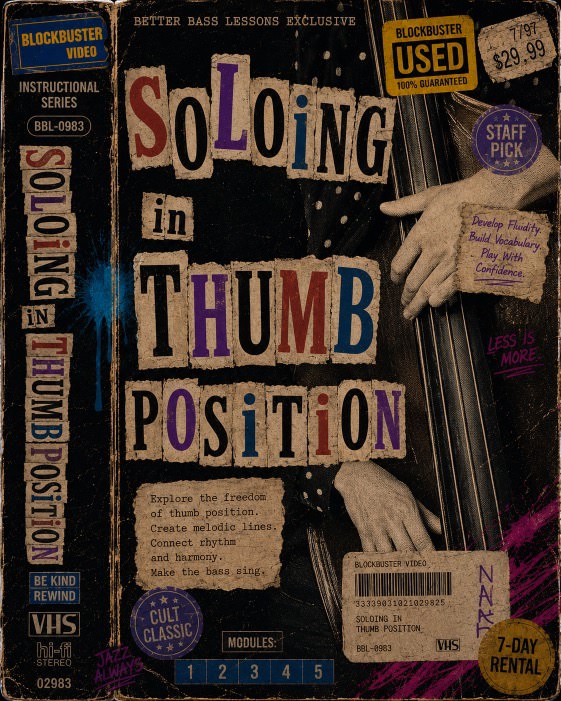
Solo in thumb position like a horn player.
You can burn on an upright. The standard fingerings just won't let you. This masterclass replaces the 0-2-3 trap with the system from Cole Davis's book Freedom of Movement: the 0-1-3 and 0-1-2 combinations, pivoting instead of shifting, and the thumb as a capo, so you can voice-lead, play bebop and fourths, and improvise over real changes all over the fingerboard.
$97 · one-time · lifetime access
Perfect for you if…
- You play upright and you're comfortable in thumb position, but you feel locked once you get there
- You can hear the changes to a tune like Cherokee but can't play over them up high
- You're stuck on the 0-2-3 fingering and shifting out of it feels impossible
- You want to play bebop lines, fourths, and outside scales in the upper register
- You've watched horn players shred fourths and wanted that vocabulary on the bass
- You can work from notation and tab. The course comes with PDF etudes and fingerings
Maybe not if…
- You're new to upright and don't have thumb position yet. This builds on it
- You only play electric bass
- You want walking basslines or beginner technique. Start elsewhere in the catalog
The standard fingering traps you up high.
You can hear it: the burning, horn-like solo you want to play up in thumb position. Then you put your hand on the bass and the 0-2-3 fingering locks you in place. Your first finger has nowhere to go. The notes right next to your third finger are out of reach. And shifting out of the position feels like a wrestling match.
So even when the changes aren't hard (most of us can hear Cherokee), you don't have enough options to actually play over them. You get an Ab7 and the note you need to resolve it isn't under your hand. You end up stranded.
It's why so many bass players get to thumb position and then freeze there. They sound uncomfortable the moment they try to leave it, they avoid fourths, and they sit out the bebop lines, quietly jealous of the saxophone player next to them.
None of that is a problem with your ears or your musicianship. It's the fingerings. Change those, and the whole upper register opens up.
Freedom of movement: a system, not a position.
This is the fingering system from my book Freedom of Movement, and it comes down to three moves. First, the 0-1-3 and 0-1-2 combinations in place of 0-2-3, so your first finger and thumb can actually go somewhere. Second, pivoting instead of shifting: the second and third fingers stay planted while the thumb and first finger move to catch each half-step. Third, the thumb as a capo (resting on the F♯, C♯, and G♯, not only on the harmonics), which extends thumb position and lets you transition into it.
Thumb position isn't one position with a few extra notes. It's a series of positions, and you're always a half step away from the right note.
Once you know where the half-steps and whole-steps are, you always know where to resolve. That's what makes burning over changes possible: in the Cherokee etude I shift my thumb to meet each chord, including the thumb on the G♭ for that Ab7 that the standard fingering can't reach.
We build the whole thing on real repertoire (etudes on Cherokee, Coltrane's "Moments Notice," and "Ornithology," straight from the book) so you're not drilling abstractions. You're learning to play.
By the end, you'll be able to…
- ✓Replace 0-2-3 with 0-1-3 and 0-1-2So your hand can finally move, not just sit in one box
- ✓Pivot instead of shiftKeep the 2nd and 3rd fingers planted; free the thumb and first finger
- ✓Use the thumb as a capo on F♯, C♯, and G♯Not just on the harmonics. That's where the options live
- ✓Treat thumb position as a series of positionsBreak the one-box habit and use the whole register
- ✓Voice-lead by half stepAlways know where to resolve: you're a half step from the right note
- ✓Burn over CherokeeIncluding the thumb on the G♭ for that Ab7 you couldn't reach before
- ✓Navigate a hard bridgeKnow every half- and whole-step and the changes stop being scary
- ✓Play bebop in the upper registerLines that feel impossible become a matter of a few shifts
- ✓Play fourths: elbow up, thumb engagedThe "Ornithology" fourth lines you thought were off-limits
- ✓Transition into thumb position fluentlyFrom the lower register, without the awkward back-and-forth
- ✓Play outside the changesScales as pathways, even E harmonic minor over an Eb7
- ✓Get a bigger, more beautiful sound up highBy playing lighter, not harder. It carries further
The full masterclass.
8 video chapters · etudes on Cherokee, Moments Notice & Ornithology · full PDF packet
Most methods teach the 0-2-3 fingering. It locks your first finger, hides the note right next to your third finger, and makes shifting out a chore. We replace it with the 0-1-3 and 0-1-2 combinations, which give your hand somewhere to go, and a wealth of options for improvising, not just for moving around.
You'll also learn the mobility drill: assigning a different finger combination to each string so you never lock into a single shape.
We seldom truly shift in thumb position. We pivot. The second and third fingers stay planted as pivot points while the thumb and first finger move a half- or whole-step to catch the next note. Knowing where you can pivot at any moment is what makes playing over changes easy.
Demonstrated through the etude on Coltrane's "Moments Notice" and the "Pivot Finger" etude, with 62 worked pivoting examples across first position in the PDF packet.
Thumb position is a series of positions, not one position with a couple of extra notes. We break free of the "Tetris block" by using the thumb as a capo, resting it on the F♯, C♯, and G♯, not only on the harmonics. The relationship between the thumb and the third finger is what lets you move between positions cleanly.
Once you see how many notes that opens up, you stop retreating to the same comfortable shape every time.
The same thumb notes that extend thumb position also get you into it. We use them as a transitional tool from the lower and middle register, then fall naturally into first position on the harmonics. The key is to practice your scales as pathways, not key centers, spanning as much of the fingerboard as possible.
That's how you stop sounding like a player who's stuck once they arrive in thumb position, and start moving back and forth with fluency.
This is where it all pays off. The jazz language is mostly half-step voice leading, so if you know where the half-steps are, you know where to resolve. We work the Cherokee etude "Time to Burn" (shifting the thumb to meet each change, including the thumb on the G♭ to nail that Ab7), then take on the harder bridge the same way.
You won't always play the changes one hundred percent, and that's fine. What makes it work is knowing exactly where to resolve.
Fourths feel impossible because the bass is tuned in fourths, but the fix starts with getting your elbow up so you can angle your hand. Then you use the thumb to play fourths all around the fingerboard instead of in one spot. We work the "Ornithology" melody, which is full of fourths and half-steps, with every fingering laid out in the PDF.
Once you realize it's possible, you stop being jealous of the saxophone players: you've got the fourth language too.
The technique is for a bigger purpose: making art. We use the 0-1-2 and 0-1-3 combinations to nail changes with precision on a hard progression, then loosen the reins, because when you're soloing, you're not responsible for the changes the way you are when you're walking.
Then we go outside: scales over a B♭ blues and an Eb7 (yes, even E harmonic minor over Eb7), practiced as pathways across the fingerboard so you have as many options as possible.
Sound comes last on purpose: the technique has to be in place first, because it's so nuanced it can get in the way of a good sound. The common mistake is forcing it: less string makes players dig in harder, which kills the tone and doesn't carry past ten or twenty feet.
The opposite is true. A light right hand and a delicate left hand give you a sound that's both more beautiful and bigger, up high and down low.
Total: 8 video chapters · etudes + full PDF packet
The masterclass, plus the packet to practice it.
- 8 HD masterclass chaptersThe full Freedom of Movement system, demonstrated on real tunes
- The etude packetEtudes from Freedom of Movement: Cherokee ("Time to Burn"), "Moments Notice," and "Playing Fourths"
- 62 pivoting examplesEvery way to pivot across first position, written out in the PDF
- Outside-playing scale packetsScale pathways over a B♭ blues and Eb7, mapped to the fingerboard
- The "Ornithology" fourths fingeringsEvery fingering for playing fourths with the thumb
- Lifetime access + free updatesNo subscription, no auto-renewal. Every revision included.

Cole Davis
Working NYC bassist · Juilliard · studied with Ron Carter
I'm a working New York bassist and upright is my main instrument. I studied at Juilliard, where I got to work with the great Ron Carter, along with Ben Wolfe and Gerald Cannon.
I wrote a book called Freedom of Movement because I got tired of watching great players, myself included, get stranded in thumb position. The standard fingerings just don't give you enough to improvise with. So I mapped out every pivot, every extended position, and every fingering I use to burn over changes, and I put them into etudes on tunes like Cherokee, "Moments Notice," and "Ornithology."
This masterclass is that whole system, demonstrated on the bass. It's the difference between being able to play in thumb position and being able to actually say something up there.
- Juilliard-trained bassist
- Studied with Ron Carter, Ben Wolfe, Gerald Cannon
- Author of Freedom of Movement
- Working bassist on the NYC scene
- Founder, Better Bass Lessons
I don't have Kawhi Leonard hands, and you probably don't either, but that's the whole point. These pivots and shifts exist so you don't have to stretch for it. With the right fingerings, the upper register stops being a cage and starts being the most expressive place on the instrument.Cole Davis
I stopped getting stranded on the Ab7.I've avoided soloing up high for years because I'd hit a change and the note just wasn't under my hand. The thumb-on-the-Gb thing for that Ab7 broke it open. I can finally make it through Cherokee without freezing.
Was struggling with: Getting stuck over changes in thumb position
Pivoting instead of shifting changed everything.Nobody ever told me to keep my second and third fingers planted and let the thumb move. The 62 pivot examples are gold. I've been working four a day. My upper register finally feels connected instead of like a separate instrument.
Was struggling with: Awkward shifting in and out of thumb position
I can finally play fourths."Get your elbow up" sounds too simple to matter. It isn't. Between that and using the thumb, I played the Ornithology line for the first time. I'm not jealous of the horn players anymore.
Was struggling with: Fourth lines that felt impossible on upright
One price. Own it forever.
$97one-time
- ✓8 HD masterclass chapters$129
- ✓The Freedom of Movement etude packet$49
- ✓62 pivoting examples (PDF)$29
- ✓Outside-playing scale packets (B♭ + Eb7)$29
- ✓"Ornithology" fourths fingerings$19
- ✓Lifetime access + free updates$49
Compare to private lessons: $80/hour with a Juilliard-trained, working NYC bassist. This is barely more than one lesson, and yours forever.
7-day money-back guarantee.
Try the whole masterclass for 7 days. Watch every chapter, take the etudes and pivots to your practice room. If it doesn't open up the upper register for you, email us and we'll refund every dollar, no questions, no follow-up sales pitch, no "are you sure?" survey. We only want you in if it's working.
Things people ask before they buy.
Yes. This is an advanced course: it builds on the thumb position you already have on the harmonics. If you're newer to the upper register, start with one of the earlier upright courses in the catalog and come back to this.
Upright. The entire method is about thumb position and using the thumb as a capo on the upright bass. Electric players are welcome to watch, but it's built for the doghouse.
No. That's the point. Cole jokes about having Kawhi Leonard hands, but the whole reason the pivots and shifts exist is so you don't have to stretch. Smaller hands use the shifts; everyone gets to the same notes.
It helps. The etudes and fingerings come as PDFs with the fingerings marked, so being able to read notation and tab will let you get the most out of the packet. You can still learn a lot by watching and copying the demonstrations.
It's Cole's book of etudes and exercises for thumb position. This masterclass teaches the system from it (the fingerings, the pivots, the extended positions) and works through its etudes on Cherokee, "Moments Notice," and "Ornithology."
The transitions chapter connects the lower register up into thumb position, so the two stop feeling like separate instruments. That said, the focus here is soloing in the upper register. If walking lines are your main goal, the walking-bass courses are a better fit.
Yes. One chapter is devoted to playing outside the changes, with scale pathways over a B♭ blues and an Eb7 (including some that look wrong on paper and sound great in context). It's about having more options, not abandoning the changes.
Forever. Buy once. No subscription. No "lifetime really means one year" fine print.
Email us within 7 days for a full refund. Read the guarantee section above.
Still have questions? Email email us
All of this technical work is really for a greater purpose. We're not learning the pivots and the fingerings just to play faster or move around the fingerboard better. We're learning them so we can express ourselves, so we can play what we hear up there instead of getting cornered by it.
Thumb position has more to offer than the one box most of us were taught. Once you know where the thumb can go, where the half-steps are, and how to pivot to meet each change, the upper register stops being the place your solo goes to die and becomes the place it comes alive.
That's what Freedom of Movement is for, and it's all in here: the system, the etudes, and the fingerings, demonstrated on the tunes you actually want to burn on.
Cole Davis
Soloing in Thumb Position. $97. Yours forever.
$97
Get instant access7-day money-back guarantee. Email us within 7 days for a full refund.