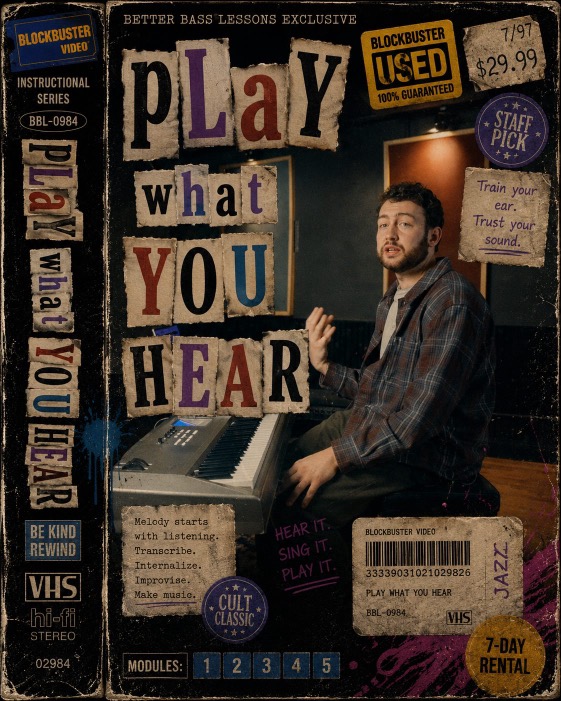
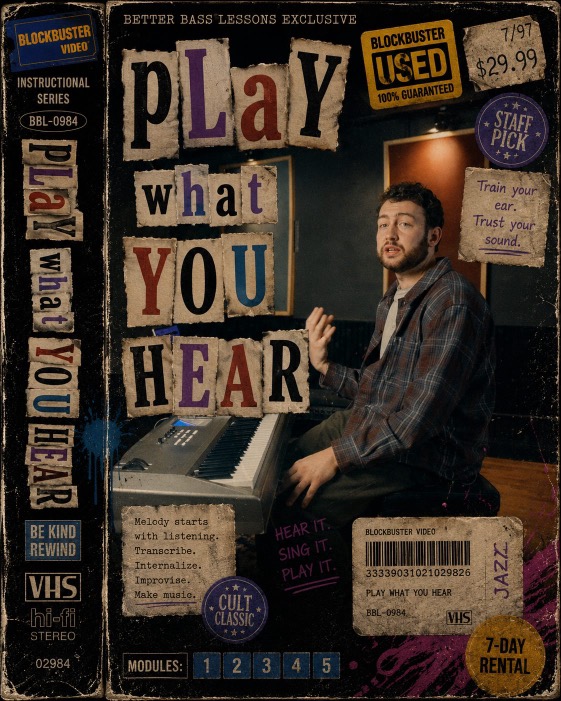
Learn your favorite songs by ear.
You already do this. You learned "Happy Birthday" and "Jingle Bells" by ear before you could read a note. Play What You Hear turns that instinct into a method you can repeat on any song: sing it, find it on the piano, play it on your instrument. No sheet music, and no perfect pitch.
$67 · one-time · lifetime access
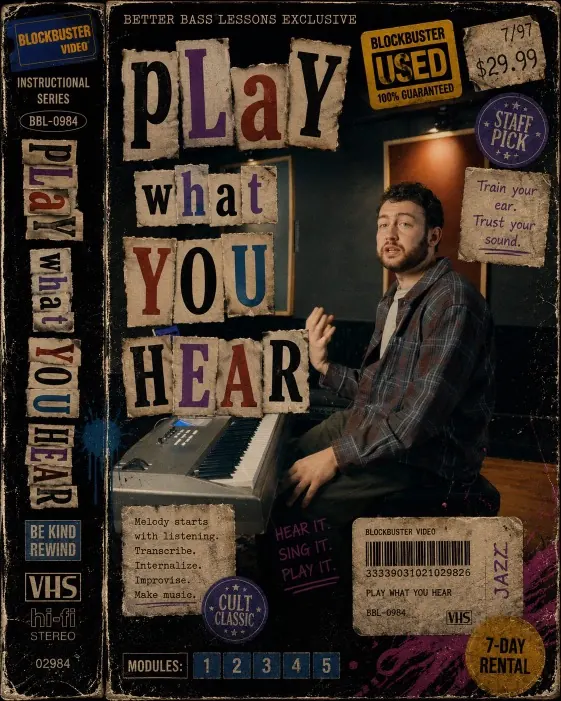
Perfect for you if…
- You can hum a song you love but can't find it on your instrument
- You're tied to the Real Book or chord charts and want to play without the page
- You've tried interval drills and apps and still can't learn an actual tune
- You play bass, guitar, piano, or anything, and want your ear to lead, not your fingers
- You want to transcribe melodies, basslines, and solos the way working musicians do
- You can sing "Happy Birthday" (that's genuinely the only prerequisite)
Maybe not if…
- You want a solfège or music-theory course. This skips solfège on purpose
- You're looking for a sight-reading method
- You won't go near a piano or keyboard app to check yourself
You can hear the song. You just can't find it.
The melody is right there in your head. You can hum it in the car. But when you pick up the instrument, you're hunting, one fret at a time, one wrong note after another, trying to reverse-engineer something you already know by heart.
So you reach for the Real Book, or you Google the chords, and you stare at the page until your fingers memorize it. You can get through the tune. But you don't really know it, and the second you look away from the chart, it's gone.
Here's the part nobody tells you: you've been learning songs by ear your whole life. Nobody handed you sheet music for "Jingle Bells" when you were three. You picked it up by ear and you can still sing it today. That's relative pitch, and you already have it.
The skill isn't missing. The method to get it out of your head and onto your instrument is. That's what this is.
Ears, voice, instrument. In that order.
Most players go straight from their ears to the instrument: they hear something and start hunting for it on the bass or the keys. That's backwards, and it's why it's so slow. The instrument is the furthest thing from your brain. Your voice is the closest.
Your voice is the translator between what's in your head and what comes out of your instrument.
So you sing it first. You match the pitch with your voice, then you let the instrument simply copy your voice. The piano is your truth-teller along the way: it's the one instrument where you can play every note of a melody at once, which is how you find a song's key and its chords. Slow the recording down, take it phrase by phrase, and check yourself against the track every step.
That's the whole method, and it's the same one working musicians use to learn any tune or transcribe any solo. No solfège, no reading, no perfect pitch, just your ear, your voice, and a way to check that you're right. We build it on two songs you already know: "Yesterday" by the Beatles and "Ain't No Sunshine" by Bill Withers.
By the end, you'll be able to…
- ✓Find the starting note of any phrase by earEvery other note comes from the one you start on
- ✓Sing a melody back and check it on the pianoVoice first, instrument second: your voice does the translating
- ✓Find a song's key centerPlay all the notes of the melody at once and the key reveals itself
- ✓Hear major, minor, and dominant chords by feelHappy, sad, and the chord that's pulling you somewhere
- ✓Tell a major third from a minor third instantlyThe happy interval vs. the sad one: the most important distinction in music
- ✓Recognize all eight core intervals by emotionFrom the "oh no" minor second to the triumphant fourth
- ✓Sing the roots of a progression against the recordHarder than melody, but checkable, and it unlocks the chords
- ✓Hear when the bass moves under a static sectionMovement is what makes a bassline, so the chords have to move
- ✓Add extensions: the 9, 11, 13, and altered tensionsThe "secret sauce" that's in pop and classical, not just jazz
- ✓Play a tune from memory, not from the pageLearn it from the inside and you never need the chart again
- ✓Transcribe a solo with your voice firstThe same process that works for melodies works for solos
- ✓Stop depending on Google and the Real BookThey're a last resort, not how you learn a song
The full curriculum.
6 video lessons · two songs taught start to finish · the interval & chord systems
You've been learning songs by ear since before you could read: "Jingle Bells," "Happy Birthday," the themes you can still sing without thinking. That's relative pitch, and you built it the same way professional musicians do.
First step is knowing where you're at. I show you how I check myself against the piano, how to slow a recording down so you can really hear it, and what to do when you're not sure a note is right.
The voice sits closest to your brain; the instrument is the furthest thing from it. So your voice has to be the translator: you sing what you hear, and the instrument copies your voice. Going straight from ear to instrument is the slow, frustrating way most people get stuck doing.
This is also where the piano earns its place: it's the one instrument where you can play every note at once, so it becomes your truth-teller for checking pitches, finding keys, and hearing chords.
We slow "Yesterday" down and build it three notes at a time. Find the starting note, sing the phrase, check it against the piano, then check it against the track. Sing along even if you're not a singer. That's how it goes into your ear and stays.
The melody always comes first, even when your real goal is the chords. By the end of the lesson you own the whole first verse, not half-humming it, actually knowing it.
Ironically, the first step to the chords is the melody. Once you have it, you play all its notes at once on the piano to find the key center, then narrow down your options and sing the roots against the record until they lock in. Singing roots is harder than melody (your ear doesn't reach for them), but it's checkable.
As Ray Brown put it, "melody and bass is all you need; everything else is just filling." So we listen for where the bass moves, because movement is what tells you the chords are changing.
You don't identify intervals by naming them. You identify them by how they make you feel, then react with your body. The major third is happy, the minor third is sad. The minor second is the "oh no" from Jaws; the major second is just "meh." The perfect fourth is the triumphant "Here Comes the Bride"; the fifth is simply perfect. The minor sixth is mysterious; the major sixth is hopeful.
Practicing intervals won't let you name notes inside a melody in real time. That's not the point. It builds the sense of where a line is going, and that's what makes your ear faster.
Three chord types, three feelings: major is happy, minor is sad, and dominant is the one pulling you somewhere, "move me." Then we stack the extensions level by level (the 7, 9, 11, and 13, plus the altered tensions on dominant chords) by singing each one against the chord and checking it on the piano.
Extensions aren't a jazz-only thing; they're the sauce in pop synth parts and classical lines too. We finish back on "Yesterday," using them to jazz it up: proof that once you can hear it, you can play it.
Total: 6 video lessons · two songs taught end to end
Everything you need to train your ear.
- 6 HD video lessonsThe full voice-first method, start to finish
- Two songs taught end to end"Yesterday" and "Ain't No Sunshine": melody, chords, and bass
- The Interval Emotion MapAll eight intervals and the feeling that names each one
- The Chord & Extension ChartMajor, minor, and dominant with the five levels of extensions
- The Voice-First practice routineThe step-by-step process on one page, for any song you take on
- Audio-only versionsFor practicing away from a screen
- Lifetime access + free updatesNo subscription, no auto-renewal. Every revision included.

Cole Davis
Working NYC bassist · Juilliard · studied with Ron Carter
I'm a working New York bassist. Upright is my main instrument (it's how I make a living), and I play electric too. I studied at Juilliard, where I got to work with the great Ron Carter, along with Ben Wolfe and Gerald Cannon.
Every piece of music I've ever learned, I learned this exact way. I sing the melody first so it's in my ear, I take it to the piano to find the chords, I match my voice to the recording, and only then do I go to my instrument. Whether I'm learning a standard or transcribing a difficult solo, the order never changes: ears, voice, instrument.
I teach ear-training lessons, and I always start students at the piano, because that's where you can hear everything at once. This course is that whole process, the way I actually use it.
- Juilliard-trained bassist
- Studied with Ron Carter, Ben Wolfe, Gerald Cannon
- Working bassist on the NYC scene
- Teaches ear training one-on-one
- Founder, Better Bass Lessons
People think learning songs by ear is a gift you're born with. It isn't. You already do it. You just don't know you're doing it the way professionals do. I made this to show you the exact steps, so you can stop staring at a chart and start playing what you actually hear.Cole Davis
One price. Own it forever.
$67one-time
- ✓6 HD video lessons$79
- ✓Two songs taught end to end$49
- ✓The Interval Emotion Map$29
- ✓The Chord & Extension Chart$29
- ✓The Voice-First practice routine$19
- ✓Lifetime access + free updates$49
One payment · lifetime access
Compare to private lessons: $80/hour with a working NYC bassist. This is less than one lesson, and yours forever.
7-day money-back guarantee.
Try the whole course for 7 days. Watch every lesson, sit at the piano, take a song apart by ear. If it doesn't change the way you hear music, email us and we'll refund every dollar, no questions, no follow-up sales pitch, no "are you sure?" survey. We only want you in if it's working.
Things people ask before they buy.
No. You learned "Happy Birthday" without reading a note, and that's exactly the skill this course is built on. There's no notation to decode here.
No. This works on relative pitch, the kind you already have from a lifetime of singing songs. Perfect pitch isn't required anywhere in this method.
Any of them. The method is voice-first, so it's instrument-agnostic: I demonstrate on piano and bass, but the steps are the same whether you play guitar, keys, or horns. You'll want access to a piano or a keyboard app to check yourself, since that's where you can hear all the notes at once.
Not at all. We learn a Beatles song and a Bill Withers song, and the extensions section shows up in pop and classical just as much as jazz. The method works on any song you want to learn.
Solfège can help you identify pitches, but it doesn't help you learn tunes, and you knew "Jingle Bells" long before you knew do-re-mi. It's a step you can skip to make your life easier, so this method leaves it out on purpose.
No. I'm not, and I never sing on gigs. You sing only to check pitch and get the song out of your head, never to perform. Even if you're embarrassed of your voice, matching the pitch in the privacy of your own room is the whole point.
A chart gets you through a tune; learning it by ear lets you own it. When you understand the melody, the chords, and how they feel, you can play from memory, take liberties, and substitute changes. The Real Book and Google are a last resort here, not the method.
Any level. It starts from "I can sing a song I know" and builds all the way to hearing altered extensions. You can work through it at any speed. Four bars at a time is completely fine.
Forever. Buy once. No subscription. No "lifetime really means one year" fine print.
Email us within 7 days for a full refund. Read the guarantee section above.
Still have questions? Email email us
The information is already in your head. We just don't give ourselves enough credit for it. You've been learning songs by ear your whole life: every time you heard "Happy Birthday" it reinforced something you could already sing. That's the same machinery professional musicians use, and yours works fine.
What's missing is a way to get it out: from your ear, through your voice, onto your instrument. That's all this is. Sing the melody, find the chords on the piano, hear how they make you feel, and put it on your instrument. However long it takes you is fine. What matters is that you start actually doing it.
Do that, and you stop staring at a chart and start playing the song. You'll know it from the inside, well enough to play it from memory and take it anywhere.
Cole Davis
Play What You Hear. $67. Yours forever.
$67
Get instant access7-day money-back guarantee. Email us within 7 days for a full refund.