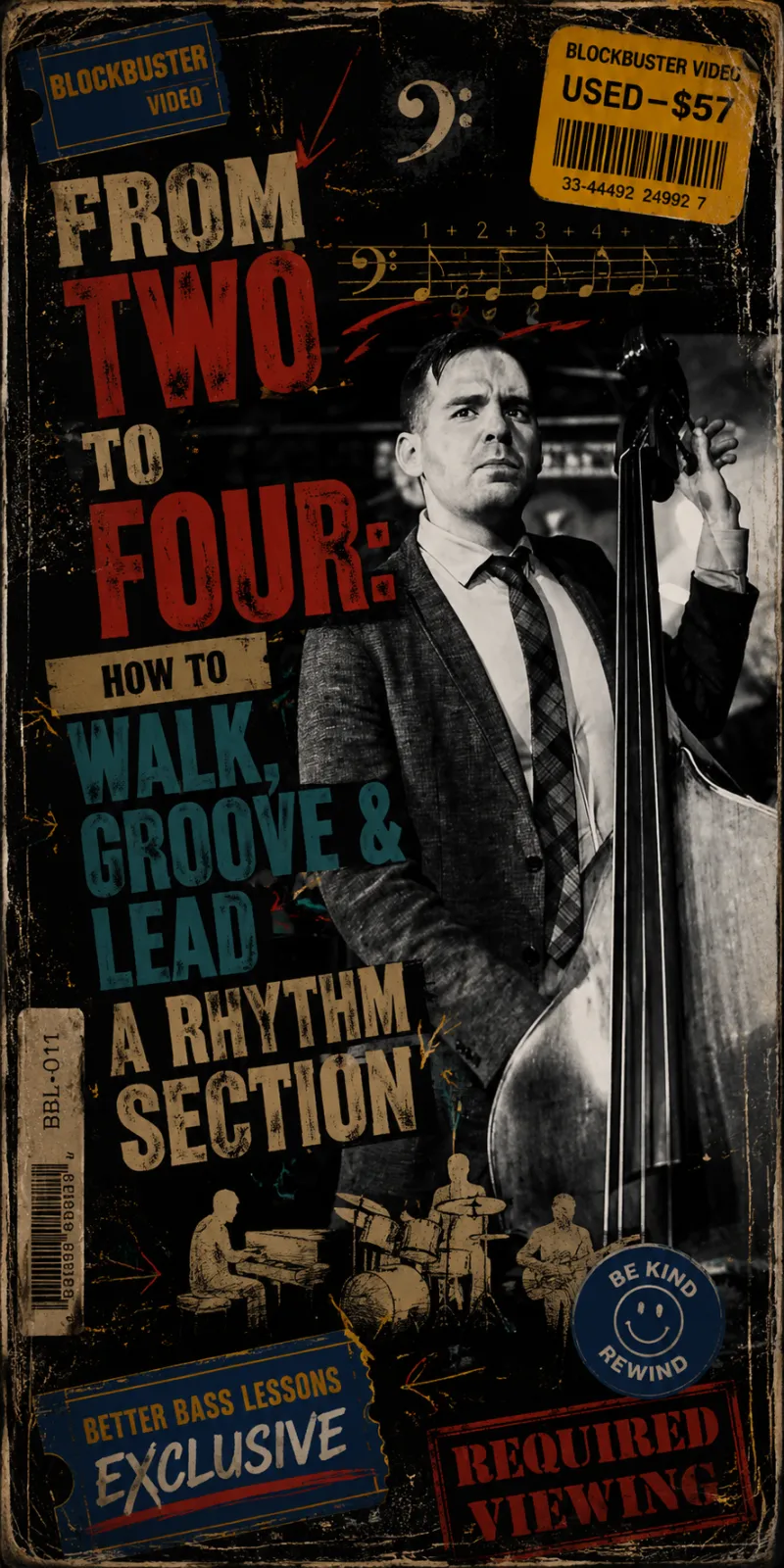
From Two to Four: Walk Any Jazz Gig With Confidence
A live masterclass with Alex Claffy, even when the piano player goes off-chart, the drummer pushes, or the tempo is way above your comfort zone. Filmed with pianist Victor Gould and drummer Joe Strasser, two of New York's most in-demand sidemen.
$77 · one-time · lifetime access
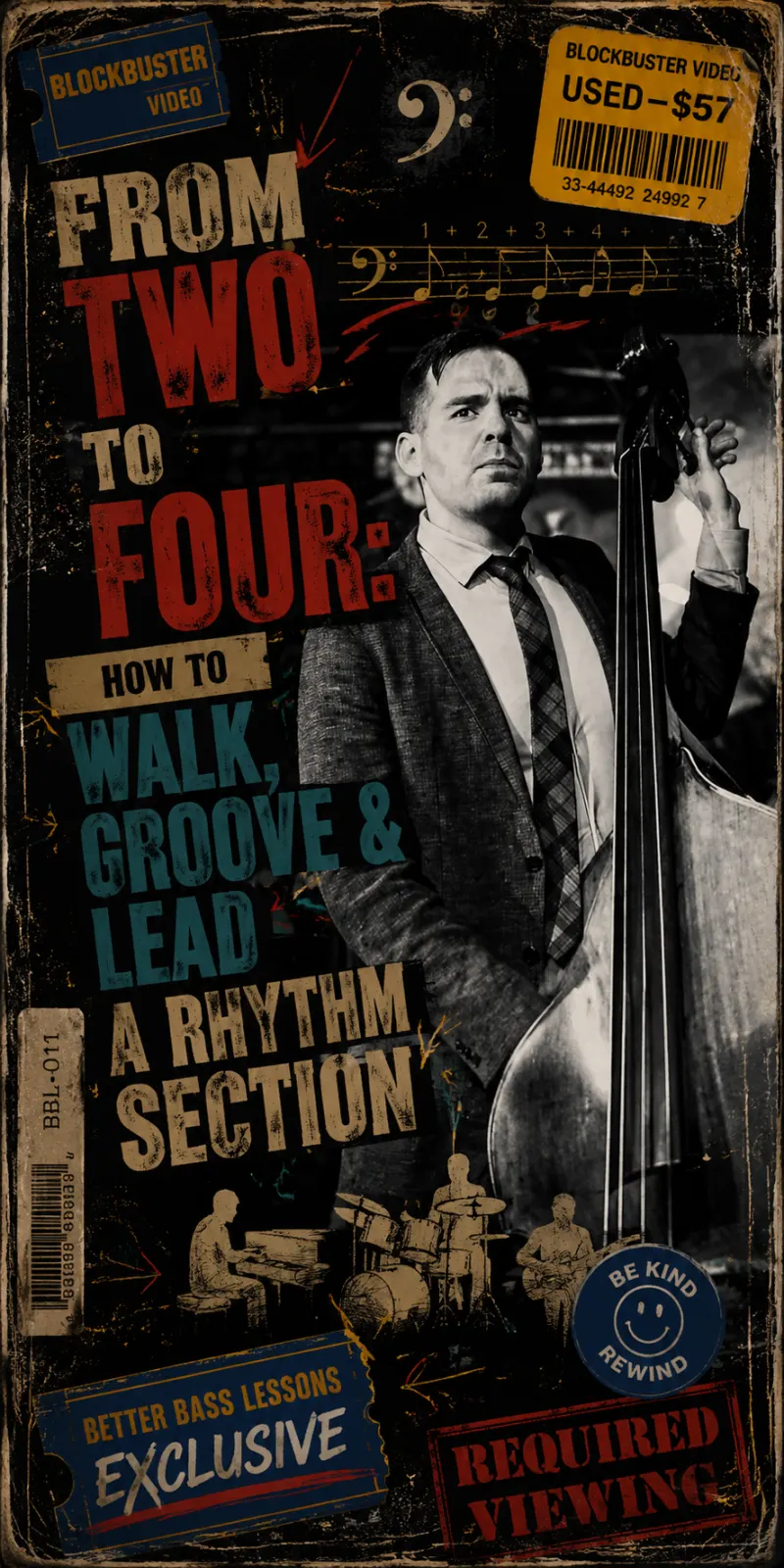
See how it's filmed before you decide.
First 2 minutes of Section 5: Walking in Four & Supporting the Band. Filmed live with Victor Gould (piano) and Joe Strasser (drums), two working New York sidemen, not studio stand-ins.
This is for you if…
- You already know your scales, can walk through a blues, and you're getting called for sessions
- You still feel like something is missing when the music gets intense, the piano player starts substituting, or the drummer plays differently than you expected
- You want to know what the great rhythm sections are doing nonverbally, the stuff nobody says out loud
- You play upright and want to learn the way working New York sidemen actually think on the bandstand
- You're tired of practice that doesn't translate the moment a real gig gets real
- You've put in the hours of theory and now want to see how it's used in real time
Maybe not if…
- You're a total beginner. You'll need to know major scales, dominant scales, and basic blues changes to get full value
- You want a pre-written fakebook of walking lines to memorize
- You're looking for shred technique or slap soloing
You've done the work. So why does the gig still expose you?
You know your scales. You can walk through a blues. You're getting called for sessions and you've put in real hours with a metronome. By every measurable standard, you've done what you were supposed to do.
Then the piano player throws a substitution you didn't see coming. Or the drummer pushes the time in a way you weren't ready for. Or someone calls a fast American Songbook tune to separate the players who've done the work from the ones who only think they have.
And it falls apart. Not because you don't know enough theory, but because nobody taught you the part that isn't in a book. The nonverbal communication. The exact moment a rhythm section moves from two to four. What working bass players are actually doing with their time, their fingers, and their ears inside a real band.
You can't learn that from a fakebook. You learn it from being in the room with people who've done it for years, or from watching them do it on camera, with one of those people breaking down what's happening as it happens.
A full-length live masterclass, filmed with a working New York rhythm section.
This isn't a slideshow with someone playing examples between bullet points. From Two to Four is filmed live with pianist Victor Gould and drummer Joe Strasser, two of New York's most in-demand sidemen, playing real music while Alex breaks down, in real time, how to think, listen, and make decisions inside a jazz rhythm section.
Nothing can make up for thousands of hours of listening to the great bass players. But this is the closest thing to sitting in the room with someone who has.
Across 8 sections you'll see how a two-feel is actually constructed, how voice leading works in the lower register without piano players stepping on you, what the nonverbal signal is for moving from two to four, how Alex thinks about up-tempo walking when the changes are flying by too fast to process chord-by-chord, and what to do when the band gets loud (hint: not what most working bass players do).
Joe Strasser explains on camera what he's listening for in the bass to know when to push to four. Alex demonstrates the Ray Brown "dollar bill" technique that completely changes how you think about register. Both sides of the rhythm section's nonverbal communication, broken down so you can hear it and use it.
What you'll see inside.
- ✓Why a two-feel is the hardest, most exposing thing on a jazz gigAnd the practice habit that makes it effortless.
- ✓The Ray Brown "dollar bill" voice-leading techniqueHow NYC bass players think about register when the piano is covering everything above you.
- ✓Why playing harder when the band gets loud is destroying your soundAnd the counterintuitive thing Alex does at maximum intensity instead.
- ✓The nonverbal signal great rhythm sections use to move from two to fourJoe Strasser explains it on camera, from the drummer's side.
- ✓The one thing Paul Chambers, Sam Jones, and Ron Carter all had in commonThat most bass teachers never mention.
- ✓How to walk an up-tempo tune when the changes are flyingThe mental shift Alex uses to reduce what he's thinking about so the line still makes harmonic sense.
- ✓What Slam Stewart and Paul Chambers did quietly on every recordingThat separates a walking line that swings from one that merely moves.
- ✓The six-page George Mraz walking line from a Sarah Vaughan recordWhat it reveals about how masters think in shapes instead of changes.
- ✓The Buster Williams turnaround principleMaster this one part of the form and piano players immediately want to call you again.
- ✓How to use substitutions you didn't know were comingWithout losing the form or the groove. It's not more theory. It's "common language."
- ✓The Miles Davis 1960 European tour recordings to studyThe clearest example on record of how a great bass-and-drum duo builds tension before going to four.
- ✓A full spontaneous performance filmed coldDifferent tune, different tempo, no plan, to see what real rhythm-section instincts look like when no one's prepared anything.
The full masterclass.
8 sections · filmed live with Victor Gould (piano) + Joe Strasser (drums)
- 01Playing the Head & Intro to Context
- 02Constructing a Two Feel
- 03Two Feel with Piano & Voice Leading
- 04Voice Leading Deep Dive & Two to Four
- 05Walking in Four & Supporting the BandPreview
- 06Full Blues Performance & Real-Time Instincts
- 07Playing Up Tempo & Thinking in Long Phrases
- 08Up Tempo Stamina & Final Performance
Total: 8 sections · live masterclass format · full blues performance + spontaneous up-tempo finale
A real masterclass, not a slideshow.
- 8-section live masterclass videoFilmed with a working New York rhythm section, not studio stand-ins
- Two of NYC's best sidemen on cameraPianist Victor Gould and drummer Joe Strasser breaking down rhythm-section communication from both sides
- Full blues performanceReal-time instincts demonstrated end-to-end, not as isolated examples
- Spontaneous up-tempo finaleFilmed cold (different tune, no plan) so you see what genuine bandstand instinct looks like
- The lineage on the recordSpecific Paul Chambers, Sam Jones, Ron Carter, George Mraz, Buster Williams, and Miles Davis 1960 references with exactly what to listen for
- Lifetime accessNo subscription, no auto-renewal
- Free updates foreverEvery revision and addition, included
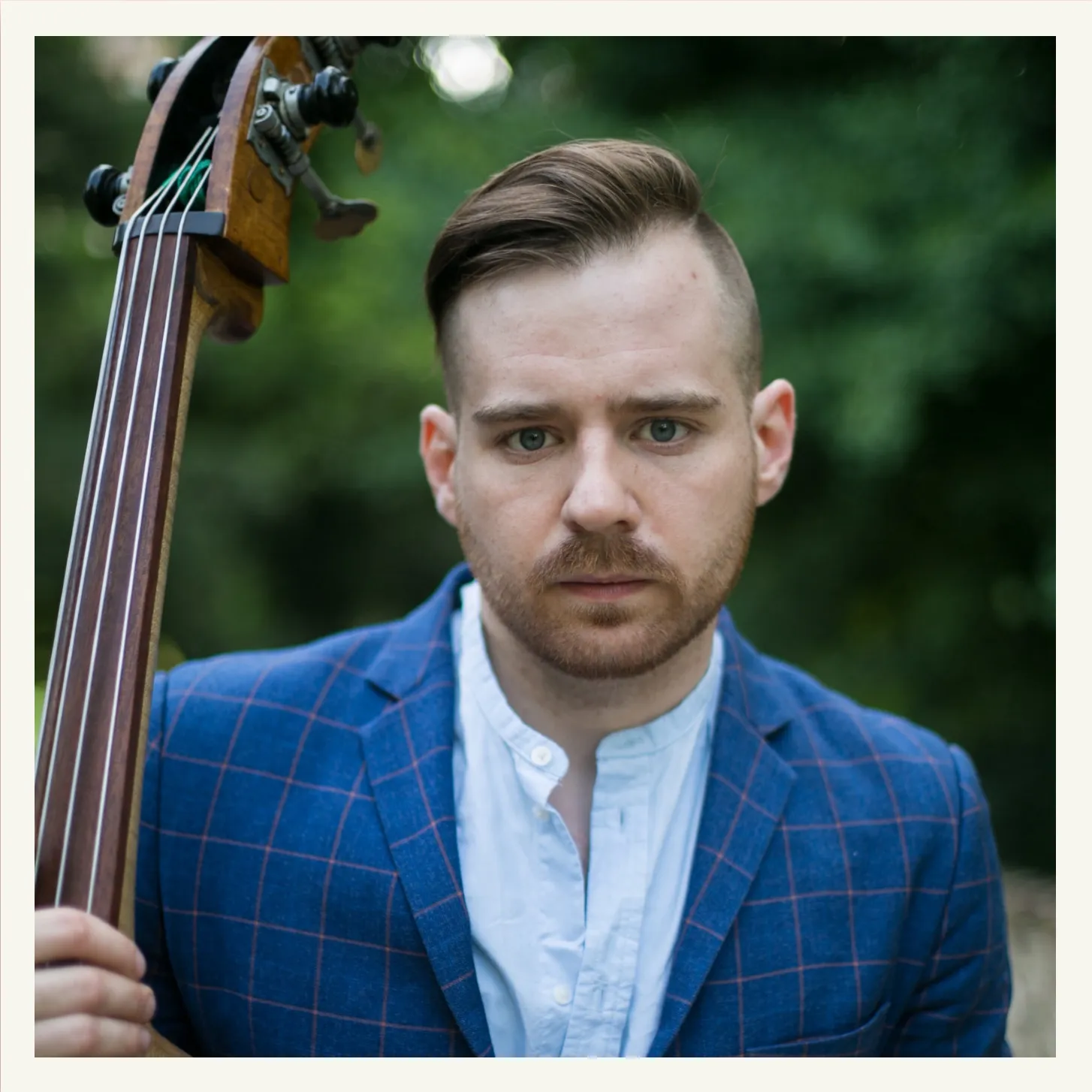
Alexander Claffy
New York City bassist & bandleader
In 2011, Alex played his first gig at Smalls Jazz Club in New York City. George Bourdon Quintet. Terell Stafford and Stacy Dillard on the front line. Rodney Green on drums. He made it through the whole night unscathed, bright laminated plywood bass and all, until the very last song. A fast American Songbook tune. The kind people call at sessions to separate the players who've done the work from the ones who only think they have.
He failed. Completely. It's on the Smalls archive.
He says he dedicated himself that night to never let it happen again. What followed was years of focused listening: not background listening, not casual listening, but sitting in front of good speakers, bass in hand, writing out what the masters actually did with their time, their fingers, and their ears inside a rhythm section.
The result of that obsession is what you're looking at right now.
- Decade-plus at Smalls, Smoke, US + Europe
- Lineage: Paul Chambers, Sam Jones, George Mraz
- Lineage: Ron Carter, Buster Williams
- Filmed with Victor Gould + Joe Strasser
One price. Own it forever.
$77one-time
- ✓8-section live masterclass video$249
- ✓Victor Gould (piano) + Joe Strasser (drums) on camera$99
- ✓Full blues + spontaneous up-tempo performances$79
- ✓The lineage references (Chambers / Mraz / Brown / Williams)$39
- ✓Lifetime access + free updates$49
7-day money-back guarantee.
Watch every section. Listen to the full blues performance and the up-tempo finale. Pull Alex's reference recordings up and listen for what he points out. If it doesn't change how you hear a rhythm section, email support within 7 days and we'll refund every dollar. No follow-up sales pitch.
Things people ask before they buy.
Intermediate. This is not a beginner course. You'll need to understand major scales, dominant scales, and basic blues changes to get full value. If you already know your scales, can walk through a blues, and are getting called for sessions but still feel like something is missing, this is for you.
Pianist Victor Gould and drummer Joe Strasser. Both are working New York sidemen, not studio stand-ins. The whole masterclass is filmed live with the three of them playing real music, including a full blues performance and a spontaneous up-tempo take with no plan.
Alex demonstrates on upright bass throughout. The harmonic and rhythmic concepts (two-feel, voice leading, supporting soloists, up-tempo construction) transfer to electric, but the physical demonstrations and tone discussion are upright-specific.
Helpful but not required. Alex demonstrates every concept on the bass and the video shows his hands clearly. You'll get more out of it if you can read a basic chord chart.
It's a full-length video masterclass across 8 sections. Watch at your own pace. Most students work through it over 2 to 4 weeks, returning to specific sections to drill the concepts on their own bass.
That's the entire point. The masterclass is filmed live with a working rhythm section because Alex's argument is that bandstand instincts don't come from theory. They come from watching how working musicians actually communicate. The course breaks down those communication patterns so you can hear them and use them.
Forever. One purchase, lifetime access, all future updates included. No subscription.
Email support within 7 days of purchase for a full refund. The guarantee section above has the policy.
Yes, see the Better Bass Lessons store for course bundles.
Still have questions? Email email us
You either want this or you don't at this point.
If you've been playing for years and still feel uncertain about what to do when the music gets real, when the piano player throws something unexpected, when the drummer pushes, when someone calls a fast tune and you have nowhere to hide, the information in this course is worth far more than what it costs.
I filmed it live, with real musicians, playing real music. So you can watch and hear how it actually works, not how someone describes it working from behind a whiteboard.
Nothing can make up for thousands of hours of listening to the great bass players. But this is the closest thing to sitting in the room with someone who has.
Alex Claffy
From Two to Four. $77. Yours forever.
$77
Get instant access7-day money-back guarantee. Email support within 7 days for a full refund.