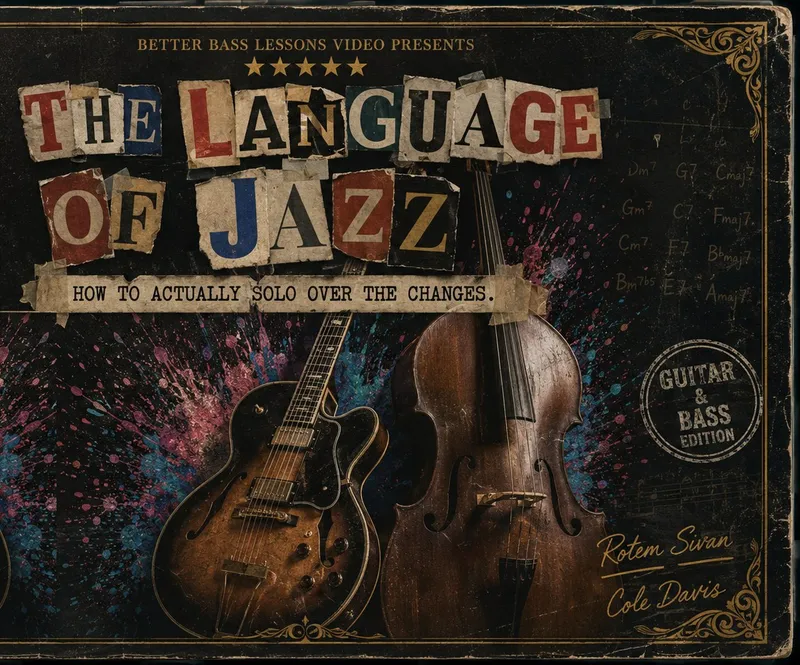
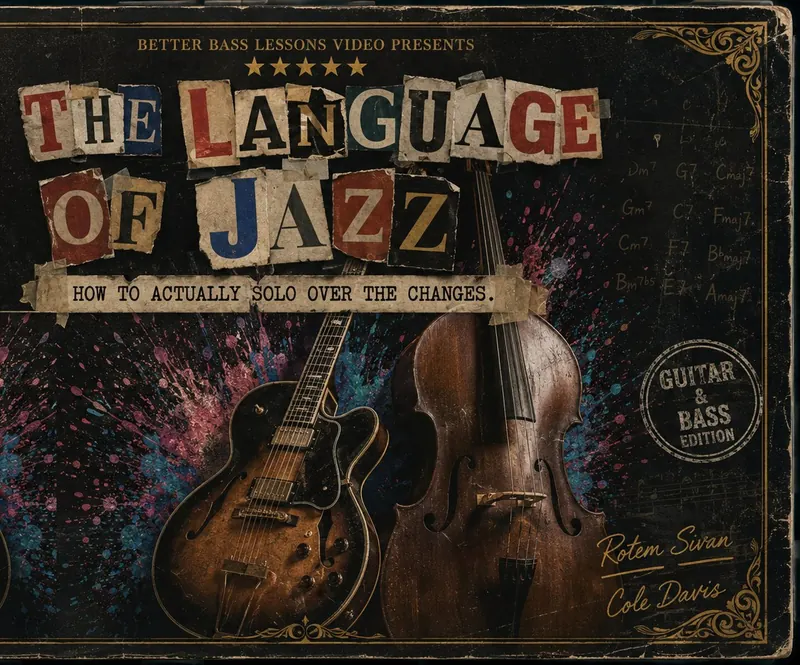
The Language of Jazz
How to actually say something when the tune gets called. The ii-V-I vocabulary, the bebop scale, the modes, the chords and real tunes, in 48 lessons filmed in one room by a Juilliard-trained bassist and a guitarist DownBeat calls “an artist to be reckoned with.”
$397 one-time, or 3 monthly payments of $147 · lifetime access · 7-day guarantee
Watch 34 seconds of the course before you read another word.
You've done the work. So why won't jazz click?
You can play. You hold down a gig, you know your scales, you've put in real hours. Maybe you've read more theory than most of the people you play with. By every measure you've done what you were told to do.
And the theory works. That’s the problem. It works on paper, in the practice room, on the page in front of you. Then a jazz tune gets called, and it all evaporates. The changes go by faster than your fingers can decide. You reach for a lick you learned off a video and it only works in the one place you learned it. You know the modes, but you have no idea which one to use, when, or why.
You don't have a talent problem. You have a vocabulary problem.
Jazz is a language. Nobody ever taught you the words. Or worse, they taught you grammar for six lessons straight and never let you say a sentence. Here's what's actually been in your way.
None of these are a ceiling on your ability. They're gaps in how you were taught. Every one of them is fixable.
Jazz is a language. We teach you the words.
The ii-V-I is the most common progression in all of music. You hear it in Bach, in Cole Porter, in Taylor Swift. Learn the vocabulary that lives on top of it and you can play over most of the standards ever written. So that's where we start: real lines, broken down note by note, until you understand why each one works and can move it anywhere.
That's the difference between memorizing a lick and owning the language. When you know the notes inside a line (the chord tones on the downbeats, the wrong notes on the upbeats that give jazz its color), you can shift it to any octave, any key, and mix the fragments into lines of your own.
Bass players think 1-3-5-7. Soloists think 3-5-7-9. In this course you learn both, and a real chord under every note, so you hear why it works.
That's the part nothing else gives you. Cole plays the bass and shows you how to hear the harmony under your notes. Rotem plays the guitar, so every line lands against actual chords instead of single notes that don't sound like anything on their own. Two working players, two perspectives (the bassist's and the soloist's) on the same vocabulary.
By the end you can take a ii-V-I, understand every note in it, move it where you want, and improvise over a full standard like Summertime or All The Things You Are, not by guessing, but because you finally speak the language.
Two players who make their living in this music.
Not a narrator behind a whiteboard. A bassist and a guitarist from the New York scene, in one room, playing every line against a real chord.
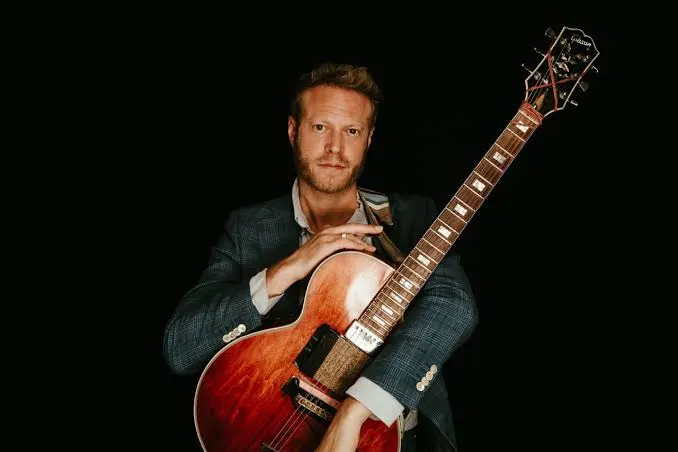
Rotem Sivan
Rotem is an Israeli-born guitarist who moved to New York in 2008 to study at The New School, and, in DownBeat’s words, he’s been “no stranger to musical success” ever since. He leads his own trio at the Blue Note and Smalls in New York, and he tours Europe, playing rooms like the Duc des Lombards in Paris, A-Trane in Berlin, Unterfahrt in Munich and Pizza Express Soho in London.
“An artist to be reckoned with in the crowded modern jazz guitar scene.”
DownBeat, 2024- Prize-winner at the Montreux Jazz Festival’s guitar competition (2009)
- Eight albums as a leader, including Dream Louder (2024) and Heart Thieves, produced by Ben Wendel of Kneebody
- Has played with Peter Bernstein and Ari Hoenig, and opened for Bill Frisell
- Festivals from the Ottawa Jazz Festival to the Polanco Jazz Festival in Mexico City
- Peter Bernstein, in Rotem’s bio: “one of the most creative and adventurous guitarists on the scene today”
In the course, Rotem is the soloist in the room. Every line you learn, he plays the chord under it, so you hear why it works instead of taking it on faith.

Cole Davis
Cole won the Ron Carter Bass Competition at twenty, then studied with Ron Carter himself at Juilliard, where he earned his Master of Music and Artist Diploma. He was named a Future Jazz Master by a panel of NEA Jazz Masters, he’s a Yamaha artist, and he’s the upright bassist on Lambchop’s The Bible. His debut album, Consider It! (2025), features Julian Lage on guitar and Justin Vernon of Bon Iver.
“One of the most versatile upright bassists of his generation.”
Bass Magazine, 2025- Juilliard: Master of Music and Artist Diploma
- Ron Carter Bass Competition winner, and a student of Ron Carter
- Honored as a Future Jazz Master at the Kennedy Center (2017)
- Headlined the Detroit Jazz Festival with his own band
- Author of The New Simandl, which has sold more than 5,000 copies
In the course, Cole is the bassist in the room. He shows you how to hear the harmony under your notes, and why the wrong notes are what make the right ones sound like jazz.
The rooms and the people behind this course.
Ron Carter · Peter Bernstein · Ari Hoenig · Bill Frisell · Julian Lage · Justin Vernon · Ben Wendel · Lambchop
“This is what makes him more than a very good young guitar player.”
The New York Times, on Rotem, 2014
“One of the best guitarists on the jazz scene of the last ten years.”
TSF Jazz, Paris, on Rotem, 2024 (translated)
“A remarkable talent and a welcome new voice on the scene.”
DownBeat, 4.5-star review of Rotem’s For Emotional Use Only
“One of the most versatile upright bassists of his generation.”
Bass Magazine, on Cole, 2025
Rooms and names are places they’ve played, people they’ve played or recorded with, opened for, or studied with. Ron Carter was Cole’s teacher.
Five sections, a bonus, and 48 lessons.
From your first ii-V-I to soloing on a tune · taught on guitar (Rotem) + bass (Cole) · Guitar Pro files, mode drones & chord-chart PDFs included
The ii-V-I is the most common progression in music. You'll learn ten lines straight from the language of Charlie Parker and Paul Chambers, break each one down note by note (chord tones on the downbeats, "wrong notes" on the upbeats), then learn to move them to any octave or key, mix the fragments, and bend them with tritone subs, the backdoor ii-V, and altered and diminished color.
- 01 Intro to ii-V-I
- 02 What is an ii-V-I?
- 03 Line #1
- 04 Line #2
- 05 Line #3
- 06 Line #4
- 07 Line #4½
- 08 Line #5
- 09 Line #6
- 10 Line #7
- 11 Line #8
- 12 Line #9
- 13 Line #10
Barry Harris taught the legends, including Paul Chambers, how to play bebop. Add one chromatic note to the dominant scale in the right place and your chord tones land on the downbeats, so a scale suddenly sounds like a line. You build the whole framework step by step until running the system sounds like music. And because the ear hears tensions on beats 2 and 4 as passing tones, it makes your walking lines better too.
- 01 Intro to Bebop Scales
- 02 Bebop Scales: Part 1
- 03 Bebop Scales: Part 2
- 04 Bebop Scales: Part 3 (1 & 2)
- 05 Bebop Scales: Part 3 (4–7)
- 06 Bebop Scales: Part 4
- 07 Bebop Scales: Part 4 (b)
- 08 Bebop Scales: Part 5
Modes scare people for no reason. If you can play one C major scale, you already know all seven. You just change which note you treat as home. You'll feel each color against a real chord, connect them to tunes you know (So What for Dorian, Nardis for Phrygian), and learn to hear your root move under the same seven notes. Practice drones are included so you can sing and internalize each one.
- 01 Intro to Modes
- 02 Intro to Modes Pt II
- 03 Ionian
- 04 Dorian
- 05 Phrygian
- 06 Lydian
- 07 Mixolydian
- 08 Aeolian
- 09 Locrian
- 10 Modes: Recap
Before you can solo over a tune, you have to hear it. You'll learn the four chord qualities (major 7, dominant, minor 7, diminished) by sound and feel, then the shell chords: just the 1, 3, and 7, the three-note voicings that open up any chart on guitar or bass. Cole shows how the same shapes let a bassist hear the whole harmony instead of just playing roots: the difference between an average player and a really good one.
- 01 Chords & Harmony: Part 1
- 02 Chords & Harmony: Part 2
- 03 Chords & Harmony: Part 3
- 04 Chords & Harmony: Part 4
- 05 Chords & Harmony: Part 5
- 06 Chords & Harmony: Part 6
- 07 Chords & Harmony: Part 7
A bonus on fretboard mastery: the major scale across five positions, laid out so you can find any note without thinking. The five positions are outlined in a downloadable PDF, a great tool for owning the whole neck.
- 01 Scales Pt. 1
- 02 Scales Pt. 2
This is where it all comes together. You'll learn how working players actually learn a song (melody first, by ear, from many recordings), then use the melody as the guideline for your solo, dressing it up with enclosures, half-steps, and the bebop vocabulary from Section 1. By the end you can take a tune from a blank chart to a chorus that sounds like music.
- 01 Learning Tunes: Part 1 (A)
- 02 Learning Tunes: Part 1 (B)
- 03 Learning Tunes: Part 2 (A)
- 04 Learning Tunes: Part 2 (B)
- 05 Learning Tunes: Part 3
- 06 Learning Tunes: Part 4
- 07 Learning Tunes: Part 5
Total: 48 lessons across 5 sections + a bonus · plus a Start Here intro · demonstrated on guitar + bass
Three more moments from the lessons.
Everything you need to learn the language.
- Full 48-lesson video courseFive sections plus a bonus, demonstrated live on guitar and bass, so you hear the harmony, not just bass notes on their own.
- The ii-V-I line libraryThe classic lines, broken down note by note, with the logic behind each one so you can move and combine them.
- Guitar Pro filesSlow down, loop, and re-key every exercise and line at your own pace.
- Practice dronesA drone for every mode, so you can sing and internalize each color away from the instrument.
- Worked chord chartsAll The Things You Are and Summertime, taught all the way through on camera.
- Lifetime accessOne purchase, no subscription, no auto-renewal.
- Free updates foreverEvery revision and addition, included.
This is for you if…
- You can already play your instrument and know your I-IV-V, but jazz still feels like a wall
- You've studied theory, maybe a lot of it, and still don't know what to play when a tune gets called
- You've learned licks off YouTube but can't move them, change them, or make them your own
- You're a bassist who wants to actually solo and hear the harmony, not just play roots
- You play guitar, piano, or a horn and want the language of jazz from two working players
- You want to be taught the way musicians actually learn: by ear, by feel, in building blocks
Maybe not if…
- You can't yet hold time or read a basic chord chart (get the fundamentals down first)
- You want a fake-book of licks to memorize and never understand
- You're after shredding, slap, or pure technique drills (this is about making music)
The whole language. Yours for good.
One payment. Lifetime access to all 48 lessons and every file.
Get The Language of JazzThree payments, one a month. The whole course opens on day one. $441 in total.
Start with $147What you get either way
- ✓Full 48-lesson video course (bass + guitar)Core
- ✓The ii-V-I line library, broken downIncluded
- ✓Bebop scales, the 7 modes & shell chordsIncluded
- ✓Guitar Pro files for every exerciseIncluded
- ✓Practice drones for every modeIncluded
- ✓Worked charts: All The Things You Are + SummertimeIncluded
- ✓Lifetime access & free updatesForever
The 7-Day Promise.
Watch the sections, work through the lines, pull up a tune and try it. If it doesn't change how you hear and play jazz, email support within 7 days and we'll refund every dollar. No questions, no hoops.
Questions.
The ones that come up most.
Yes. Pick three monthly payments of $147 at checkout. The whole course opens with the first payment, and the other two go through automatically, one a month. Paying in full ($397) saves you $44.
Both. It's taught on bass (Cole) and guitar (Rotem) so you hear the harmony and the line together, but the vocabulary itself, the ii-V-Is, the bebop scales, the modes, the tunes, is the same on every instrument. Pianists, guitarists, and horn players get just as much from it as bassists.
You should already be able to play your instrument and read a basic chord chart. You don't need to know any jazz. The course starts from what a ii-V-I is and what a chord is. It climbs all the way to altered scales and tritone substitutions, so there's plenty of room to grow into it.
It helps, but it isn't required. Every concept is demonstrated on camera and taught by sound and by feel as much as by notation. The Guitar Pro files let you slow anything down or change the key.
Cole Davis, a Juilliard-trained bassist who studied with Ron Carter, and Rotem Sivan, a New York jazz guitarist who leads his own trio at the Blue Note and tours Europe. Two working players, two perspectives: the bassist's and the soloist's.
YouTube hands you a lick and moves on. This teaches you the language underneath it (the notes inside the line, why they work, and how to move and combine them) so you can create your own lines instead of only copying someone else's.
The full video course (five sections plus a bonus), Guitar Pro files for the exercises and lines, practice drones for every mode, and worked chord charts for All The Things You Are and Summertime. Lifetime access and free updates.
Forever. One purchase, lifetime access, all future updates included. No subscription.
7-day money-back guarantee. Email support within 7 days of purchase for a full refund.
We both remember being on the outside of this music: playing the notes, studying the theory, and still not knowing how to actually make jazz. What changed it for both of us wasn't more theory. It was learning the language: a handful of building blocks, understood deeply enough that we could move them, bend them, and create with them.
That's the whole course. The ii-V-Is, the bebop scales, the modes, the chords, the tunes: small pieces, learned well, until they become a language you speak instead of a subject you study.
It takes a little time. But it's not as much time as you think. And we filmed it together (bass and guitar, in the same room) so you can hear how it actually works, not how someone describes it from behind a whiteboard.
Cole Davis & Rotem Sivan
Jazz isn't a talent.
It's a language.
Learn to speak it.
$397
or 3 monthly payments of $147
Get The Language of Jazz7-day promise · Lifetime access
P.S.You can keep collecting theory and licks you can't use, or you can learn the actual language: the building blocks the masters used, from two working players who use them on the bandstand. By the end you'll take a standard from a blank chart to a chorus that sounds like music. That's the whole promise, and it's covered for 7 days.