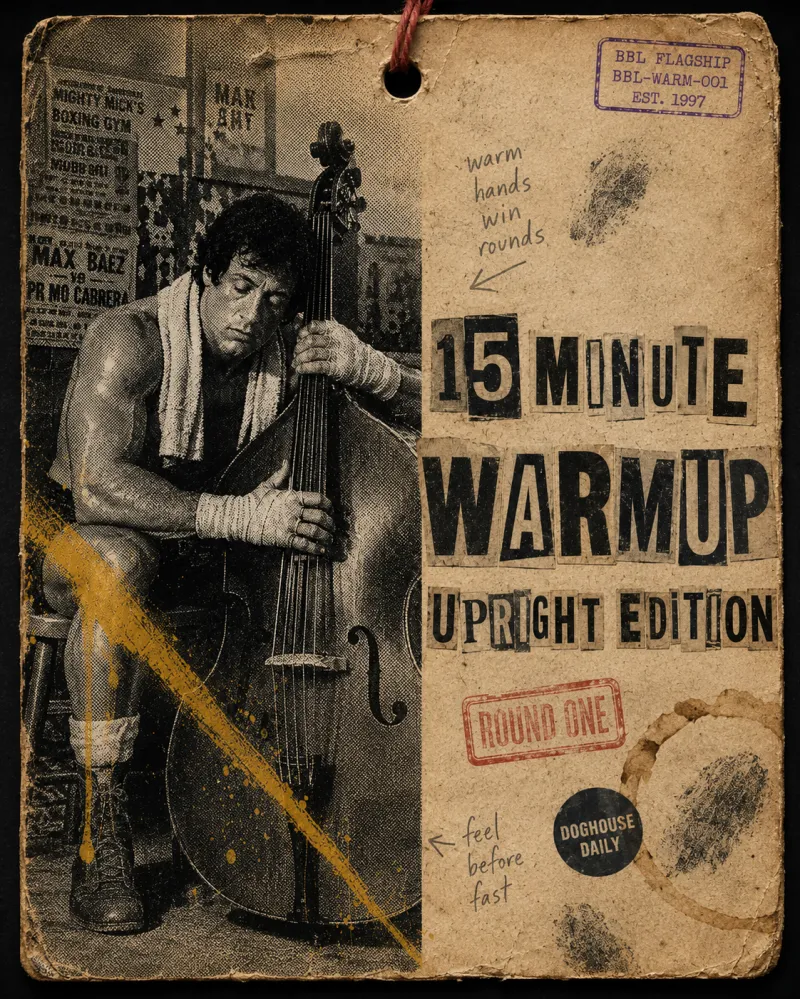
The 15 Minute Warmup: Upright Edition
How to start every gig with intonation already locked in, using a 15-minute warmup that comes before Simandl. The same 11 exercises I run before every gig with Peter Cincotti, Simandl-correct throughout.
$47 · one-time · yours forever · 30-day money-back
This is for you if…
- You've been playing upright bass for at least a year
- You can hold the instrument and produce a tone
- You understand Simandl positions (half, first, second, etc.), or you're actively learning them
- You read bass clef
- You came to upright from electric and your muscle memory keeps fighting the instrument
- You're a classical player moving into jazz and your changes don't sit yet
- You're a returner picking the bass back up after years off
- You're a self-taught adult who can't easily get lessons and wants a teacher-built routine
Maybe not if…
- You're a six-month beginner: work through a beginner method first, save this for later
- You're committed Rabbath and won't re-finger anything in Simandl 1-2-4
- You only play arco: these are pizz exercises (left-hand work still transfers)
The tax you're already paying.
Yeah, yeah, warming up matters. Upright players know better than anybody. I'm not going to give you the lecture.
But who wants to play 30 minutes of Simandl etudes before getting to play actual music? I sure as hell don't. I did 45 minutes of scales every morning at Juilliard and watched the clock the entire time. The reason most upright players skip the warmup isn't that we don't know it matters, it's that the only real warmup we've ever been handed is half an hour of Simandl, and nobody has 30 minutes to spare on something that's not even the practice.
For years, the first tune of every gig was my worst tune. Intonation was sketchy through the first chorus. Shifts didn't land. I'd never warmed up before walking on (because no real warmup existed that didn't feel like punishment), so the first tune did the work. Every gig. Upright players don't really talk about this. We just live with it.
You stopped noticing because you've been paying it for years.
You pay this every time you pick up the bass cold. The room hears it. You don't, because you're inside the playing. But it's real, and it's the reason you clicked into this page in the first place.
Four taxes, paid every session. The 15 minutes you skip aren't free. They're the tax bill.
Your warmup is probably page one of Simandl.
Most upright players default to one of three things when they pick the bass up cold: open the Simandl book to wherever they left off, play long tones on open strings, or noodle through a standard they could play in their sleep. None of it is a real warmup. All of it is a stalling tactic while the hands wake up.
Yours is probably one of these:
That's not a warmup. That's a stalling tactic. It's a piece you've played a thousand times so your cold hands can still get through it, and you play it while your fingers wake up. Then real practice starts.
It works, kind of. But Simandl Book 1 page 1 only opens up half position. Long tones don't move your left hand at all. The standard you noodle through only covers the keys and positions that tune lives in. None of it touches your right hand seriously. And it all stops the moment that piece ends.
The 15-minute warmup is what you'd build if you tried to make a real routine out of your fallback. Same press-play feeling. Same "I don't have to think." But across every position on the bass, and ending when you're actually warmed up, not when the open string runs out of breath.
So I built what upright players don't have.
Fifteen minutes · Eleven exercises · Simandl-correct throughout
Same routine I run before every gig with Peter Cincotti: different city, different bass, different room every night. If nothing else is consistent, this is.
Every exercise is written in Simandl 1-2-4 fingering with positions named on the page. The backing tracks pair each line with a chord vamp you can either play through as written or improvise on: same chord, same track, your choice. Every exercise comes with two audio versions: one with me playing, one without. Play along when you want a guide. Run the no-bass version when you want to be the bassist.
The part nobody believes until they hear it: these tracks actually groove. Fresh Fifths sits in a Mingus pocket. Morning Stretch has a slow, lyrical feel that's almost meditative. If somebody walked into the room while you were running this, they wouldn't think you were practicing. They'd think you had a record on.
The full warmup.
11 exercises · Simandl 1-2-4 fingerings · backing tracks with bass and without · PDFs + editable Finale files
The first ninety seconds. A slow Em7 vamp with a simple line on top: the bass wakes, the bow arm relaxes, the body settles into the routine. Once the line feels easy, you can improvise over the same chord. This is where the press-play habit gets built.
Strict half position across all four strings, Simandl 1-2-4 fingerings printed on the page. The position your hand defaults to on the gig, and the position where intonation has to be perfect because every other position references it.
The two positions you'll spend most of your gig in, and the shift between them. The exercise trains the move so the shift starts to land cold instead of mid-third-position. By the end of the line, third position feels like an extension of first.
The pizz foundation: strict index-middle-index-middle alternation in low position. The mechanic most upright players assume is fine and isn't, because they never warm it up. Five minutes of this and the right hand stops feeling like it's playing catch-up to the left.
A longer pizz exercise with string crossings, the right-hand endurance work that decides whether song 8 sounds like song 2 or like your forearm finally gave up. Crosses every string pair, all four fingers of the left hand engaged.
The stretch your back needs after standing behind the bass for forty-five minutes the night before. Cross-string interval work with a slow, lyrical feel, the kind of thing that warms up your body and your ear at the same time.
Multiple position shifts per measure, lots of string crossing. The exercise that teaches your hand to move between shapes instead of locking into one position. After this, the bridges of standards stop scaring you.
The flat-key zones. The notes between half and first, the ones between second-and-a-half and third. Every working upright player's nemesis, and the place where intonation goes when nobody's looking. This exercise puts a microscope on the cracks and trains your hand to live there.
Fifths across keys with a backing track that sits in a Mingus pocket. The intervals you don't drill as often, in the keys you don't usually visit, over a groove that makes the warmup feel like a hang.
Chromatic lines, ascending and descending, walking through every position on the bass. By the end of this exercise, your hand has touched every note you'll play on the gig and your ear has heard them in context.
The graduation. A full-neck chromatic workout that runs from the lowest register to thumb position and back. By the end of minute fifteen, every position on the bass has been engaged, every cross-string move has been rehearsed, and you've played over five different chord vamps. You're not warmed up. You're ready.
Total: 11 exercises · PDFs + editable Finale files · backing tracks with bass and without · master press-play track
These tracks groove.
30 seconds of Fresh Fifths, exercise 9 of the pack, with bass.
Fresh Fifths · Exercise 9 · With Bass
If it sounds like a cheesy warmup drill, close the tab and don't buy it.
15 minutes is the work-up.
Here's how I think about it now. When upright students walk into a lesson and start in on Autumn Leaves with a full walking line on the first measure, I stop them. That's like walking into the gym and putting 135 on the bench on your first lift. You don't start with your max. You work up to it.
15 minutes is the work-up. It's not extra. It's the first part of the playing, the part you've been skipping.
Here's why every exercise comes with two tracks. The one without bass is for the days you want to play. The one with bass is for the days you don't, when you just need to hear it done right and let me carry it.
Spec by spec, against everything else you might be running instead.
| This | Simandl Book 1 | Vade Mecum | Discover Double Bass | Doing nothing | |
|---|---|---|---|---|---|
| Time per session | 15 min | 30-60+ min | varies | varies | 0 |
| Built as a daily warmup | ✓ | method book | reference | course | ✗ |
| Simandl-correct fingerings | ✓ | ✓ | Rabbath system | mixed | n/a |
| Backing tracks (with bass) | ✓ | ✗ | ✗ | video only | ✗ |
| Backing tracks (no bass) | ✓ | ✗ | ✗ | ✗ | ✗ |
| Editable Finale files | ✓ | ✗ | ✗ | ✗ | ✗ |
| Price | $47 once | $25 (or free IMSLP) | ~$20 | $30-150 / course | $0 |
Simandl is great, for the work itself. Vade Mecum is great, when you want a Rabbath-flavored scale reference. Discover Double Bass is great, when you want classical-leaning bowed technique. None of them are a daily 15-minute warmup. They're method content. The 15 minutes you do before any of them doesn't exist anywhere else.
Not for the 450.
Worth saying out loud since I'm here: there are 450 people in the NBA. Everyone else is semi-pro, hobbyist, or amateur. Nobody writes basketball training programs for the 450 and expects the rest of us to use them. But that's what every upright warmup book does. Simandl wrote his method in 1881 for conservatory students. Vade Mecum was built for serious pedagogy. Rabbath's six-position system is a technique overhaul, not a daily warmup.
This one is for the rest of us. The adult who picked up upright after years of electric. The jazz player working through Real Book changes in their basement. The orchestral hobbyist. The teacher who needs something to give their own students. The bassist who plays a few hours a week and a few gigs a month and just wants their hands to feel like their hands.
The upright players you know on records all warm up. They don't talk about it (it's not glamorous and the audience never sees it), but it's the difference between the player who shows up consistent and the player who shows up "having an off night." I used to live with Alex Claffy, one of the working bassists in this city. Alex warmed up religiously: 10 or 15 minutes, every single time he left the house with his bass. He never had off nights.
Warming up isn't what insecure musicians do. It's what working upright players do.
Bonus nobody mentions: on the days you only have 15 minutes to play, this is your practice session. Both hands. Whole neck. Intervals I don't usually visit. By minute fifteen the chops are maintained and the bass feels like the bass again. So on the days life ate the practice window and there's only 15 minutes between getting home and bedtime, 15 minutes is enough.
And on the subject of hands: I've hurt mine plenty over the years. I used to dig in trying to get a big sound, full-aggression with no warmup, because I was twenty-three and I thought practicing was the whole point. I was wrong. Practicing is the workout. Warmup is the part that lets you do the workout tomorrow. I started teaching this 15-minute routine to my students, and the ones who used it stopped having the physical problems they came to me with. Not because the warmup was magic, because they finally weren't starting with 135 on the bench.
Pick the genre you play most.
Pick a genre above.
Every genre uses this routine differently. Click yours to see which exercises matter most for the music you play.
I built this for four kinds of upright player. Find yours.
You've played electric for years. Now you're learning upright, and your electric muscle memory works against you: the spacing is wrong, the force is wrong, the third finger lives in the wrong place. This routine retrains your hands for the instrument that doesn't have frets, with Simandl-correct fingerings printed on every page.
You studied classical. You can play Simandl. You can play Bottesini. But your jazz feels stiff: the changes don't sit right, the walking lines don't groove. This routine warms up your hands the way classical training did, but the chord vamps train your ear for the music classical didn't teach.
You played in school, took years off, and now you're picking the bass back up at 40 or 50 or 60. Your hands forgot what they used to know. This is the daily routine that rebuilds your chops without the forearm tendonitis that comes from going too hard, too fast.
You bought an upright in your 30s or 40s. You can't easily get lessons: rural, no jazz scene, too expensive. You're learning from YouTube and method books. This is the daily warmup an upright teacher would give you: Simandl-correct, professionally produced, and built so you don't pick up bad habits on your own.
If you're a working professional already running a daily routine, this might be simpler than what you've got. But most pros download it anyway, for the tour days when nothing else is consistent.
Everything you need to press play.
- Master PDFAll 11 exercises, Simandl-correct fingerings printed throughout. Ready for the stand.
- Individual PDFs11 separate exercise PDFs for breaking them out.
- Finale files11 .musx files, fully editable. Transpose, slow down, customize.
- Tracks with bass11 backing tracks with me playing. Your guide.
- Tracks without bass11 backing tracks without bass. Your turn.
- Master backing trackAll 11 stitched together. Your daily press-play.
- Lifetime accessNo subscription, no auto-renewal.
- Lifetime updatesWhen I add exercises, you get them.

Cole Davis
Juilliard · Peter Cincotti · Author of the New Simandl
I went to Juilliard. I did 45 minutes of Simandl every morning and watched the clock the entire time. Then I graduated, started gigging, and stopped warming up, because every warmup I knew felt like punishment, and I had a band to play with.
For years, the first tune of every gig was my worst tune. Intonation was sketchy through the first chorus. Shifts didn't land. I lived with another working bassist, Alex Claffy, who warmed up religiously, every single time he left the house with his bass, and never had an off night. I noticed.
So I built the warmup I wished existed. 15 minutes. 11 exercises. Simandl-correct throughout. Same routine I run before every gig with Peter Cincotti: different city, different bass, every night. This is the daily 15 minutes I wish I'd been handed in school instead.
- Juilliard Artist Diploma
- Peter Cincotti band
- Author of the New Simandl
- Author of Freedom of Movement
$47 once. Yours forever.
$47one-time · lifetime access
Two coffees a week for a month. Less than a single upright lesson.
- ✓Master PDF: all 11 exercisesCore
- ✓11 individual exercise PDFsIncluded
- ✓11 editable Finale (.musx) filesIncluded
- ✓11 backing tracks with bassIncluded
- ✓11 backing tracks without bassIncluded
- ✓Master backing track (all 11 stitched)Press-play
- ✓Lifetime access & updatesForever
What changes, and when.
The 30-Day Promise.
Run it daily for thirty days. If the bass doesn't feel easier in your hands and in your body, email me and I'll refund you. No questions, no explanations.
Questions.
The ones that come up most.
If you can hold the bass and produce a tone, and you've been playing more than a few months, and you know what half position and first position are, you can run this. There are exercises you'll skip at first. That's the design. The warmup grows with you.
Simandl is the work. This is the 15 minutes you do before you open the book. They're complementary, not competing. The Simandl etudes are pedagogically thorough, and pedagogically dry. This is what gets your hands ready for them.
The exercises use Simandl 1-2-4 fingerings. If you're committed Rabbath, you'll need to re-finger as you play. The musical content (chord vamps, interval work, position studies) still applies, but the page is Simandl-coded.
These are pizzicato exercises. You can bow them if you want (the lines work), but I built the right-hand exercises specifically for pizz. If you mainly play arco, you'll get value from the left-hand work but the pizz exercises won't transfer directly.
You can follow the backing track with bass (that's me playing it) and learn the lines by ear. The notation helps but isn't required. The Finale files let you slow exercises down if you need to.
Yes. The exercises are technique-focused: positions, shifts, intervals, right-hand work. The chord vamps are jazz-flavored but the work transfers to classical, bluegrass, rockabilly, Latin, folk, or anything else you play on upright.
The PDFs cover everything you need to play and read. Finale files are optional. They're for players who want to transpose, slow exercises down, or edit. There's a free Finale reader if you ever want to use them.
Probably not. The exercises are pedagogically simple, but I run this exact warmup before every gig with Peter Cincotti. If your own daily routine works for you, keep it. If you don't have one yet, this is the one I'd hand a colleague.
30 days, no questions. Email support and we'll send the money back.
15 minutes.
Intonation locked in
by song 1.
$47
Get The 15 Minute Warmup30-day promise · Lifetime access
P.S. There's no real warmup for upright bass. There's 30 minutes of Simandl, there's nothing, or there's a Rabbath course that overhauls your entire technique. This is the first time anyone has built the 15-minute middle path: Simandl-coded, music-first, designed for adult intermediate players. If you're going to skip it, at least don't skip it because you didn't know it existed.